
Interested in this AI/ML Engineer role at 株式会社天地人?
Apply Now →Skills & Technologies
About This Role
仕事概要
--------
\[ ABOUT TENCHIJIN ] Tenchijin Inc. is a Tokyo\-headquartered space\-tech company and JAXA (Japan Aerospace Exploration Agency) certified venture. Through its land\-evaluation and analytics platform, Tenchijin COMPASS, the company fuses earth\-observation satellite data, geospatial and environmental layers, IoT and ground\-sensor feeds, and clients' operational data with proprietary AI to deliver multimodal analytics for utilities and infrastructure enterprises. Tenchijin's flagship water\-infrastructure solution, KnoWaterleak, assesses pipeline deterioration and leak risk from space\-derived insights and is used by a growing number of water utilities to prioritize inspection and investment, reduce non\-revenue water, and extend asset life. \[ ABOUT THE PROJECT ] The Global South Project is an 18\-month initiative (October 2026 – March 2028\) to design, build, and deploy a scalable, secure, AI\-ready analytics platform tailored to utilities and infrastructure operators across Global South markets. The project adapts Tenchijin's satellite\-data and GeoAI capabilities to regions facing aging or rapidly expanding infrastructure, constrained budgets, and limited field\-inspection capacity — delivering risk assessment and decision\-support tools that improve infrastructure management workflows. All positions are contract\-based and fully remote, operating as one distributed, cross\-border team with English as the working language. \[ ROLE SUMMARY ] This role sits at the core of Tenchijin's value proposition. You will develop the GeoAI machine\-learning models that turn fused satellite imagery, geospatial layers, IoT feeds, and utility operational data into actionable risk\-assessment and recommendation outputs — the same class of technology behind Tenchijin's land\-evaluation and water\-infrastructure risk products, adapted and extended for Global South infrastructure challenges. \[ Reports To ] Senior Cloud Architect / Director of Product Management \[ Project Language ] English (professional working proficiency or higher required) \[ KEY RESPONSIBILITIES ] \- Design, train, validate, and deploy machine\-learning models for infrastructure risk assessment and recommendations (e.g., asset deterioration risk, environmental stress factors, prioritization scoring) using multimodal inputs. \- Build geospatial feature\-engineering pipelines that fuse satellite/earth\-observation data (optical, SAR, thermal), terrain and environmental layers, IoT sensor streams, and client operational records. \- Establish the ML lifecycle: experiment tracking, model registry, evaluation frameworks, retraining pipelines, and monitoring for drift in production. \- Adapt models to data\-sparse Global South contexts — transfer learning, handling incomplete asset records, and calibrating outputs against local ground truth. \- Collaborate with the Lead Backend Engineer to productionize models: batch scoring, low\-latency serving, and integration into the analytics APIs. \- Define data\-quality standards and validation for incoming geospatial and operational datasets. \- Communicate model behavior, accuracy, and limitations to product leadership and client stakeholders in clear, non\-technical terms. \- Mentor engineers on geospatial data science practices and review analytical methodology across the project. \[ WHAT WE OFFER ] \- A central role in applying satellite data and AI to real infrastructure challenges, with measurable social and environmental impact in Global South markets. \- Fully remote, cross\-border collaboration with senior specialists across cloud, GeoAI, product, and design. \- Competitive contractor compensation commensurate with experience and scope. \- Direct exposure to earth\-observation technology, including data ecosystems built with Japan's space agency (JAXA). Tenchijin Inc. is an equal\-opportunity organization. We evaluate all applicants on qualifications and merit, without regard to nationality, race, religion, gender, age, or disability. TENCHIJIN INC. · GLOBAL SOUTH PROJECT
必須スキル
---------
\- 6\+ years in data science / machine\-learning engineering, with substantial production experience building, validating, and deploying ML models. \- Strong proficiency with ML frameworks (PyTorch/TensorFlow, scikit\-learn, XGBoost) and the Python data\-science stack. \- Experience building end\-to\-end data pipelines for large, heterogeneous datasets, including imagery, IoT, and time\-series data. \- Demonstrated experience taking models from experimentation to production: serving, monitoring, drift detection, and retraining. \- Solid statistical grounding: model validation, uncertainty quantification, and communicating confidence and limitations honestly. \- Professional working proficiency in English.歓迎スキル
---------
\- Geospatial / remote\-sensing expertise — tooling such as GDAL, rasterio, GeoPandas, PostGIS, or Google Earth Engine, and experience integrating satellite imagery (optical and/or SAR) into predictive models. Candidates coming directly from earth\-observation organizations (e.g., Atlas AI, Google Earth Engine, NASA, JAXA, NOAA, ESA, or comparable) are especially encouraged to apply. \- Domain experience in infrastructure, utilities, water, energy, or climate\-risk analytics. \- Experience with MLOps tooling (MLflow, Kubeflow, SageMaker, Vertex AI). \- Publications, competition results, or open\-source contributions in GeoAI / remote sensing. \- Experience working in a cross\-functional POD / squad delivery model.応募概要
--------
勤務地 Remote — Global (cross\-border, distributed team)
雇用形態 Independent Contractor (fixed\-term project engagement)
勤務体系 Contract Period: October 1, 2026 – March 31, 2028 (18 months / 1\.5 years)
企業情報
--------
企業名 株式会社天地人
設立年月 2019年5月
本社所在地 東京都中央区日本橋1\-4\-1 日本橋一丁目三井ビルディング5階 THE E.A.S.T. 日本橋一丁目 ROOM 13
従業員数 83
Role Details
About This Role
AI/ML Engineers build and deploy machine learning models in production. They work across the full ML lifecycle: data pipelines, model training, evaluation, and serving infrastructure. The role has evolved significantly over the past two years. Where ML Engineers once spent most of their time on model architecture, the job now tilts heavily toward inference optimization, cost management, and integrating LLM capabilities into existing systems. Companies want engineers who can ship production systems, and the experimenter-only role is fading fast.
Day-to-day, you're writing training pipelines, debugging data quality issues, setting up evaluation frameworks, and figuring out why your model performs differently in staging than it did on your dev set. The best ML engineers are obsessive about reproducibility and measurement. They instrument everything. They know that a model is only as good as the data feeding it and the infrastructure serving it.
Across the 3,708 AI roles we're tracking, AI/ML Engineer positions make up 70% of the market. At 株式会社天地人, this role fits into their broader AI and engineering organization.
Demand for AI/ML Engineers has been strong and consistent. Unlike some AI roles that spike with hype cycles, ML engineering is a foundational need. Every company deploying AI models needs people who can keep them running, and the gap between research prototypes and production systems keeps growing.
What the Work Looks Like
A typical week might include: debugging a data pipeline that's silently dropping 3% of training examples, running A/B tests on a new model version, writing documentation for a feature flag system that lets you roll back model deployments, and reviewing a junior engineer's PR for a new evaluation metric. Meetings tend to be cross-functional since ML touches product, engineering, and data teams.
Demand for AI/ML Engineers has been strong and consistent. Unlike some AI roles that spike with hype cycles, ML engineering is a foundational need. Every company deploying AI models needs people who can keep them running, and the gap between research prototypes and production systems keeps growing.
Skills Required
Python and PyTorch dominate the requirements. Most roles expect experience with cloud platforms (AWS, GCP, or Azure) and familiarity with ML frameworks like TensorFlow or JAX. RAG (Retrieval-Augmented Generation) has become a top-3 skill requirement as companies integrate LLMs into their products. Docker and Kubernetes show up in about a third of postings, reflecting the production focus of the role.
Beyond the core stack, employers increasingly want experience with experiment tracking tools (MLflow, Weights & Biases), feature stores, and vector databases. Fine-tuning experience is valuable but less common than you'd think from reading Twitter. Most production LLM work is RAG and prompt engineering, not fine-tuning. If you have both, you're in a strong position.
Companies that are serious about AI/ML hiring tend to post specific infrastructure details in the job description: the frameworks they use, their model serving stack, their data pipeline tools. Vague postings that just say 'ML experience required' without specifics are often companies that haven't figured out what they need yet.
Compensation Benchmarks
AI/ML Engineer roles pay a median of $218,750 based on 3,817 positions with disclosed compensation. Senior-level AI roles across all categories have a median of $230,000.
Across all AI roles, the market median is $217,500. Top-quartile compensation starts at $272,100. The 90th percentile reaches $325,000. For comparison, the highest-paying categories include AI Safety ($300,000) and Research Engineer ($280,000). By seniority level: Entry: $120,000; Mid: $200,000; Senior: $230,000; Director: $272,150; VP: $250,000.
株式会社天地人 AI Hiring
株式会社天地人 has 1 open AI role right now. They're hiring across AI/ML Engineer. Based in Remote, US.
Remote Work Context
Remote AI roles pay a median of $185,334 across 717 positions. About 14% of all AI roles offer remote work.
Career Path
Common paths into AI/ML Engineer roles include Data Scientist, Software Engineer, Research Engineer.
From here, career progression typically leads toward ML Architect, AI Engineering Manager, Principal ML Engineer.
The fastest path into ML engineering is through software engineering with a self-directed ML education. A CS degree helps, but production engineering skills matter more than academic credentials. Build something that works, deploy it, and measure it. That portfolio project is worth more than a Coursera certificate. For career growth, the fork comes around the senior level: go deep on technical complexity (staff/principal track) or move into managing ML teams.
What to Expect in Interviews
Expect system design questions around ML pipelines: how you'd build a training pipeline for a specific use case, handle data drift, or design A/B testing infrastructure for model deployments. Coding rounds typically involve Python, with emphasis on data manipulation (pandas, numpy) and algorithm implementation. Take-home assignments often ask you to build an end-to-end ML pipeline from raw data to deployed model.
When evaluating opportunities: Companies that are serious about AI/ML hiring tend to post specific infrastructure details in the job description: the frameworks they use, their model serving stack, their data pipeline tools. Vague postings that just say 'ML experience required' without specifics are often companies that haven't figured out what they need yet.
AI Hiring Overview
The AI job market has 3,708 open positions tracked in our dataset. By seniority: 102 entry-level, 1,705 mid-level, 1,469 senior, and 432 leadership roles (Director, VP, C-Level). Remote roles make up 14% of the market (508 positions). The remaining 3,180 roles require on-site or hybrid attendance.
The market median for AI roles is $217,500. Top-quartile compensation starts at $272,100. The 90th percentile reaches $325,000. Highest-paying categories: AI Safety ($300,000 median, 21 roles); Research Engineer ($280,000 median, 147 roles); AI Architect ($254,798 median, 67 roles).
Demand for AI/ML Engineers has been strong and consistent. Unlike some AI roles that spike with hype cycles, ML engineering is a foundational need. Every company deploying AI models needs people who can keep them running, and the gap between research prototypes and production systems keeps growing.
The AI Job Market Today
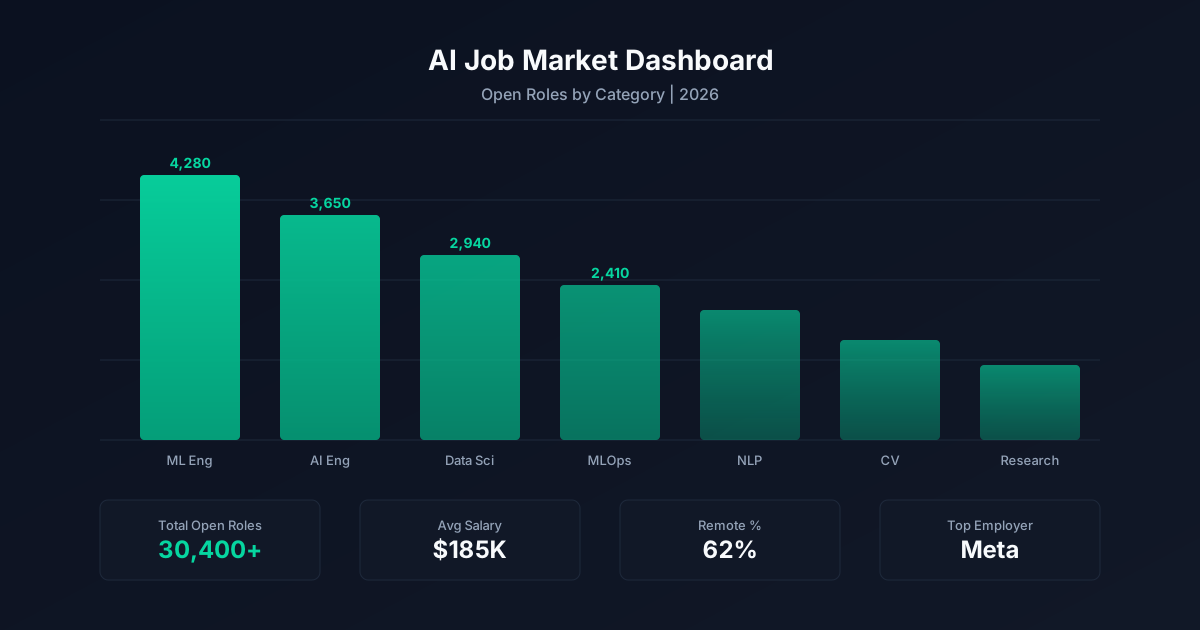
The AI job market spans 3,708 open positions across 16 role categories. The largest categories by volume: AI/ML Engineer (2,605), Data Scientist (310), AI Software Engineer (259). These three account for the majority of open positions, though smaller categories often have higher per-role compensation because of specialized skill requirements.
The seniority mix tells a story about where AI teams are in their maturity. Entry-level roles (102) are outnumbered by mid-level (1,705) and senior (1,469) positions, reflecting that most companies are past the 'build a team from scratch' phase and need experienced engineers who can ship production systems. Leadership roles (Director, VP, C-Level) total 432 positions, representing the bottleneck between technical execution and organizational strategy.
Remote work availability sits at 14% of all AI roles (508 positions), with 3,180 requiring on-site or hybrid attendance. The remote share has stabilized after the post-pandemic correction. Senior and specialized roles (Research Scientist, ML Architect) are more likely to be remote-eligible than entry-level positions, partly because experienced hires have more negotiating power and partly because these roles require less hands-on mentorship.
AI compensation is structured in clear tiers. The market median sits at $217,500. Top-quartile roles start at $272,100, and the 90th percentile reaches $325,000. These figures include base salary with disclosed compensation. Total compensation (including equity, bonuses, and sign-on) runs 20-40% higher at companies that offer those components.
Category matters for compensation. AI Safety roles lead at $300,000 median, while Prompt Engineer roles sit at $140,000. The spread between highest and lowest-paying categories reflects the premium on specialized technical skills versus broader analytical roles.
The most in-demand skills across all AI postings: Python (1,890 postings), Aws (1,103 postings), Azure (877 postings), Rag (855 postings), Gcp (631 postings), Prompt Engineering (560 postings), Pytorch (545 postings), Claude (498 postings). Python dominates, appearing in the vast majority of role descriptions regardless of category. Cloud platform experience (AWS, GCP, Azure) is the second most common requirement. The newer entrants to the top skills list (RAG, vector databases, LLM APIs) reflect the shift from traditional ML toward generative AI applications.
Frequently Asked Questions
Get Weekly AI Career Intelligence
Salary data, skills demand, and market signals from 16,000+ AI job postings. Every Monday.