
Interested in this AI Agent Developer role at 1Mind?
Apply Now →Skills & Technologies
About This Role
Customer Solutions Engineer, AI Agents
------------------------------------------
*This is a fully remote opportunity and can be worked from any location in the United States.*
About Us
------------
1mind is building the next generation of revenue teams.
We are creating a new category of enterprise software: Autonomous Customer Experience. Our platform deploys Superhumans, go\-to\-market teammates with a face, a voice, and a GTM brain that serve the buyer across the entire journey with one continuous memory. They engage, demo, onboard, and support in the moments no company could ever staff, so the handoffs disappear and growth stops leaking.
Join us as we define the category and build the platform that powers the next generation of revenue teams. When the buyer wins, the company wins. Every1 Wins.
About the Role
------------------
As an Agent Architect at 1mind, you are the master orchestrator of our AI Superhumans. You don’t just "onboard" customers; you design the digital consciousness and operational framework that allows our AI to integrate seamlessly into a customer’s ecosystem.
This is a hybrid role requiring a key blend of technical engineering, systems thinking, and consultative leadership. You will be the primary technical guide for our customers, taking them from a conceptual vision to a fully activated, high\-performing AI workforce. You will map complex workflows, configure intricate agent behaviors, and ensure our Superhumans are transformative team members for our clients.
What You’ll Do
------------------
- Architect Superhuman Activation: Lead the technical discovery and "blueprint" phase for new customers, mapping their existing business systems to our AI framework
- System Mapping \& Integration: Design and implement the data flows between 1mind agents and client tech stacks (CRMs, MAPs, APIs, and proprietary databases)
- Experiential Configuration: Fine\-tune Superhuman experiential elements such as visualizations, logic gates, and response triggers
- Customer Consultation: Serve as the technical face of the services team, guiding stakeholders through the activation journey and translating complex technical hurdles into clear, actionable outcomes
- Quality Assurance \& Optimization: Conduct rigorous testing of agent behaviors pre \& post\-deployment to ensure peak performance and reliability
- Feedback Loop: Partner with Product and Engineering teams to advocate for new features and platform enhancements based on real\-world activation challenges
What You'll Bring
---------------------
- 3 \- 5\+ years in a technical, customer\-facing role (e.g., Solutions Architect, Implementation Engineer, or Technical Account Manager) within a SaaS environment
- Proven track record of system integration: You should be comfortable working with REST APIs, webhooks, and middleware
- Background in Workflow Design: Experience mapping complex business processes using tools like LucidChart, Miro, or Visio
- Client Management: Experience managing high\-stakes projects for enterprise\-level stakeholders, specifically during the "onboarding" or "activation" lifecycle
What Will Help You Thrive
-----------------------------
- The "Architect" Mindset: You enjoy zooming out to see the big picture of a system, but you have the discipline to zoom in and fix a broken line of logic
- High Emotional Intelligence: You can read a room and pivot your communication style from "deeply technical" for developers to "value\-driven" for executive stakeholders
- Adaptability: You are excited by the "blank canvas" of AI and aren't afraid to build the playbook as you go in a fast\-evolving industry
- Relentless Curiosity: You want to understand the "why" behind every customer request to build a better "how."
Preferred Skills
--------------------
- AI/ML Literacy: Familiarity with LLM prompt engineering, vector databases, or natural language processing (NLP) concepts
- Technical Proficiency: Knowledge of Python, JavaScript, or SQL is a major plus for troubleshooting integrations
- Industry Knowledge: Experience in CX (Customer Experience) or Digital Transformation sectors
- Project Management: Proficiency with tools like Asana, Jira, or Monday.com to keep multi\-phase activations on track
Why Join Us
---------------
- Be at the forefront of AI\-powered GTM operations
- Shape the future of how humans and AI collaborate in high\-stakes business environments
- Work alongside a team of builders at the forefront of AI, product design, and GTM innovation
- Design for a product that lives at the intersection of visual design, voice, motion, and intelligence
- Remote\-first, fast\-moving culture with ownership, autonomy, and impact from day one
- Expand your network of Superhumans!
1mind's total compensation package is designed to be competitive and includes base salary, equity, and a full range of benefits and perks. Final compensation will depend on factors such as your skills, experience, qualifications, and location, and will be determined during the interview process. The hiring manager will share more details about the full compensation package and benefits as you move through the process.
\[Please note that all legitimate communication from 1mind will come only from email addresses ending in @1mind.com. We will never ask for payment, financial information, or personal details outside of our official application process. If you receive a suspicious message, please disregard it and alert us at [email protected]]
*We may use artificial intelligence (AI) tools to support parts of the hiring process, such as reviewing applications, analyzing resumes, notetaking, or summarizing responses. These tools assist our recruitment team but do not replace human judgment \- all hiring decisions are made by people. If you would like more information about how your data is processed or prefer to opt out of any AI\-assisted tools, please let your recruiter know. Opting out will not impact your experience or consideration.*
Compensation Range: $125K \- $220K
Salary Context
This $125K-$220K range is below the median for AI Agent Developer roles in our dataset (median: $188K across 26 roles with salary data).
View full AI Agent Developer salary data →Role Details
About This Role
AI Agent Developers build autonomous systems that can reason, plan, and take actions. They design multi-step workflows, tool-use frameworks, and orchestration layers that let LLMs interact with external systems. This is the frontier of applied AI engineering.
Agent development is where the most interesting (and hardest) problems in applied AI live right now. Making an LLM answer a question is straightforward. Making it reliably execute a 15-step workflow that involves calling APIs, reading databases, making decisions, and recovering from errors is an unsolved problem. You're building systems that have to work despite the fact that the underlying model is non-deterministic.
Across the 3,708 AI roles we're tracking, AI Agent Developer positions make up 1% of the market. At 1Mind, this role fits into their broader AI and engineering organization.
AI Agent Developer is one of the newest and fastest-growing AI role categories. The market is early but accelerating as companies move beyond simple chatbots toward AI systems that can take real actions. Compensation is high because the skill set is rare and the business impact is potentially enormous.
What the Work Looks Like
A typical week includes: designing the action space and tool definitions for a new agent use case, debugging why the agent chose the wrong action sequence on a specific input, building evaluation frameworks that test agent reliability across hundreds of scenarios, optimizing the prompt chain for cost and latency, and implementing safety guardrails to prevent the agent from taking destructive actions. The work is equal parts engineering and empirical science.
AI Agent Developer is one of the newest and fastest-growing AI role categories. The market is early but accelerating as companies move beyond simple chatbots toward AI systems that can take real actions. Compensation is high because the skill set is rare and the business impact is potentially enormous.
Skills Required
Deep experience with LLM APIs and agent frameworks (LangChain, CrewAI, AutoGen). Strong understanding of prompt engineering, function calling, and error handling for non-deterministic systems. Python is standard. Experience with orchestration patterns, state management, and workflow engines adds significant value.
The best agent developers think like systems engineers. They design for failure modes, build observability into every step, and understand that agent reliability is the product. Expertise in evaluation methodology for non-deterministic systems is the differentiator. Can you measure whether your agent works 'well enough'? Can you find the edge cases where it breaks?
Look for roles that describe specific agent use cases, mention evaluation methodology, and talk about production deployment. Early-stage companies exploring agents can be exciting, but be prepared for ambiguity. The most valuable roles are at companies that have already shipped a v1 and need to make it reliable.
Compensation Benchmarks
AI Agent Developer roles pay a median of $238,500 based on 58 positions with disclosed compensation. Mid-level AI roles across all categories have a median of $200,000. This role's midpoint ($172K) sits 28% below the category median. Disclosed range: $125K to $220K.
Across all AI roles, the market median is $217,500. Top-quartile compensation starts at $272,100. The 90th percentile reaches $325,000. For comparison, the highest-paying categories include AI Safety ($300,000) and Research Engineer ($280,000). By seniority level: Entry: $120,000; Mid: $200,000; Senior: $230,000; Director: $272,150; VP: $250,000.
1Mind AI Hiring
1Mind has 2 open AI roles right now. They're hiring across AI Agent Developer, AI/ML Engineer. Based in US. Compensation range: $165K - $220K.
Location Context
AI roles in Austin pay a median of $214,343 across 87 tracked positions.
Career Path
Common paths into AI Agent Developer roles include Software Engineer, LLM Engineer, Prompt Engineer.
From here, career progression typically leads toward AI Architect, Principal Engineer, Head of AI Engineering.
Build agents. That's the portfolio. Take an open-source agent framework, build something that completes a non-trivial multi-step task, evaluate it rigorously, and document what you learned about reliability, cost, and failure modes. The field is new enough that practical experience counts for more than credentials.
What to Expect in Interviews
Interviews focus on systems thinking and reliability engineering. Expect questions about agent architecture: how you'd design a multi-step workflow with error recovery, how you'd evaluate agent performance, and how you'd prevent agents from taking destructive actions. Coding exercises often involve building a simple agent with tool use and evaluating its behavior across different scenarios. Discussion of safety and guardrails is increasingly common.
When evaluating opportunities: Look for roles that describe specific agent use cases, mention evaluation methodology, and talk about production deployment. Early-stage companies exploring agents can be exciting, but be prepared for ambiguity. The most valuable roles are at companies that have already shipped a v1 and need to make it reliable.
AI Hiring Overview
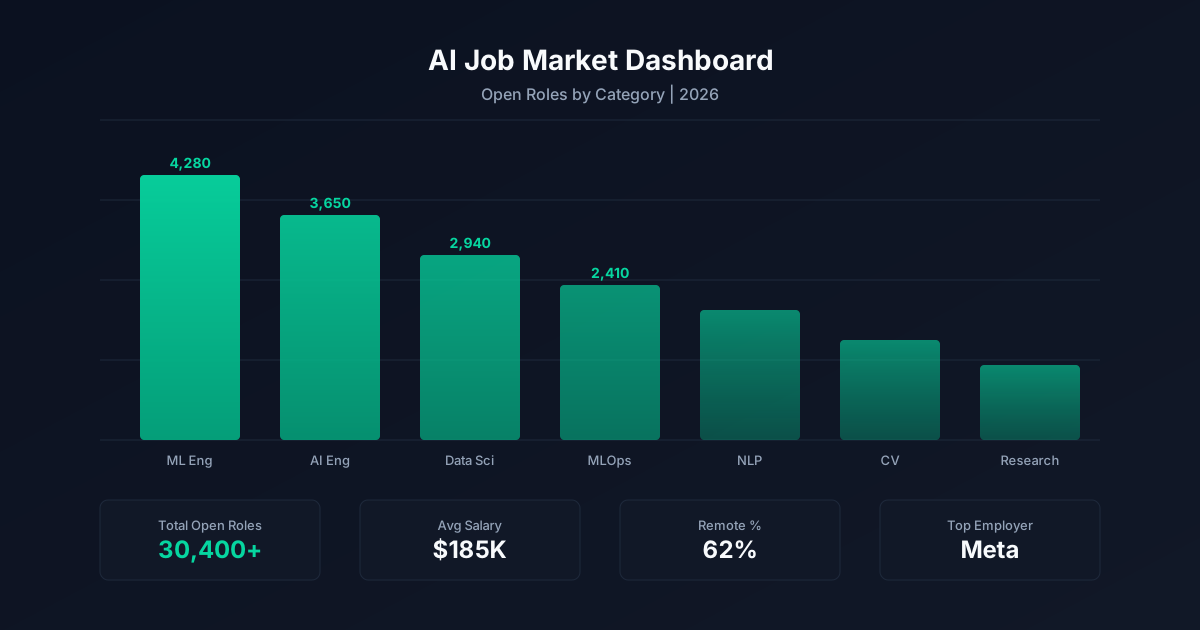
The AI job market has 3,708 open positions tracked in our dataset. By seniority: 102 entry-level, 1,705 mid-level, 1,469 senior, and 432 leadership roles (Director, VP, C-Level). Remote roles make up 14% of the market (508 positions). The remaining 3,180 roles require on-site or hybrid attendance.
The market median for AI roles is $217,500. Top-quartile compensation starts at $272,100. The 90th percentile reaches $325,000. Highest-paying categories: AI Safety ($300,000 median, 21 roles); Research Engineer ($280,000 median, 147 roles); AI Architect ($254,798 median, 67 roles).
AI Agent Developer is one of the newest and fastest-growing AI role categories. The market is early but accelerating as companies move beyond simple chatbots toward AI systems that can take real actions. Compensation is high because the skill set is rare and the business impact is potentially enormous.
The AI Job Market Today
The AI job market spans 3,708 open positions across 16 role categories. The largest categories by volume: AI/ML Engineer (2,605), Data Scientist (310), AI Software Engineer (259). These three account for the majority of open positions, though smaller categories often have higher per-role compensation because of specialized skill requirements.
The seniority mix tells a story about where AI teams are in their maturity. Entry-level roles (102) are outnumbered by mid-level (1,705) and senior (1,469) positions, reflecting that most companies are past the 'build a team from scratch' phase and need experienced engineers who can ship production systems. Leadership roles (Director, VP, C-Level) total 432 positions, representing the bottleneck between technical execution and organizational strategy.
Remote work availability sits at 14% of all AI roles (508 positions), with 3,180 requiring on-site or hybrid attendance. The remote share has stabilized after the post-pandemic correction. Senior and specialized roles (Research Scientist, ML Architect) are more likely to be remote-eligible than entry-level positions, partly because experienced hires have more negotiating power and partly because these roles require less hands-on mentorship.
AI compensation is structured in clear tiers. The market median sits at $217,500. Top-quartile roles start at $272,100, and the 90th percentile reaches $325,000. These figures include base salary with disclosed compensation. Total compensation (including equity, bonuses, and sign-on) runs 20-40% higher at companies that offer those components.
Category matters for compensation. AI Safety roles lead at $300,000 median, while Prompt Engineer roles sit at $140,000. The spread between highest and lowest-paying categories reflects the premium on specialized technical skills versus broader analytical roles.
The most in-demand skills across all AI postings: Python (1,890 postings), Aws (1,103 postings), Azure (877 postings), Rag (855 postings), Gcp (631 postings), Prompt Engineering (560 postings), Pytorch (545 postings), Claude (498 postings). Python dominates, appearing in the vast majority of role descriptions regardless of category. Cloud platform experience (AWS, GCP, Azure) is the second most common requirement. The newer entrants to the top skills list (RAG, vector databases, LLM APIs) reflect the shift from traditional ML toward generative AI applications.
Frequently Asked Questions
Get Weekly AI Career Intelligence
Salary data, skills demand, and market signals from 16,000+ AI job postings. Every Monday.