
Interested in this AI Software Engineer role at ALLEN INSTITUTE?
Apply Now →Skills & Technologies
About This Role
*Senior Software Engineer, AI/ML Platforms and Infrastructure – Brain Health Accelerator*
The mission of the AllenInstitute is to understand the principles that govern life and to advance health. Our creative and multi\-dimensional teams focus on answering some of the biggest questions in bioscience. We accelerate foundational research, catalyze bold ideas, develop tools and models, and openly share our science to make a broad, transformational impact on the world.
The Allen Institute is launching a new accelerator on human brain health and disease. This initiative aims to dramatically accelerate our understanding of human brain structure and function, identify the molecular, cellular and circuit basis of disease progression, and pioneer new therapeutic strategies targeting vulnerable and affected cell types. Our mission focuses on taking a human\-centric approach to understanding and treating disease, combining a large\-scale open science discovery approach across multiple diseases, AI\-based disease modeling, and translational programs in specific diseases to move from discovery to clinical application. We aim to make transformational change in understanding and treating brain disorders, the biggest health challenge of our time.
We are seeking a Senior Software Engineer, AI/ML Platforms and Infrastructure with deep expertise in software engineering, ML software platforms, cloud\-base ML infrastructure, and Federated Learning to drive the architecture, design, delivery, and operation of AI training and inference services and infrastructure to support modelling efforts by Brain Health Accelerator scientists. This role requires both strategic vision and hands\-on execution to enable and support training of biological foundation models with data from the Allen Institute and numerous external collaborators. This will include architecting solutions to work with sensitive and controlled access data, which may include enabling federated model training.
As one of the first engineers on the Brain Health data and technology team, you will be responsible for contributing to our team’s vision, architecting and overseeing complex technical solutions and architectures, and ensuring that our training platforms and infrastructure are secure, reliable, compliant, and cost\-effective. You will serve as a key technical partner to research and engineering teams and represent the Institute in engagements with external vendors and collaborators.
The successful candidate will collaborate closely with system administrators, software engineers, neuroscientists, data scientists, and cross\-institutional partners to advance the Institute’s scientific mission.
At the Allen Institute, we believe that science is for everyone – and should be open to everyone. We are dedicated to combating biases and reducing barriers to STEM careers more broadly.
We also believe that science is better when it includes different perspectives and voices. We strive to make the Allen Institute a place where everyone feels like they belong and are empowered to do their best work in a supportive environment.
We are an equal\-opportunity employer and strongly encourage people from all backgrounds to apply for our open positions.
Essential Functions
- Design and implement cloud\-based and on\-premise solutions to support training of large\-scale, multi\-modality biological foundation models
- Collaborate with external partners to design and implement solutions for training of models with a mix of Allen Institute data and sensitive, non\-shareable data from external collaborators. This may include investigating and making recommendations on the feasibility of federated learning and analytics for Brain Health Accelerator and partner use cases.
- Guide benchmarking and optimization efforts of ML software and infrastructure, including performance tuning and cost management
- Provide AI workflow expertise and support to science and engineering teams in Brain Health
- Collaborate with internal stakeholders and external partners to define requirements, scope, and priorities
- Identify risks, dependencies, and trade\-offs, and proactively drive mitigation strategies
- Represent the Allen Institute in technical discussions with external vendors and partners
- Build and maintain strong relationships with internal stakeholders, including research teams, Central IT, and the Office of the CTO
- Translate complex technical concepts into clear, actionable insights for diverse audiences
- Ensure timely delivery of initiatives, managing scope, timelines, and resources effectively
- Ensure reliability and maintainability of deployed systems
- Drive continuous improvement in operational processes and tooling
- Foster effective communication across cross\-functional and cross\-institutional teams
- Lead knowledge\-sharing initiatives (e.g., technical forums, training, or presentations)
- Mentor team members and contribute to the development of organizational best practices
- Serve as a technical and strategic advisor to stakeholders and leadership
*\*Note: Reasonable accommodations may be made to enable individuals with disabilities to perform the essential functions. This description reflects management’s assignment of essential functions; it does not proscribe or restrict the tasks that may be assigned.\**
Required Education and Experience
- Bachelor’s degree in computer science, Data Science, or related fields, or equivalent experience
- Minimum five years of experience in architecting, implementing, and supporting AI/ML platforms and infrastructure
- Proficiency with project management tools (e.g. Jira)
- Proficiency with Python and shell scripting
- Proficiency with Git for source code management
- Proficiency with cloud platforms (e.g., AWS, Google Cloud, Azure) and distributed systems
Preferred Education and Experience
- Master’s degree in Computer Science, Data Science, or related fields, or equivalent experience
- Experience building and optimizing AI for science training pipelines
- Experience with federated learning
- Experience with at least one lower\-level/compiled programming language
- Demonstrated experience leading complex, cross\-functional technical initiatives
- Strong communication and collaboration skills, with the ability to work effectively in cross\-functional teams.
- Experience with life sciences, healthcare, or scientific research environments
- Demonstrated experience engaging with vendors and managing technical partnerships
Physical Demands
- Fine motor movements in fingers/hands to operate computers and other office equipment
Position Type/Expected Hours of Work
- This role is currently able to work both remotely and onsite in a hybrid work environment. We are a Washington State employer, and the primary work location for all Allen Institute employees is 615 Westlake Ave N.; any remote work must be performed in Washington State.
Travel
- Occasional travel to partner sites required
- Occasional attendance and participation in national and international conferences required
Additional Comments
- \*\*Please note, this opportunity offers relocation assistance\*\*
- \*\*Please note, this opportunity may offer work visa sponsorship\*\*
- *Please include a cover letter with your application*
Annualized Salary Range
$167,850 \- $209,750\*
- Final salary depends on the required education for the role, experience, level of skills relevant to the role, and work location, where applicable.
Benefits
- Employees (and their families) are eligible to enroll in benefits per eligibility rules outlined in the Allen Institute’s Benefits Guide. These benefits include medical, dental, vision, and basic life insurance. Employees are also eligible to enroll in the Allen Institute’s 401k plan. Paid time off is also available as outlined in the Allen Institutes Benefits Guide. Details on the Allen Institute’s benefits offering are located at the following link to the Benefits Guide: https://alleninstitute.org/careers/benefits.
*It is the policy of the Allen Institute to provide equal employment opportunity (EEO) to all persons regardless of age, color, national origin, citizenship status, physical or mental disability, race, religion, creed, gender, sex, sexual orientation, gender identity and/or expression, genetic information, marital status, status with regard to public assistance, veteran status, or any other characteristic protected by federal, state or local law. In addition, the Allen Institute will provide reasonable accommodations for qualified individuals with disabilities.*
Salary Context
This $167K-$209K range is above the median for AI Software Engineer roles in our dataset (median: $183K across 194 roles with salary data).
Role Details
About This Role
AI Software Engineers build the applications and systems that AI models run inside. They own the API layers, data pipelines, frontend integrations, and infrastructure that turn a model into a product users interact with. Every AI company needs engineers who can build the software around the AI.
The challenge is building reliable systems around inherently unreliable components. Models are probabilistic. They'll give different answers to the same question. They hallucinate. They're slow. They're expensive. Your job is to build an application layer that handles all of this gracefully while delivering a product that users trust and enjoy.
Across the 3,708 AI roles we're tracking, AI Software Engineer positions make up 7% of the market. At ALLEN INSTITUTE, this role fits into their broader AI and engineering organization.
AI Software Engineer roles are among the most numerous in the AI job market. Every company deploying AI needs software engineers who understand AI integration patterns. The demand is broad, spanning startups to enterprises, across every industry adopting AI capabilities.
What the Work Looks Like
A typical week includes: building API endpoints that serve model inference with caching and fallback logic, designing the data pipeline that feeds context to a RAG system, implementing streaming responses in the frontend, debugging a race condition in the async inference pipeline, and optimizing database queries for the vector search layer. It's full-stack engineering with AI at the center.
AI Software Engineer roles are among the most numerous in the AI job market. Every company deploying AI needs software engineers who understand AI integration patterns. The demand is broad, spanning startups to enterprises, across every industry adopting AI capabilities.
Skills Required
Full-stack engineering skills with AI integration experience. Python and TypeScript are the most common requirements. You'll need to understand API design, database architecture, and how to build reliable systems around probabilistic outputs. Experience with streaming, async processing, and caching patterns is increasingly important as real-time AI applications proliferate.
Knowledge of vector databases, embedding APIs, and LLM integration patterns (function calling, structured outputs, retry logic) differentiates AI software engineers from general software engineers. Understanding cost optimization (caching strategies, model routing, batched inference) is valuable since inference costs can dominate application economics.
Strong postings describe the product you'll be building, the AI integration patterns you'll work with, and the scale requirements. Look for companies that have existing AI features and need engineers to improve and expand them, not companies that are 'planning to add AI' someday.
Compensation Benchmarks
AI Software Engineer roles pay a median of $219,250 based on 424 positions with disclosed compensation. Senior-level AI roles across all categories have a median of $230,000. This role's midpoint ($188K) sits 14% below the category median. Disclosed range: $167K to $209K.
Across all AI roles, the market median is $217,500. Top-quartile compensation starts at $272,100. The 90th percentile reaches $325,000. For comparison, the highest-paying categories include AI Safety ($300,000) and Research Engineer ($280,000). By seniority level: Entry: $120,000; Mid: $200,000; Senior: $230,000; Director: $272,150; VP: $250,000.
ALLEN INSTITUTE AI Hiring
ALLEN INSTITUTE has 1 open AI role right now. They're hiring across AI Software Engineer. Based in Seattle, WA, US. Compensation range: $209K - $209K.
Location Context
AI roles in Seattle pay a median of $236,900 across 267 tracked positions. That's 9% above the national median.
Career Path
Common paths into AI Software Engineer roles include Software Engineer, Full-Stack Developer, Backend Engineer.
From here, career progression typically leads toward Staff Engineer, AI Architect, Engineering Manager.
If you're a software engineer, you're already 80% there. Learn the AI integration patterns: RAG, streaming inference, function calling, structured outputs. Build a project that demonstrates you can wrap an AI model in a production-quality application with proper error handling, caching, and user experience. That's the portfolio piece that gets you hired.
What to Expect in Interviews
Technical screens look like standard software engineering interviews with an AI twist. Expect system design questions about building reliable applications around probabilistic models: handling streaming responses, implementing retry logic for API failures, and designing caching strategies for LLM outputs. Coding rounds test standard algorithms plus practical integration patterns like async processing and rate limiting.
When evaluating opportunities: Strong postings describe the product you'll be building, the AI integration patterns you'll work with, and the scale requirements. Look for companies that have existing AI features and need engineers to improve and expand them, not companies that are 'planning to add AI' someday.
AI Hiring Overview
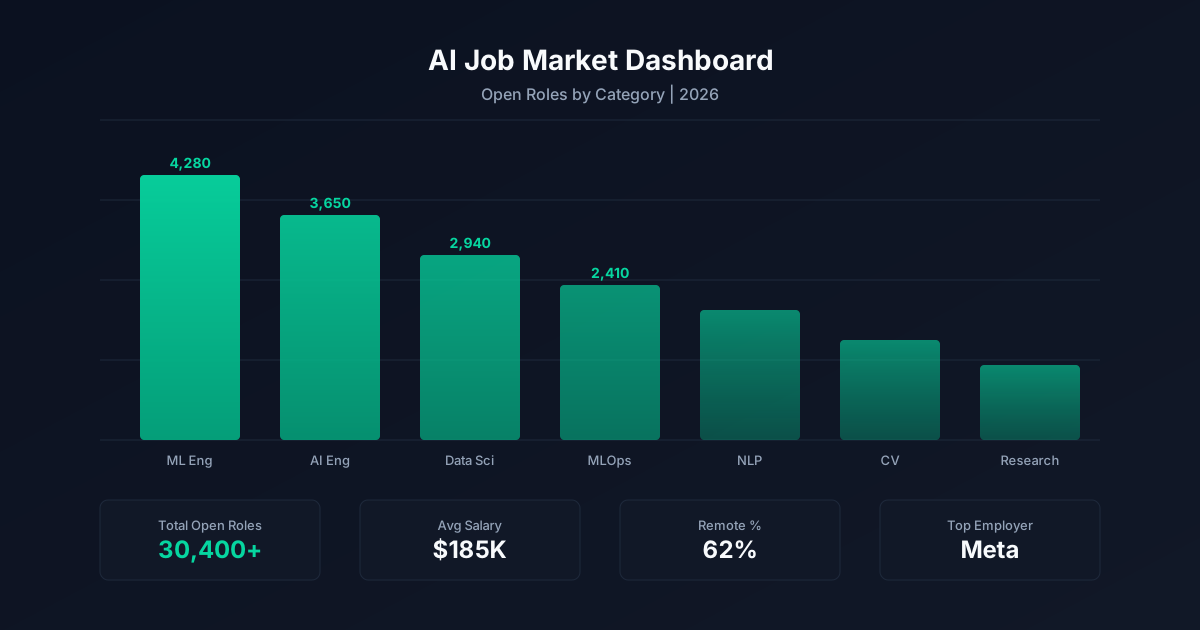
The AI job market has 3,708 open positions tracked in our dataset. By seniority: 102 entry-level, 1,705 mid-level, 1,469 senior, and 432 leadership roles (Director, VP, C-Level). Remote roles make up 14% of the market (508 positions). The remaining 3,180 roles require on-site or hybrid attendance.
The market median for AI roles is $217,500. Top-quartile compensation starts at $272,100. The 90th percentile reaches $325,000. Highest-paying categories: AI Safety ($300,000 median, 21 roles); Research Engineer ($280,000 median, 147 roles); AI Architect ($254,798 median, 67 roles).
AI Software Engineer roles are among the most numerous in the AI job market. Every company deploying AI needs software engineers who understand AI integration patterns. The demand is broad, spanning startups to enterprises, across every industry adopting AI capabilities.
The AI Job Market Today
The AI job market spans 3,708 open positions across 16 role categories. The largest categories by volume: AI/ML Engineer (2,605), Data Scientist (310), AI Software Engineer (259). These three account for the majority of open positions, though smaller categories often have higher per-role compensation because of specialized skill requirements.
The seniority mix tells a story about where AI teams are in their maturity. Entry-level roles (102) are outnumbered by mid-level (1,705) and senior (1,469) positions, reflecting that most companies are past the 'build a team from scratch' phase and need experienced engineers who can ship production systems. Leadership roles (Director, VP, C-Level) total 432 positions, representing the bottleneck between technical execution and organizational strategy.
Remote work availability sits at 14% of all AI roles (508 positions), with 3,180 requiring on-site or hybrid attendance. The remote share has stabilized after the post-pandemic correction. Senior and specialized roles (Research Scientist, ML Architect) are more likely to be remote-eligible than entry-level positions, partly because experienced hires have more negotiating power and partly because these roles require less hands-on mentorship.
AI compensation is structured in clear tiers. The market median sits at $217,500. Top-quartile roles start at $272,100, and the 90th percentile reaches $325,000. These figures include base salary with disclosed compensation. Total compensation (including equity, bonuses, and sign-on) runs 20-40% higher at companies that offer those components.
Category matters for compensation. AI Safety roles lead at $300,000 median, while Prompt Engineer roles sit at $140,000. The spread between highest and lowest-paying categories reflects the premium on specialized technical skills versus broader analytical roles.
The most in-demand skills across all AI postings: Python (1,890 postings), Aws (1,103 postings), Azure (877 postings), Rag (855 postings), Gcp (631 postings), Prompt Engineering (560 postings), Pytorch (545 postings), Claude (498 postings). Python dominates, appearing in the vast majority of role descriptions regardless of category. Cloud platform experience (AWS, GCP, Azure) is the second most common requirement. The newer entrants to the top skills list (RAG, vector databases, LLM APIs) reflect the shift from traditional ML toward generative AI applications.
Frequently Asked Questions
Get Weekly AI Career Intelligence
Salary data, skills demand, and market signals from 16,000+ AI job postings. Every Monday.