
Interested in this AI/ML Engineer role at Amazon Web Services?
Apply Now →Skills & Technologies
About This Role
DESCRIPTION
---------------
Application deadline: Jul 20, 2026
AWS Global Sales drives adoption of the AWS cloud worldwide, enabling customers of all sizes to innovate and expand in the cloud. Our team empowers every customer to grow by providing tailored service, unmatched technology, and comprehensive support. We dive deep to understand each customer's unique challenges, then craft innovative solutions that accelerate their success. This customer\-first approach is how we built the world's most adopted cloud. Join us and help us grow.
Are you passionate about Artificial Intelligence, Machine Learning, and GenerativeAI? Are you passionate about helping customers build solutions leveraging the state\-of\-the\-art AI/ML/GenAI tools on Amazon Web Service (AWS)? Come join us!
At Amazon, we’ve been investing deeply in artificial intelligence for over 20 years, and many of the capabilities customers experience in our products are driven by machine learning. Amazon.com’s recommendations engine is driven by machine learning (ML), as are the paths that optimize robotic picking routes in our fulfillment centers. Our supply chain, forecasting, and capacity planning are also informed by ML algorithms. Alexa is fueled by Natural Language Understanding and Automated Speech Recognition deep learning; as is Prime Air, and the computer vision technology in our new retail experience, Amazon Go. We have thousands of engineers at Amazon committed to machine learning and deep learning, and it’s a big part of our heritage.
Within AWS, we’re focused on bringing that knowledge and capability to customers through layers of the AI stack: 1\) API\-driven Inference Services like Amazon Bedrock 2\) Agentic AI including Agentic platforms, tool usage, evaluations, governance and cost management along with use of Agentic SDKs such as Strands and platforms such as Amazon Bedrock AgentCore 3\) Frameworks and Infrastructure with tools like Pytorch and TensorFlow, 2\) Machine Learning Platforms such as Amazon SageMaker for data scientists, and, k to quickly add intelligence to applications with simple API calls.
AWS is looking for a Machine Learning Solutions Architect (ML SA), who will be the Subject Matter Expert (SME) for helping customers in the AMERICAS design solutions that leverage our ML services. As part of the team, you will work closely with ISV(Independent Software Vendors) to enable large\-scale use cases, design ML pipelines, and drive the adoption of AWS for the AI/ML platforms. You will interact with other SAs in the field, providing guidance on their customer engagements, and you will develop white papers, blogs, reference implementations, and presentations to enable customers to fully leverage AI/ML on AWS. Additionally, as the voice of the customer, you will work closely with the service teams, and submit product feature requests to drive the platform forward.
You must have deep technical experience working with technologies related to Generative AI, machine learning and/or deep learning. A strong mathematics and statistics background is preferred in addition to experience building complex machine learning models. You will be familiar with the ecosystem of software vendors in the GenAI space, and will leverage this knowledge to help AWS customers in their selection process.
If you are a qualified and accepted candidate, you may work out of any of the following cities: San Jose, Los Angeles, Denver, Chicago, Austin, Dallas, Atlanta, Arlington.
Travel up to 50% across the USA may be possible.
Key job responsibilities
Working with customers’ development and data science teams to deeply understand their business and technical needs. After understanding their needs, you will design solutions that make the best use of the AWS cloud platform and AWS AI/ML Services including SageMaker, Amazon Bedrock, Amazon AgentCore, Amazon Rekognition, Amazon Transcribe, Amazon Quick, Amazon Personalize, and other AI/ML services.
- Partner with SAs, Sales, Business Development and the AI/ML Service teams to accelerate customer adoption and revenue attainment in the AMERICAS for Amazon SageMaker and related services that support GenAI use cases.
- Thought Leadership – Evangelize AWS ML services and share best practices through forums such as AWS blogs, whitepapers, reference architectures and public\-speaking events such as AWS Summit, AWS re:Invent, etc.
- Act as a technical liaison between customers and the AWS SageMaker or other service teams to provide customer driven product improvement feedback.
- Develop and support an AWS internal community of GenAI related subject matter experts in the AMERICAS.
About the team
Diverse Experiences
AWS values diverse experiences. Even if you do not meet all of the preferred qualifications and skills listed in the job description, we encourage candidates to apply. If your career is just starting, hasn’t followed a traditional path, or includes alternative experiences, don’t let it stop you from applying.
Why AWS?
Amazon Web Services (AWS) is the world’s most comprehensive and broadly adopted cloud platform. We pioneered cloud computing and never stopped innovating — that’s why customers from the most successful startups to Global 500 companies trust our robust suite of products and services to power their businesses.
Inclusive Team Culture
AWS values curiosity and connection. Our employee\-led and company\-sponsored affinity groups promote inclusion and empower our people to take pride in what makes us unique. Our inclusion events foster stronger, more collaborative teams. Our continual innovation is fueled by the bold ideas, fresh perspectives, and passionate voices our teams bring to everything we do.
Mentorship \& Career Growth
We’re continuously raising our performance bar as we strive to become Earth’s Best Employer. That’s why you’ll find endless knowledge\-sharing, mentorship and other career\-advancing resources here to help you develop into a better\-rounded professional.
Work/Life Balance
We value work\-life harmony. Achieving success at work should never come at the expense of sacrifices at home, which is why we strive for flexibility as part of our working culture. When we feel supported in the workplace and at home, there’s nothing we can’t achieve.BASIC QUALIFICATIONS
------------------------
- 2\+ years of design, implementation, or consulting in applications and infrastructures experience
- 4\+ years of specific technology domain areas (e.g. software development, cloud computing, systems engineering, infrastructure, security, networking, data \& analytics) experience
- 10\+ years of IT development or implementation/consulting in the software or Internet industries experience
PREFERRED QUALIFICATIONS
----------------------------
- Experience working within software development or Internet\-related industries
- Experience migrating or transforming legacy customer solutions to the cloud
- Experience working with AWS technologies from a dev/ops perspective
Amazon is an equal opportunity employer and does not discriminate on the basis of protected veteran status, disability, or other legally protected status.
Los Angeles County applicants: Job duties for this position include: work safely and cooperatively with other employees, supervisors, and staff; adhere to standards of excellence despite stressful conditions; communicate effectively and respectfully with employees, supervisors, and staff to ensure exceptional customer service; and follow all federal, state, and local laws and Company policies. Criminal history may have a direct, adverse, and negative relationship with some of the material job duties of this position. These include the duties and responsibilities listed above, as well as the abilities to adhere to company policies, exercise sound judgment, effectively manage stress and work safely and respectfully with others, exhibit trustworthiness and professionalism, and safeguard business operations and the Company’s reputation. Pursuant to the Los Angeles County Fair Chance Ordinance, we will consider for employment qualified applicants with arrest and conviction records.
Pursuant to the San Francisco Fair Chance Ordinance, we will consider for employment qualified applicants with arrest and conviction records.
Our inclusive culture empowers Amazonians to deliver the best results for our customers. If you have a disability and need a workplace accommodation or adjustment during the application and hiring process, including support for the interview or onboarding process, please visit https://amazon.jobs/content/en/how\-we\-hire/accommodations for more information. If the country/region you’re applying in isn’t listed, please contact your Recruiting Partner.
The base salary range for this position is listed below. Your Amazon package will include sign\-on payments and restricted stock units (RSUs). Final compensation will be determined based on factors including experience, qualifications, and location. Amazon also offers comprehensive benefits including health insurance (medical, dental, vision, prescription, Basic Life \& AD\&D insurance and option for Supplemental life plans, EAP, Mental Health Support, Medical Advice Line, Flexible Spending Accounts, Adoption and Surrogacy Reimbursement coverage), 401(k) matching, paid time off, and parental leave. Learn more about our benefits at https://amazon.jobs/en/benefits.
USA, CA, San Francisco \- 151,000\.00 \- 204,300\.00 USD annually
USA, CO, Denver \- 131,300\.00 \- 177,600\.00 USD annually
USA, NY, New York \- 144,500\.00 \- 195,400\.00 USD annually
Salary Context
This $144K-$204K range is below the median for AI/ML Engineer roles in our dataset (median: $180K across 1841 roles with salary data).
View full AI/ML Engineer salary data →Role Details
About This Role
AI/ML Engineers build and deploy machine learning models in production. They work across the full ML lifecycle: data pipelines, model training, evaluation, and serving infrastructure. The role has evolved significantly over the past two years. Where ML Engineers once spent most of their time on model architecture, the job now tilts heavily toward inference optimization, cost management, and integrating LLM capabilities into existing systems. Companies want engineers who can ship production systems, and the experimenter-only role is fading fast.
Day-to-day, you're writing training pipelines, debugging data quality issues, setting up evaluation frameworks, and figuring out why your model performs differently in staging than it did on your dev set. The best ML engineers are obsessive about reproducibility and measurement. They instrument everything. They know that a model is only as good as the data feeding it and the infrastructure serving it.
Across the 3,708 AI roles we're tracking, AI/ML Engineer positions make up 70% of the market. At Amazon Web Services, this role fits into their broader AI and engineering organization.
Demand for AI/ML Engineers has been strong and consistent. Unlike some AI roles that spike with hype cycles, ML engineering is a foundational need. Every company deploying AI models needs people who can keep them running, and the gap between research prototypes and production systems keeps growing.
What the Work Looks Like
A typical week might include: debugging a data pipeline that's silently dropping 3% of training examples, running A/B tests on a new model version, writing documentation for a feature flag system that lets you roll back model deployments, and reviewing a junior engineer's PR for a new evaluation metric. Meetings tend to be cross-functional since ML touches product, engineering, and data teams.
Demand for AI/ML Engineers has been strong and consistent. Unlike some AI roles that spike with hype cycles, ML engineering is a foundational need. Every company deploying AI models needs people who can keep them running, and the gap between research prototypes and production systems keeps growing.
Skills Required
Python and PyTorch dominate the requirements. Most roles expect experience with cloud platforms (AWS, GCP, or Azure) and familiarity with ML frameworks like TensorFlow or JAX. RAG (Retrieval-Augmented Generation) has become a top-3 skill requirement as companies integrate LLMs into their products. Docker and Kubernetes show up in about a third of postings, reflecting the production focus of the role.
Beyond the core stack, employers increasingly want experience with experiment tracking tools (MLflow, Weights & Biases), feature stores, and vector databases. Fine-tuning experience is valuable but less common than you'd think from reading Twitter. Most production LLM work is RAG and prompt engineering, not fine-tuning. If you have both, you're in a strong position.
Companies that are serious about AI/ML hiring tend to post specific infrastructure details in the job description: the frameworks they use, their model serving stack, their data pipeline tools. Vague postings that just say 'ML experience required' without specifics are often companies that haven't figured out what they need yet.
Compensation Benchmarks
AI/ML Engineer roles pay a median of $218,750 based on 3,817 positions with disclosed compensation. Mid-level AI roles across all categories have a median of $200,000. This role's midpoint ($174K) sits 20% below the category median. Disclosed range: $144K to $204K.
Across all AI roles, the market median is $217,500. Top-quartile compensation starts at $272,100. The 90th percentile reaches $325,000. For comparison, the highest-paying categories include AI Safety ($300,000) and Research Engineer ($280,000). By seniority level: Entry: $120,000; Mid: $200,000; Senior: $230,000; Director: $272,150; VP: $250,000.
Amazon Web Services AI Hiring
Amazon Web Services has 73 open AI roles right now. They're hiring across AI/ML Engineer, AI Product Manager, Research Scientist, Data Scientist. Positions span New York, NY, US, Austin, TX, US, Jersey City, NJ, US. Compensation range: $129K - $342K.
Location Context
AI roles in New York pay a median of $220,000 across 1,045 tracked positions.
Career Path
Common paths into AI/ML Engineer roles include Data Scientist, Software Engineer, Research Engineer.
From here, career progression typically leads toward ML Architect, AI Engineering Manager, Principal ML Engineer.
The fastest path into ML engineering is through software engineering with a self-directed ML education. A CS degree helps, but production engineering skills matter more than academic credentials. Build something that works, deploy it, and measure it. That portfolio project is worth more than a Coursera certificate. For career growth, the fork comes around the senior level: go deep on technical complexity (staff/principal track) or move into managing ML teams.
What to Expect in Interviews
Expect system design questions around ML pipelines: how you'd build a training pipeline for a specific use case, handle data drift, or design A/B testing infrastructure for model deployments. Coding rounds typically involve Python, with emphasis on data manipulation (pandas, numpy) and algorithm implementation. Take-home assignments often ask you to build an end-to-end ML pipeline from raw data to deployed model.
When evaluating opportunities: Companies that are serious about AI/ML hiring tend to post specific infrastructure details in the job description: the frameworks they use, their model serving stack, their data pipeline tools. Vague postings that just say 'ML experience required' without specifics are often companies that haven't figured out what they need yet.
AI Hiring Overview
The AI job market has 3,708 open positions tracked in our dataset. By seniority: 102 entry-level, 1,705 mid-level, 1,469 senior, and 432 leadership roles (Director, VP, C-Level). Remote roles make up 14% of the market (508 positions). The remaining 3,180 roles require on-site or hybrid attendance.
The market median for AI roles is $217,500. Top-quartile compensation starts at $272,100. The 90th percentile reaches $325,000. Highest-paying categories: AI Safety ($300,000 median, 21 roles); Research Engineer ($280,000 median, 147 roles); AI Architect ($254,798 median, 67 roles).
Demand for AI/ML Engineers has been strong and consistent. Unlike some AI roles that spike with hype cycles, ML engineering is a foundational need. Every company deploying AI models needs people who can keep them running, and the gap between research prototypes and production systems keeps growing.
The AI Job Market Today
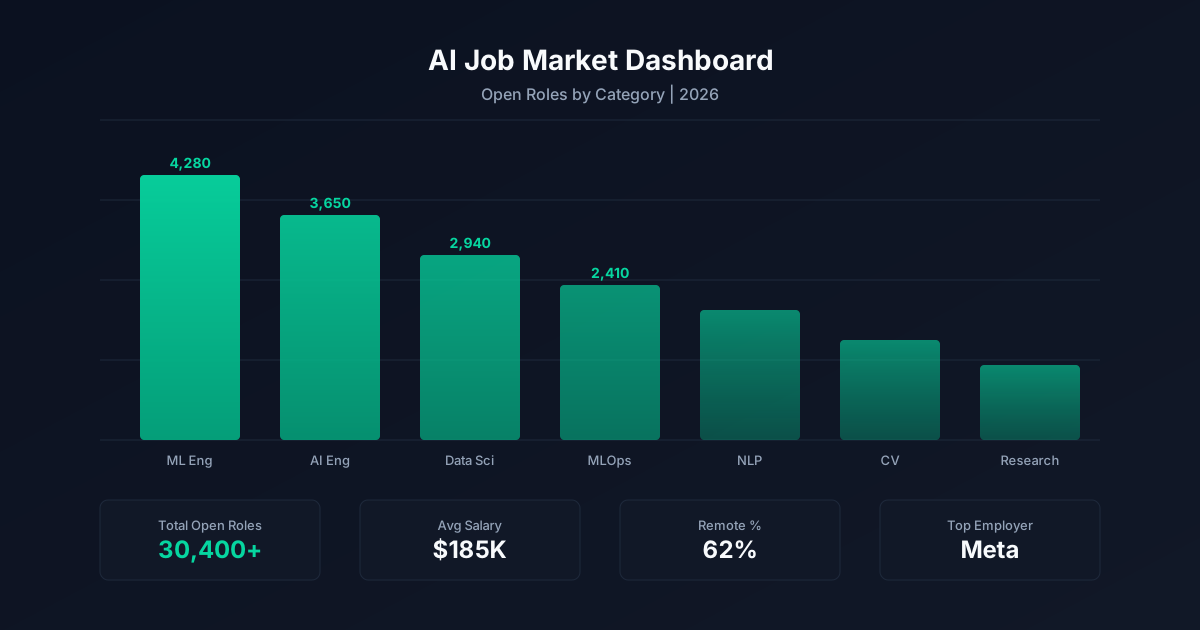
The AI job market spans 3,708 open positions across 16 role categories. The largest categories by volume: AI/ML Engineer (2,605), Data Scientist (310), AI Software Engineer (259). These three account for the majority of open positions, though smaller categories often have higher per-role compensation because of specialized skill requirements.
The seniority mix tells a story about where AI teams are in their maturity. Entry-level roles (102) are outnumbered by mid-level (1,705) and senior (1,469) positions, reflecting that most companies are past the 'build a team from scratch' phase and need experienced engineers who can ship production systems. Leadership roles (Director, VP, C-Level) total 432 positions, representing the bottleneck between technical execution and organizational strategy.
Remote work availability sits at 14% of all AI roles (508 positions), with 3,180 requiring on-site or hybrid attendance. The remote share has stabilized after the post-pandemic correction. Senior and specialized roles (Research Scientist, ML Architect) are more likely to be remote-eligible than entry-level positions, partly because experienced hires have more negotiating power and partly because these roles require less hands-on mentorship.
AI compensation is structured in clear tiers. The market median sits at $217,500. Top-quartile roles start at $272,100, and the 90th percentile reaches $325,000. These figures include base salary with disclosed compensation. Total compensation (including equity, bonuses, and sign-on) runs 20-40% higher at companies that offer those components.
Category matters for compensation. AI Safety roles lead at $300,000 median, while Prompt Engineer roles sit at $140,000. The spread between highest and lowest-paying categories reflects the premium on specialized technical skills versus broader analytical roles.
The most in-demand skills across all AI postings: Python (1,890 postings), Aws (1,103 postings), Azure (877 postings), Rag (855 postings), Gcp (631 postings), Prompt Engineering (560 postings), Pytorch (545 postings), Claude (498 postings). Python dominates, appearing in the vast majority of role descriptions regardless of category. Cloud platform experience (AWS, GCP, Azure) is the second most common requirement. The newer entrants to the top skills list (RAG, vector databases, LLM APIs) reflect the shift from traditional ML toward generative AI applications.
Frequently Asked Questions
Get Weekly AI Career Intelligence
Salary data, skills demand, and market signals from 16,000+ AI job postings. Every Monday.