
Interested in this AI Product Manager role at Amazon.com?
Apply Now →Skills & Technologies
About This Role
DESCRIPTION
---------------
Join the Edge AI team within the Silicon and Systems Group (SSG) at Amazon. As a Systems Development Engineer, you will own the
test and release infrastructure that validates custom AI accelerator silicon IP, kernel drivers, and ML inference software across Amazon's edge device portfolio.
This role demands someone who understands hardware IP at the register level AND can build scalable automation around it. You will design hardware\-in\-the\-loop test frameworks that exercise AI accelerator compute cores, DMA engines, and security subsystems on physical silicon — then build the CI/CD pipelines and AI\-assisted workflows that make those tests run continuously, reliably, and at scale.
You won't just run existing tests. You will create new test processes from scratch — defining what to measure, building the execution infrastructure, instrumenting coverage, and using AI to
multiply your effectiveness. When an inference failure surfaces in production, you need the IP\-level understanding to trace it from a CloudWatch metric through the kernel driver down to specific hardware accelerator behavior.
Key job responsibilities
Hardware\-in\-the\-Loop Test Infrastructure: Design, build, and maintain automated test systems that execute on physical AI accelerator silicon across device pools. Own scheduling, device provisioning, firmware flashing, result collection, and failure triage at scale.
IP\-Level Technical Depth: Develop deep understanding of AI accelerator hardware IP (compute cores, DMA controllers, MMU/IOMMU, power domains) to write meaningful validation
that exercises real silicon behavior, not just software interfaces.
Test Process Creation: Define and implement new test methodologies and frameworks from the ground up. Build systems that are robust to device failures, scale across multiple platform generations, and produce actionable signal.
AI\-Powered Workflows: Apply AI fundamentals to force\- multiply engineering effectiveness — automated log analysis, intelligent test selection, failure pattern recognition, AI\-assisted code generation, and agentic CI workflows.
Coverage \& Quality Tooling: Implement and maintain code coverage, test coverage mapping, Static Code Analysis (SCA), and Dynamic Code Analysis (DCA) integrated into the development workflow and CI gates.
CI/CD Pipeline Ownership: Build and maintain release pipelines using AWS services (CDK, Lambda, CodePipeline) and embedded build systems (Yocto/BitBake) that take validated
software from commit to production.
Production Monitoring: Create dashboards and alerting for on\-device inference metrics, crash rates, and performance regressions across the device fleet. Investigate issues
spanning hardware accelerator behavior through kernel driver to userspace.
Cross\-Team Collaboration: Work with silicon validation, platform software, ML science, and QA teams to identify test gaps, define coverage targets, and close them systematically.
BASIC QUALIFICATIONS
------------------------
- Experience in automating, deploying, and supporting large\-scale infrastructure
- Experience programming with at least one modern language such as Python, Ruby, Golang, Java, C\+\+, C\#, Rust
- Experience with Linux/Unix
- Experience with CI/CD pipelines build processes
PREFERRED QUALIFICATIONS
----------------------------
- Experience with distributed systems at scale
Amazon is an equal opportunity employer and does not discriminate on the basis of protected veteran status, disability, or other legally protected status.
Los Angeles County applicants: Job duties for this position include: work safely and cooperatively with other employees, supervisors, and staff; adhere to standards of excellence despite stressful conditions; communicate effectively and respectfully with employees, supervisors, and staff to ensure exceptional customer service; and follow all federal, state, and local laws and Company policies. Criminal history may have a direct, adverse, and negative relationship with some of the material job duties of this position. These include the duties and responsibilities listed above, as well as the abilities to adhere to company policies, exercise sound judgment, effectively manage stress and work safely and respectfully with others, exhibit trustworthiness and professionalism, and safeguard business operations and the Company’s reputation. Pursuant to the Los Angeles County Fair Chance Ordinance, we will consider for employment qualified applicants with arrest and conviction records.
Our inclusive culture empowers Amazonians to deliver the best results for our customers. If you have a disability and need a workplace accommodation or adjustment during the application and hiring process, including support for the interview or onboarding process, please visit https://amazon.jobs/content/en/how\-we\-hire/accommodations for more information. If the country/region you’re applying in isn’t listed, please contact your Recruiting Partner.
The base salary range for this position is listed below. Your Amazon package will include sign\-on payments and restricted stock units (RSUs). Final compensation will be determined based on factors including experience, qualifications, and location. Amazon also offers comprehensive benefits including health insurance (medical, dental, vision, prescription, Basic Life \& AD\&D insurance and option for Supplemental life plans, EAP, Mental Health Support, Medical Advice Line, Flexible Spending Accounts, Adoption and Surrogacy Reimbursement coverage), 401(k) matching, paid time off, and parental leave. Learn more about our benefits at https://amazon.jobs/en/benefits.
USA, CA, Sunnyvale \- 148,700\.00 \- 201,200\.00 USD annually
Salary Context
This $148K-$201K range is below the median for AI Product Manager roles in our dataset (median: $188K across 140 roles with salary data).
View full AI Product Manager salary data →Role Details
About This Role
AI Product Managers define what AI features get built and why. They translate business problems into ML-solvable tasks, work with engineering to scope model requirements, and own the metrics that determine if an AI feature is working. The role requires a rare combination of technical fluency and product instinct.
Unlike traditional product management, AI PM work involves managing uncertainty at a fundamental level. Your model might work 90% of the time. What happens the other 10%? What's the user experience when the AI is wrong? How do you measure 'good enough' for a probabilistic system? These questions don't have easy answers, and the AI PM is the person responsible for finding them.
Across the 3,708 AI roles we're tracking, AI Product Manager positions make up 5% of the market. At Amazon.com, this role fits into their broader AI and engineering organization.
AI Product Manager roles are growing as companies realize that shipping AI features requires different product thinking than traditional software. The best candidates combine product management experience with enough technical depth to have productive conversations with ML engineers about model capabilities and limitations.
What the Work Looks Like
A typical week includes: reviewing model evaluation results with the ML team, defining success metrics for a new AI feature, conducting user research on how customers respond to AI-generated outputs, writing product requirements that include accuracy thresholds and fallback behaviors, and presenting the AI roadmap to leadership. You're the translator between technical capability and business value.
AI Product Manager roles are growing as companies realize that shipping AI features requires different product thinking than traditional software. The best candidates combine product management experience with enough technical depth to have productive conversations with ML engineers about model capabilities and limitations.
Skills Required
Technical fluency with ML concepts is essential, though you won't be writing models. Expect to understand training data, evaluation metrics, model limitations, and responsible AI practices. SQL and basic Python are increasingly expected. Experience with A/B testing, data analysis, and product analytics is baseline. Understanding LLM capabilities and limitations is now a core requirement.
The differentiator is AI-specific product thinking: knowing when to use ML vs. heuristics, understanding the cost of training data collection, designing graceful degradation for model failures, and building products that improve with usage data. Experience with AI safety, bias mitigation, and responsible AI deployment is increasingly important.
Strong postings describe specific AI products the PM will own, mention the ML team structure, and talk about measurement methodology. Look for companies that have already shipped AI features. Roles at companies that are 'exploring AI' often mean you'll spend a year defining the strategy before any building happens.
Compensation Benchmarks
AI Product Manager roles pay a median of $216,175 based on 270 positions with disclosed compensation. Mid-level AI roles across all categories have a median of $200,000. This role's midpoint ($174K) sits 19% below the category median. Disclosed range: $148K to $201K.
Across all AI roles, the market median is $217,500. Top-quartile compensation starts at $272,100. The 90th percentile reaches $325,000. For comparison, the highest-paying categories include AI Safety ($300,000) and Research Engineer ($280,000). By seniority level: Entry: $120,000; Mid: $200,000; Senior: $230,000; Director: $272,150; VP: $250,000.
Amazon.com AI Hiring
Amazon.com has 97 open AI roles right now. They're hiring across Research Scientist, AI/ML Engineer, Data Scientist, AI Product Manager. Positions span Sunnyvale, CA, US, Culver City, CA, US, San Francisco, CA, US. Compensation range: $97K - $327K.
Location Context
Across all AI roles, 14% (508 positions) offer remote work, while 3,180 require on-site attendance. Top AI hiring metros: New York (1,045 roles, $220,000 median); San Francisco (810 roles, $277,088 median); Los Angeles (397 roles, $215,000 median).
Career Path
Common paths into AI Product Manager roles include Product Manager, Data Analyst, Technical Program Manager.
From here, career progression typically leads toward Director of AI Product, VP Product, Head of AI.
The most effective path is PM experience plus self-directed AI education. Take Andrew Ng's courses, build a small ML project, and learn enough Python to read model evaluation code. The goal isn't to become an ML engineer. It's to have credibility in technical conversations and to understand what's possible, what's hard, and what's a bad idea.
What to Expect in Interviews
AI interviews typically combine coding challenges (Python-focused), system design questions tailored to the role, and discussions about your experience with relevant tools and frameworks. Strong candidates demonstrate both technical depth and the ability to make pragmatic engineering tradeoffs. Prepare portfolio projects that demonstrate end-to-end capability rather than isolated skills.
When evaluating opportunities: Strong postings describe specific AI products the PM will own, mention the ML team structure, and talk about measurement methodology. Look for companies that have already shipped AI features. Roles at companies that are 'exploring AI' often mean you'll spend a year defining the strategy before any building happens.
AI Hiring Overview
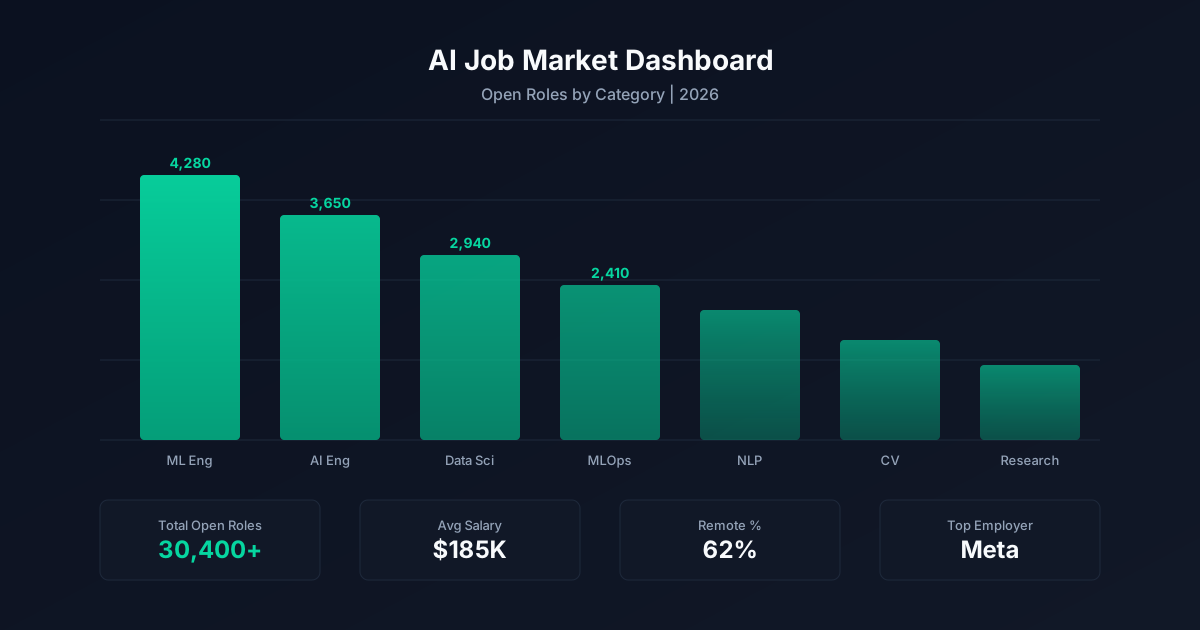
The AI job market has 3,708 open positions tracked in our dataset. By seniority: 102 entry-level, 1,705 mid-level, 1,469 senior, and 432 leadership roles (Director, VP, C-Level). Remote roles make up 14% of the market (508 positions). The remaining 3,180 roles require on-site or hybrid attendance.
The market median for AI roles is $217,500. Top-quartile compensation starts at $272,100. The 90th percentile reaches $325,000. Highest-paying categories: AI Safety ($300,000 median, 21 roles); Research Engineer ($280,000 median, 147 roles); AI Architect ($254,798 median, 67 roles).
AI Product Manager roles are growing as companies realize that shipping AI features requires different product thinking than traditional software. The best candidates combine product management experience with enough technical depth to have productive conversations with ML engineers about model capabilities and limitations.
The AI Job Market Today
The AI job market spans 3,708 open positions across 16 role categories. The largest categories by volume: AI/ML Engineer (2,605), Data Scientist (310), AI Software Engineer (259). These three account for the majority of open positions, though smaller categories often have higher per-role compensation because of specialized skill requirements.
The seniority mix tells a story about where AI teams are in their maturity. Entry-level roles (102) are outnumbered by mid-level (1,705) and senior (1,469) positions, reflecting that most companies are past the 'build a team from scratch' phase and need experienced engineers who can ship production systems. Leadership roles (Director, VP, C-Level) total 432 positions, representing the bottleneck between technical execution and organizational strategy.
Remote work availability sits at 14% of all AI roles (508 positions), with 3,180 requiring on-site or hybrid attendance. The remote share has stabilized after the post-pandemic correction. Senior and specialized roles (Research Scientist, ML Architect) are more likely to be remote-eligible than entry-level positions, partly because experienced hires have more negotiating power and partly because these roles require less hands-on mentorship.
AI compensation is structured in clear tiers. The market median sits at $217,500. Top-quartile roles start at $272,100, and the 90th percentile reaches $325,000. These figures include base salary with disclosed compensation. Total compensation (including equity, bonuses, and sign-on) runs 20-40% higher at companies that offer those components.
Category matters for compensation. AI Safety roles lead at $300,000 median, while Prompt Engineer roles sit at $140,000. The spread between highest and lowest-paying categories reflects the premium on specialized technical skills versus broader analytical roles.
The most in-demand skills across all AI postings: Python (1,890 postings), Aws (1,103 postings), Azure (877 postings), Rag (855 postings), Gcp (631 postings), Prompt Engineering (560 postings), Pytorch (545 postings), Claude (498 postings). Python dominates, appearing in the vast majority of role descriptions regardless of category. Cloud platform experience (AWS, GCP, Azure) is the second most common requirement. The newer entrants to the top skills list (RAG, vector databases, LLM APIs) reflect the shift from traditional ML toward generative AI applications.
Frequently Asked Questions
Get Weekly AI Career Intelligence
Salary data, skills demand, and market signals from 16,000+ AI job postings. Every Monday.