
Interested in this AI Architect role at Banyan Software?
Apply Now →Skills & Technologies
About This Role
Banyan Software is the best permanent home for software businesses that serve specialized industries, their employees, and their customers. We are on a mission to acquire, build, and grow great companies worldwide, helping them modernize through shared AI expertise and operational discipline. The Banyan Software Foundation, endowed with $100 million in Banyan stock, leverages technology to build a greener and more equitable world. Banyan is Great Place to Work Certified, a five\-time Inc. 5000 honoree, and a top 10 company on the Deloitte Technology Fast 500\. Founded in 2016 and headquartered in Atlanta, Banyan operates more than 100 portfolio companies across North America, the UK, EU, and APAC.
Lead AI Architect
Central Data \& AI Platform
-----------------------------------------------------
About Banyan
We acquire and grow great software businesses for life. We provide a permanent home where founders, teams, and customers can thrive. Our portfolio is a growing family of vertical market software companies across many industries and geographies.
Our model is built on accountable autonomy. We pair that with a strong central team that supports our portfolio and runs Banyan itself. AI and data science are increasingly central to how that central team operates, and we are now investing in the platform foundation that will make it scale.
The Role
We are hiring our first Lead AI Architect to design, build, and run the centralized data and AI platform that powers Banyan. The cornerstone of the work is a centralized data model, a Banyan data lake, that consolidates the data we already have and unlocks safe AI experimentation for our internal functional teams: Finance, M\&A, Business Development, and others.
This role is modeled on a classical Enterprise Architect role and adapted for an AI\-first world. You will set the target\-state architecture, choose the patterns we standardize on, write code yourself, and own the result. You will partner with our embedded business analysts and the leaders of each functional vertical so the platform stays grounded in real use cases, not abstractions.
This is a player\-coach role. You start hands\-on. Over time you build and lead a small platform team.
What You Will Build
- A centralized data lake on AWS: the single, governed source of truth for internal Banyan data. Designed for analytics, ML, and AI experimentation.
- A reference architecture for AI: patterns and building blocks our verticals use to go from idea to safe production: model selection, RAG, evaluation, observability, cost controls.
- Guardrails that make experimentation safe: data classification, access tiering, sandboxes, audit logging, and clear rules for what can be sent where.
- A platform team and operating model: the team, standards, and rituals that keep the platform reliable and improving as adoption grows.
What You Will Do
- Define and own the target\-state data and AI architecture for Banyan. Make the trade\-offs explicit and write them down.
- Design and build the AWS\-centric data lake. Set the patterns for storage, cataloging, query, ingestion, modeling, and lineage. Likely stack: S3, Glue, Lake Formation, Athena, Redshift, Iceberg or similar open table formats, plus Terraform or CDK for infrastructure as code.
- Stand up the AI experimentation layer: model access via Anthropic, OpenAI and other LLM
- Establish data contracts, schema standards, naming conventions, and a domain model that holds up as we add sources and acquire companies.
- Partner with our Senior Business Analysts embedded in Finance, M\&A, and Business Development to translate use cases into platform requirements and to unblock their work.
- Define security, privacy, and AI safety guardrails. Classify data, design access tiering, and set the rules for handling PII, regulated data, and confidential portfolio information.
- Stay hands\-on. Write code, ship infrastructure, run code reviews, and debug production issues. Architects who do not build lose touch.
- Build the team including vertical aligned Senior Business AI Analysts. Find suitable contractors for data platform engineers, ML platform engineers, and data engineers. Mentor them. Set the bar for engineering quality.
- Own platform reliability, observability, and cost. Set SLOs, monitor usage, and keep the bill rational as we scale.
- Represent Banyan's AI and data architecture to our executive team, our portfolio companies, and external partners.
First\-Year Outcomes
- A production\-ready, governed data lake foundation deployed on AWS, with at least three priority data domains landed and modeled.
- At least two functional verticals onboarded to the platform with safe, audited data access for analytics and AI experimentation.
- A documented reference architecture, security model, and standards library that new use cases and new hires can plug into.
- At least one AI use case running in production through the platform, with monitoring, evaluation, and a clear ROI story.
- First one to two team hires made and ramped.
Who You Are
- 10\+ years building data and AI platforms in production at meaningful scale. You have shipped, not just diagrammed.
- Deep AWS expertise. Hands\-on with S3, IAM, KMS, networking, Glue, Lake Formation, Athena, Redshift, SageMaker, Bedrock, and EKS or ECS.
- Strong data architecture chops: lakehouse patterns, open table formats (Iceberg, Delta, or Hudi), data modeling, ingestion frameworks (Fivetran, Airbyte, custom), orchestration (Airflow, Dagster, or similar), and lineage.
- Real experience with modern AI/ML platform patterns: feature stores, model registries, experiment tracking, prompt and evaluation frameworks, retrieval\-augmented generation, and basic agentic workflows.
- A working point of view on AI safety: data classification, PII handling, access tiering, evaluation, and model\-risk controls.
- Hands\-on coder. Strong Python and SQL. Comfortable in Terraform or AWS CDK. Reads logs, fixes issues, ships pull requests.
- Player\-coach experience. You have led small teams, mentored engineers, set hiring bars, and grown people.
- A strong communicator. You can drive an architecture decision review with engineers and explain trade\-offs to executives in the same week.
- Bachelor's degree in computer science, engineering, or a related field. A master's degree is a plus, not a requirement.
Bonus Points
- Experience in private\-equity\-backed or holding\-company environments with multiple business units and inconsistent source systems.
- Experience designing AI guardrails for non\-public, regulated, or competitively sensitive data.
- Track record of treating internal platforms as products, with named users, SLAs, and a real adoption strategy.
- Experience with Snowflake or Databricks. Useful when bridging to portfolio company data without forcing a single stack.
- Past experience as the first or early platform hire at a growth\-stage company.
Why Banyan
- Greenfield with real budget. You set the foundation, you do not inherit a tangle.
- Real ownership of the AI and data architecture for an entire holding company.
- A long\-term horizon. We do not optimize for the next quarter, so the platform you build can compound.
- A team that treats AI as a serious capability, not a buzzword. We have already built internal AI tooling we use every day.
- A culture of accountable autonomy. We trust you to do the work.
- Competitive compensation, benefits, and meaningful long\-term upside.
Quick Facts
Team: AI \& Data Science
Reports to: Head of IT
Scope: Player\-coach. Hands\-on architect today, leading a small platform team over time.
Type: Full\-time
Level: Lead
Compensation: Competitive base of CAD $180,000 to $240,000 plus performance bonus and benefits. Final offer reflects experience and qualifications.
How to Apply
Send your resume and a short note describing a data or AI platform you have architected. Tell us the choices you made, what shipped to production, and what you would do differently if you were starting over today.
We look forward to hearing from you.
Diversity, Equity, Inclusion \& Equal Employment Opportunity at Banyan: Banyan affirms that inequality is detrimental to our Global Teams, associates, our Operating Companies, and the communities we serve. As a collective, our goal is to impact lasting change through our actions. Together, we unite for equality and equity. Banyan is committed to equal employment opportunities regardless of any protected characteristic, including race, color, genetic information, creed, national origin, religion, sex, affectional or sexual orientation, gender identity or expression, lawful alien status, ancestry, age, marital status, or protected veteran status and will not discriminate against anyone on the basis of a disability. We support an inclusive workplace where associates excel based on personal merit, qualifications, experience, ability, and job performance.
Please Note: Banyan Software does not accept unsolicited resumes or applications submitted via email, LinkedIn, or other direct channels. All candidates must apply through our official Careers site to be considered for employment. Applications submitted outside of our applicant tracking system will not be reviewed.
*Recruitment Notice*
Banyan Software may use artificial intelligence (AI) tools to assist in screening and/or assessing applicants during the recruitment process. All hiring decisions are made by our team. Personal information submitted through your application will be collected and used for recruitment purposes in accordance with applicable privacy laws. Contact us at any time with questions about our process or to request accommodation.
*Beware of Recruitment Scams*
We have been made aware of individuals fraudulently posing as members of our Talent Acquisition team and extending fake job offers. These scams may involve requests for personal information or payment for equipment.
Protect yourself by following these steps:
- Verify that all communications from our recruiting team come from an @banyansoftware.com email address.
- Remember, employers will never request payment or banking information during the hiring process.
- If you receive a suspicious message, do not respond — instead, forward it to [email protected] and/or report it to the platform where you received it.
Your safety and security are important to us. Thank you for staying vigilant.
Salary Context
This $180K-$240K range is above the median for AI Architect roles in our dataset (median: $197K across 33 roles with salary data).
Role Details
About This Role
This role sits at the intersection of AI and engineering, building systems that bring machine learning capabilities into production environments. The scope varies by company, but the common thread is applying AI technology to solve real business problems at scale. Most AI roles today require a combination of software engineering fundamentals and domain-specific ML knowledge, with the exact mix depending on the team's maturity and the product they're building.
The AI job market is evolving fast. New role categories emerge as companies figure out what they need to ship AI-powered products. What matters most is the ability to learn quickly, build working systems, and iterate based on real-world performance data. The specific title matters less than the skills you bring and the problems you can solve. Companies are past the experimentation phase and want engineers who can deliver production-quality systems that work reliably at scale.
Across the 3,708 AI roles we're tracking, AI Architect positions make up 1% of the market. At Banyan Software, this role fits into their broader AI and engineering organization.
AI hiring keeps growing across industries. Companies in tech, finance, healthcare, and retail are all building AI teams. The strongest demand is for people who can bridge the gap between AI research and production engineering. The shift toward generative AI has created new role types (LLM Engineer, Prompt Engineer, AI Agent Developer) that didn't exist three years ago, while traditional roles (Data Scientist, ML Engineer) have evolved to incorporate LLM capabilities.
What the Work Looks Like
Day-to-day work involves a mix of building, debugging, and collaborating. You'll write code, review pull requests, participate in design discussions, and work with cross-functional teams (product, design, data) to define what AI features should do and how they should behave. Expect to spend time on both technical implementation and communication. Most AI teams operate in two-week sprint cycles, with regular demos and retrospectives. The ratio of heads-down coding to meetings and reviews varies by seniority, with senior roles spending more time on architecture decisions and mentorship.
AI hiring keeps growing across industries. Companies in tech, finance, healthcare, and retail are all building AI teams. The strongest demand is for people who can bridge the gap between AI research and production engineering. The shift toward generative AI has created new role types (LLM Engineer, Prompt Engineer, AI Agent Developer) that didn't exist three years ago, while traditional roles (Data Scientist, ML Engineer) have evolved to incorporate LLM capabilities.
Skills Required
Python and cloud platform experience are common requirements. Specific skill needs vary by company and focus area, but familiarity with ML frameworks, data pipelines, and API design covers the basics for most roles. RAG (Retrieval-Augmented Generation), vector databases, and LLM API integration are increasingly standard requirements across role types.
Beyond the core stack, communication skills matter more than many technical candidates realize. The ability to explain AI capabilities and limitations to non-technical stakeholders is a differentiator at every level. Technical writing, documentation, and clear thinking about tradeoffs are underrated skills in AI roles. Experience with evaluation methodology (how to measure whether an AI system is working well) is becoming a core requirement, especially for roles that involve LLM integration.
Look for job postings that specify the problems you'll work on, the tech stack, and the team structure. Vague postings that list every AI buzzword are often a sign the company hasn't figured out what they need. Strong postings describe the product context, the team you'd join, and the specific challenges you'd tackle.
Compensation Benchmarks
AI Architect roles pay a median of $254,798 based on 67 positions with disclosed compensation. Senior-level AI roles across all categories have a median of $230,000. This role's midpoint ($210K) sits 18% below the category median. Disclosed range: $180K to $240K.
Across all AI roles, the market median is $217,500. Top-quartile compensation starts at $272,100. The 90th percentile reaches $325,000. For comparison, the highest-paying categories include AI Safety ($300,000) and Research Engineer ($280,000). By seniority level: Entry: $120,000; Mid: $200,000; Senior: $230,000; Director: $272,150; VP: $250,000.
Banyan Software AI Hiring
Banyan Software has 1 open AI role right now. They're hiring across AI Architect. Based in Seattle, WA, US. Compensation range: $240K - $240K.
Location Context
AI roles in Seattle pay a median of $236,900 across 267 tracked positions. That's 9% above the national median.
Career Path
Common paths into AI Architect roles include Software Engineer, Data Scientist, Data Analyst.
From here, career progression typically leads toward Senior Engineer, AI Architect, Engineering Manager, Principal Engineer.
Focus on building things that work. A deployed project that solves a real problem is worth more than any certification. Contribute to open-source, build portfolio projects, and invest in fundamentals (software engineering, statistics, systems design) rather than chasing the latest framework. The AI field moves fast, but the engineers who succeed long-term are the ones with strong fundamentals who can adapt to new tools and paradigms as they emerge.
What to Expect in Interviews
AI interviews typically combine coding challenges (Python-focused), system design questions tailored to the role, and discussions about your experience with relevant tools and frameworks. Strong candidates demonstrate both technical depth and the ability to make pragmatic engineering tradeoffs. Prepare portfolio projects that demonstrate end-to-end capability rather than isolated skills.
When evaluating opportunities: Look for job postings that specify the problems you'll work on, the tech stack, and the team structure. Vague postings that list every AI buzzword are often a sign the company hasn't figured out what they need. Strong postings describe the product context, the team you'd join, and the specific challenges you'd tackle.
AI Hiring Overview
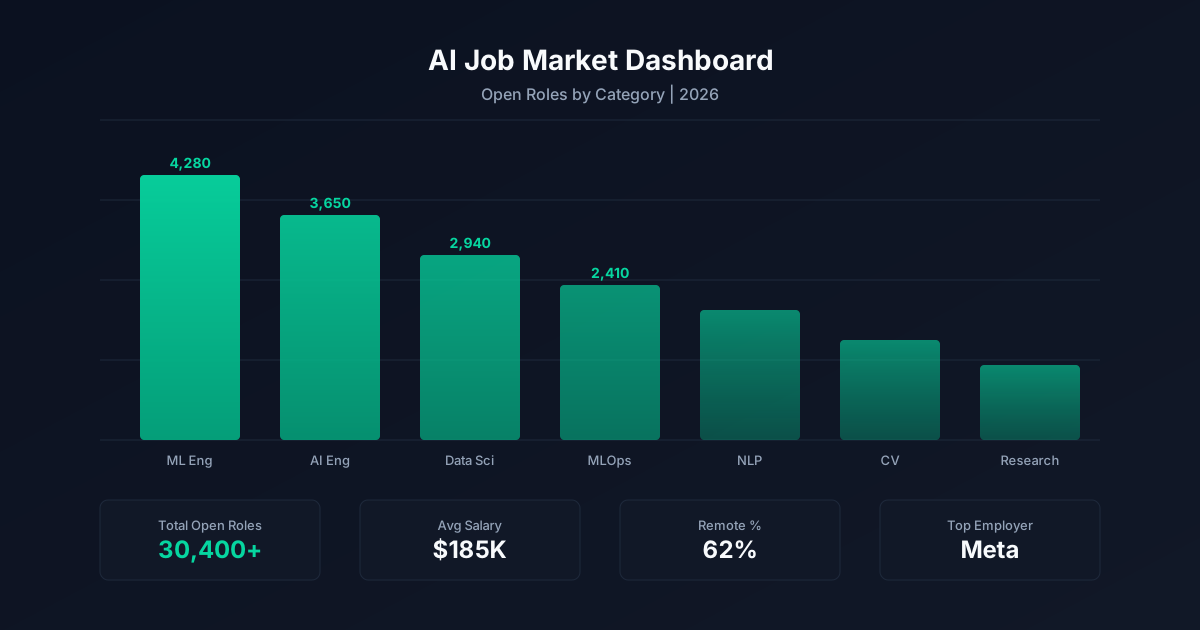
The AI job market has 3,708 open positions tracked in our dataset. By seniority: 102 entry-level, 1,705 mid-level, 1,469 senior, and 432 leadership roles (Director, VP, C-Level). Remote roles make up 14% of the market (508 positions). The remaining 3,180 roles require on-site or hybrid attendance.
The market median for AI roles is $217,500. Top-quartile compensation starts at $272,100. The 90th percentile reaches $325,000. Highest-paying categories: AI Safety ($300,000 median, 21 roles); Research Engineer ($280,000 median, 147 roles); AI Architect ($254,798 median, 67 roles).
AI hiring keeps growing across industries. Companies in tech, finance, healthcare, and retail are all building AI teams. The strongest demand is for people who can bridge the gap between AI research and production engineering. The shift toward generative AI has created new role types (LLM Engineer, Prompt Engineer, AI Agent Developer) that didn't exist three years ago, while traditional roles (Data Scientist, ML Engineer) have evolved to incorporate LLM capabilities.
The AI Job Market Today
The AI job market spans 3,708 open positions across 16 role categories. The largest categories by volume: AI/ML Engineer (2,605), Data Scientist (310), AI Software Engineer (259). These three account for the majority of open positions, though smaller categories often have higher per-role compensation because of specialized skill requirements.
The seniority mix tells a story about where AI teams are in their maturity. Entry-level roles (102) are outnumbered by mid-level (1,705) and senior (1,469) positions, reflecting that most companies are past the 'build a team from scratch' phase and need experienced engineers who can ship production systems. Leadership roles (Director, VP, C-Level) total 432 positions, representing the bottleneck between technical execution and organizational strategy.
Remote work availability sits at 14% of all AI roles (508 positions), with 3,180 requiring on-site or hybrid attendance. The remote share has stabilized after the post-pandemic correction. Senior and specialized roles (Research Scientist, ML Architect) are more likely to be remote-eligible than entry-level positions, partly because experienced hires have more negotiating power and partly because these roles require less hands-on mentorship.
AI compensation is structured in clear tiers. The market median sits at $217,500. Top-quartile roles start at $272,100, and the 90th percentile reaches $325,000. These figures include base salary with disclosed compensation. Total compensation (including equity, bonuses, and sign-on) runs 20-40% higher at companies that offer those components.
Category matters for compensation. AI Safety roles lead at $300,000 median, while Prompt Engineer roles sit at $140,000. The spread between highest and lowest-paying categories reflects the premium on specialized technical skills versus broader analytical roles.
The most in-demand skills across all AI postings: Python (1,890 postings), Aws (1,103 postings), Azure (877 postings), Rag (855 postings), Gcp (631 postings), Prompt Engineering (560 postings), Pytorch (545 postings), Claude (498 postings). Python dominates, appearing in the vast majority of role descriptions regardless of category. Cloud platform experience (AWS, GCP, Azure) is the second most common requirement. The newer entrants to the top skills list (RAG, vector databases, LLM APIs) reflect the shift from traditional ML toward generative AI applications.
Frequently Asked Questions
Get Weekly AI Career Intelligence
Salary data, skills demand, and market signals from 16,000+ AI job postings. Every Monday.