
Interested in this AI Architect role at BayOne Solutions?
Apply Now →Skills & Technologies
About This Role
This role has been designed as ‘Hybrid’ with an expectation that you will work on average 2 days per week from an HPE office.
Who We Are:
Hewlett Packard Enterprise is the global edge\-to\-cloud company advancing the way people live and work. We help companies connect, protect, analyze, and act on their data and applications wherever they live, from edge to cloud, so they can turn insights into outcomes at the speed required to thrive in today’s complex world. Our culture thrives on finding new and better ways to accelerate what’s next. We know varied backgrounds are valued and succeed here. We have the flexibility to manage our work and personal needs. We make bold moves, together, and are a force for good. If you are looking to stretch and grow your career our culture will embrace you. Open up opportunities with HPE.
Job Description:
We are seeking an AI Architect a senior technical leader responsible for designing and overseeing end\-to\-end AI systems that align with business objectives. This role bridges business strategy and technical execution, ensuring scalability, security, and compliance across AI solutions. Should have Good Networking knowledge
Responsibilities:
Design end\-to\-end AI systems (data ingestion → model deployment → UI).
Collaborate with AI/ML engineers, Data engineers, and MLOps for production readiness.
Strategic Planning \& Business Alignment
Define AI roadmap aligned with organizational goals.
Identify high\-impact AI use cases and assess ROI.
Engage stakeholders early for feasibility and governance.
Architecture \& System Design
Design AI system architecture (data pipelines, model lifecycle, orchestration).
Integrate AI with enterprise apps and internal systems.
Ensure scalability, fault tolerance, and cost efficiency.
Model \& Data Management
Select appropriate ML/DL models and frameworks (TensorFlow, PyTorch).
Define versioning, fine\-tuning, and deployment strategies.
Implement CI/CD for ML pipelines and monitoring.
Security, Compliance \& Governance
Enforce data privacy, ethical AI practices, and audit trails.
Implement guardrails for LLMs and prompt safety.
Collaborate with security teams for risk mitigation.
Cross\-Functional Leadership
Mentor engineers and data scientists.
Translate business requirements into technical tasks.
Drive collaboration across product, data, and operations teams.
Education and Experience Required:
Bachelor's or master’s degree in computer science, engineering, data science, machine learning, artificial intelligence, or closely related quantitative discipline.
Typically, 10\+ years’ experience.
Knowledge and Skills:
Programming \& Software Engineering: Python, Java, Node.js; API design; microservices.
Cloud \& Distributed Systems: AWS, Azure, GCP; container orchestration. (desirable)
Technical Expertise
Strong knowledge of AI/ML algorithms, LLMs, RAG, and agent\-based systems.
Proficiency in Python and API integration.
AI/ML Expertise: Model selection, NLP frameworks like TensorFlow, PyTorch, Hugging Face.
Experience with MLOps, containerization (Docker/Kubernetes), and cloud platforms (AWS/Azure/GCP).
System design for distributed AI applications.
Data architecture (ETL, feature stores, vector databases).
Security and compliance for AI systems.
Strong communication skills are necessary to collaborate with cross\-functional teams effectively, explain complex AI concepts to non\-technical stakeholders, and provide technical leadership and mentorship to junior engineers.
\#LI\-Hybrid
Additional Skills:
Artificial Intelligence Technologies, Cross Domain Knowledge, Data Engineering, Data Science, Design Thinking, Development Fundamentals, Full Stack Development, IT Performance, Machine Learning Operations, Scalability Testing, Security\-First Mindset
What We Can Offer You:
Health \& Wellbeing
We strive to provide our team members and their loved ones with a comprehensive suite of benefits that supports their physical, financial and emotional wellbeing.
Personal \& Professional Development
We also invest in your career because the better you are, the better we all are. We have specific programs catered to helping you reach any career goals you have — whether you want to become a knowledge expert in your field or apply your skills to another division.
Unconditional Inclusion
We are unconditionally inclusive in the way we work and celebrate individual uniqueness. We know varied backgrounds are valued and succeed here. We have the flexibility to manage our work and personal needs. We make bold moves, together, and are a force for good.
Let's Stay Connected:
Follow @HPECareers on Instagram to see the latest on people, culture and tech at HPE.
\#puertorico
\#networking
Job:
Engineering
Job Level:
TCP\_05
HPE is an Equal Employment Opportunity/ Veterans/Disabled/LGBT employer. We do not discriminate on the basis of race, gender, or any other protected category, and all decisions we make are made on the basis of qualifications, merit, and business need. Our goal is to be one global team that is representative of our customers, in an inclusive environment where we can continue to innovate and grow together. Please click here: Equal Employment Opportunity.
Hewlett Packard Enterprise is EEO Protected Veteran/ Individual with Disabilities.
HPE will comply with all applicable laws related to employer use of arrest and conviction records, including laws requiring employers to consider for employment qualified applicants with criminal histories.
No Fees Notice \& Recruitment Fraud Disclaimer
It has come to HPE’s attention that there has been an increase in recruitment fraud whereby scammer impersonate HPE or HPE\-authorized recruiting agencies and offer fake employment opportunities to candidates. These scammers often seek to obtain personal information or money from candidates.
Please note that Hewlett Packard Enterprise (HPE), its direct and indirect subsidiaries and affiliated companies, and its authorized recruitment agencies/vendors will never charge any candidate a registration fee, hiring fee, or any other fee in connection with its recruitment and hiring process. The credentials of any hiring agency that claims to be working with HPE for recruitment of talent should be verified by candidates and candidates shall be solely responsible to conduct such verification. Any candidate/individual who relies on the erroneous representations made by fraudulent employment agencies does so at their own risk, and HPE disclaims liability for any damages or claims that may result from any such communication.
Role Details
About This Role
This role sits at the intersection of AI and engineering, building systems that bring machine learning capabilities into production environments. The scope varies by company, but the common thread is applying AI technology to solve real business problems at scale. Most AI roles today require a combination of software engineering fundamentals and domain-specific ML knowledge, with the exact mix depending on the team's maturity and the product they're building.
The AI job market is evolving fast. New role categories emerge as companies figure out what they need to ship AI-powered products. What matters most is the ability to learn quickly, build working systems, and iterate based on real-world performance data. The specific title matters less than the skills you bring and the problems you can solve. Companies are past the experimentation phase and want engineers who can deliver production-quality systems that work reliably at scale.
Across the 3,708 AI roles we're tracking, AI Architect positions make up 1% of the market. At BayOne Solutions, this role fits into their broader AI and engineering organization.
AI hiring keeps growing across industries. Companies in tech, finance, healthcare, and retail are all building AI teams. The strongest demand is for people who can bridge the gap between AI research and production engineering. The shift toward generative AI has created new role types (LLM Engineer, Prompt Engineer, AI Agent Developer) that didn't exist three years ago, while traditional roles (Data Scientist, ML Engineer) have evolved to incorporate LLM capabilities.
What the Work Looks Like
Day-to-day work involves a mix of building, debugging, and collaborating. You'll write code, review pull requests, participate in design discussions, and work with cross-functional teams (product, design, data) to define what AI features should do and how they should behave. Expect to spend time on both technical implementation and communication. Most AI teams operate in two-week sprint cycles, with regular demos and retrospectives. The ratio of heads-down coding to meetings and reviews varies by seniority, with senior roles spending more time on architecture decisions and mentorship.
AI hiring keeps growing across industries. Companies in tech, finance, healthcare, and retail are all building AI teams. The strongest demand is for people who can bridge the gap between AI research and production engineering. The shift toward generative AI has created new role types (LLM Engineer, Prompt Engineer, AI Agent Developer) that didn't exist three years ago, while traditional roles (Data Scientist, ML Engineer) have evolved to incorporate LLM capabilities.
Skills Required
Python and cloud platform experience are common requirements. Specific skill needs vary by company and focus area, but familiarity with ML frameworks, data pipelines, and API design covers the basics for most roles. RAG (Retrieval-Augmented Generation), vector databases, and LLM API integration are increasingly standard requirements across role types.
Beyond the core stack, communication skills matter more than many technical candidates realize. The ability to explain AI capabilities and limitations to non-technical stakeholders is a differentiator at every level. Technical writing, documentation, and clear thinking about tradeoffs are underrated skills in AI roles. Experience with evaluation methodology (how to measure whether an AI system is working well) is becoming a core requirement, especially for roles that involve LLM integration.
Look for job postings that specify the problems you'll work on, the tech stack, and the team structure. Vague postings that list every AI buzzword are often a sign the company hasn't figured out what they need. Strong postings describe the product context, the team you'd join, and the specific challenges you'd tackle.
Compensation Benchmarks
AI Architect roles pay a median of $254,798 based on 67 positions with disclosed compensation. Senior-level AI roles across all categories have a median of $230,000.
Across all AI roles, the market median is $217,500. Top-quartile compensation starts at $272,100. The 90th percentile reaches $325,000. For comparison, the highest-paying categories include AI Safety ($300,000) and Research Engineer ($280,000). By seniority level: Entry: $120,000; Mid: $200,000; Senior: $230,000; Director: $272,150; VP: $250,000.
BayOne Solutions AI Hiring
BayOne Solutions has 1 open AI role right now. They're hiring across AI Architect. Based in PR, US.
Location Context
Across all AI roles, 14% (508 positions) offer remote work, while 3,180 require on-site attendance. Top AI hiring metros: New York (1,045 roles, $220,000 median); San Francisco (810 roles, $277,088 median); Los Angeles (397 roles, $215,000 median).
Career Path
Common paths into AI Architect roles include Software Engineer, Data Scientist, Data Analyst.
From here, career progression typically leads toward Senior Engineer, AI Architect, Engineering Manager, Principal Engineer.
Focus on building things that work. A deployed project that solves a real problem is worth more than any certification. Contribute to open-source, build portfolio projects, and invest in fundamentals (software engineering, statistics, systems design) rather than chasing the latest framework. The AI field moves fast, but the engineers who succeed long-term are the ones with strong fundamentals who can adapt to new tools and paradigms as they emerge.
What to Expect in Interviews
AI interviews typically combine coding challenges (Python-focused), system design questions tailored to the role, and discussions about your experience with relevant tools and frameworks. Strong candidates demonstrate both technical depth and the ability to make pragmatic engineering tradeoffs. Prepare portfolio projects that demonstrate end-to-end capability rather than isolated skills.
When evaluating opportunities: Look for job postings that specify the problems you'll work on, the tech stack, and the team structure. Vague postings that list every AI buzzword are often a sign the company hasn't figured out what they need. Strong postings describe the product context, the team you'd join, and the specific challenges you'd tackle.
AI Hiring Overview
The AI job market has 3,708 open positions tracked in our dataset. By seniority: 102 entry-level, 1,705 mid-level, 1,469 senior, and 432 leadership roles (Director, VP, C-Level). Remote roles make up 14% of the market (508 positions). The remaining 3,180 roles require on-site or hybrid attendance.
The market median for AI roles is $217,500. Top-quartile compensation starts at $272,100. The 90th percentile reaches $325,000. Highest-paying categories: AI Safety ($300,000 median, 21 roles); Research Engineer ($280,000 median, 147 roles); AI Architect ($254,798 median, 67 roles).
AI hiring keeps growing across industries. Companies in tech, finance, healthcare, and retail are all building AI teams. The strongest demand is for people who can bridge the gap between AI research and production engineering. The shift toward generative AI has created new role types (LLM Engineer, Prompt Engineer, AI Agent Developer) that didn't exist three years ago, while traditional roles (Data Scientist, ML Engineer) have evolved to incorporate LLM capabilities.
The AI Job Market Today
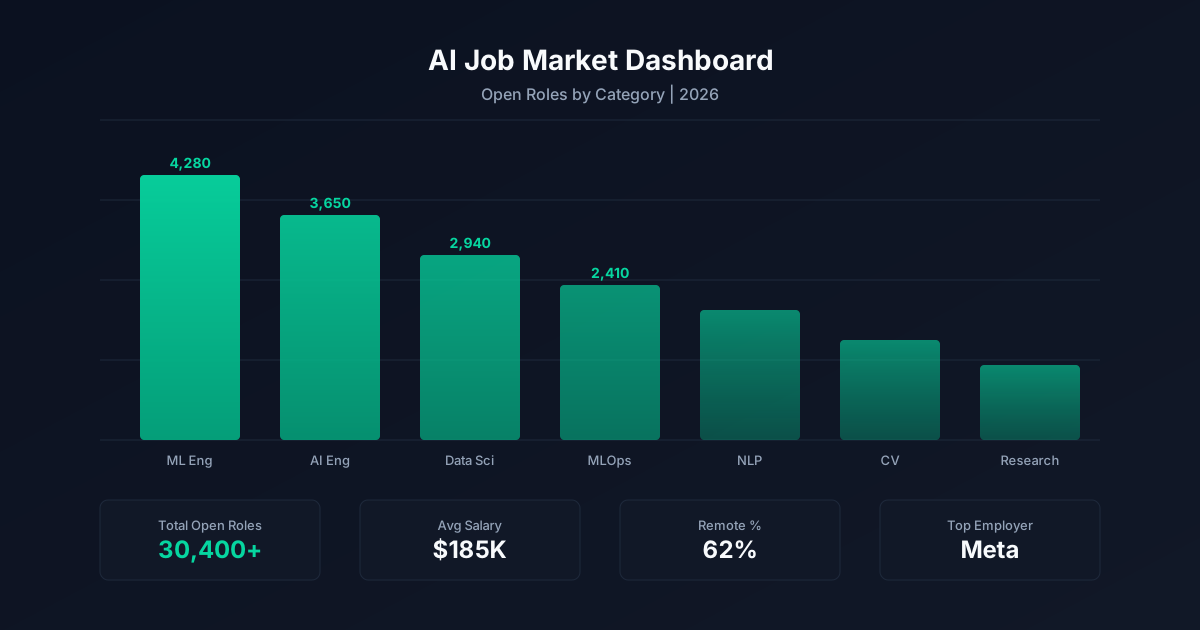
The AI job market spans 3,708 open positions across 16 role categories. The largest categories by volume: AI/ML Engineer (2,605), Data Scientist (310), AI Software Engineer (259). These three account for the majority of open positions, though smaller categories often have higher per-role compensation because of specialized skill requirements.
The seniority mix tells a story about where AI teams are in their maturity. Entry-level roles (102) are outnumbered by mid-level (1,705) and senior (1,469) positions, reflecting that most companies are past the 'build a team from scratch' phase and need experienced engineers who can ship production systems. Leadership roles (Director, VP, C-Level) total 432 positions, representing the bottleneck between technical execution and organizational strategy.
Remote work availability sits at 14% of all AI roles (508 positions), with 3,180 requiring on-site or hybrid attendance. The remote share has stabilized after the post-pandemic correction. Senior and specialized roles (Research Scientist, ML Architect) are more likely to be remote-eligible than entry-level positions, partly because experienced hires have more negotiating power and partly because these roles require less hands-on mentorship.
AI compensation is structured in clear tiers. The market median sits at $217,500. Top-quartile roles start at $272,100, and the 90th percentile reaches $325,000. These figures include base salary with disclosed compensation. Total compensation (including equity, bonuses, and sign-on) runs 20-40% higher at companies that offer those components.
Category matters for compensation. AI Safety roles lead at $300,000 median, while Prompt Engineer roles sit at $140,000. The spread between highest and lowest-paying categories reflects the premium on specialized technical skills versus broader analytical roles.
The most in-demand skills across all AI postings: Python (1,890 postings), Aws (1,103 postings), Azure (877 postings), Rag (855 postings), Gcp (631 postings), Prompt Engineering (560 postings), Pytorch (545 postings), Claude (498 postings). Python dominates, appearing in the vast majority of role descriptions regardless of category. Cloud platform experience (AWS, GCP, Azure) is the second most common requirement. The newer entrants to the top skills list (RAG, vector databases, LLM APIs) reflect the shift from traditional ML toward generative AI applications.
Frequently Asked Questions
Get Weekly AI Career Intelligence
Salary data, skills demand, and market signals from 16,000+ AI job postings. Every Monday.