
Interested in this Research Engineer role at Cisco?
Apply Now →Skills & Technologies
About This Role
The application window is expected to close on: 07/21/2026Job posting may be removed earlier if the position is filled or if a sufficient number of applications are received.
Meet the Team
Our security team is dynamic, hardworking, fun, and high\-energy, but the work is done in a very casual environment that strongly encourages a work/life balance. Not only will you work alongside a team of skilled security researchers with a diverse spectrum of talents and experience levels, but you will also be interacting with a variety of engineering teams across Cisco. Cisco ASIG cultivates an environment where every individual's input and experience is valued. We prioritize training sessions and a mentor program surrounding you with the resources you will need to succeed.
Your Impact
As a team member of Cisco's Advanced Security Initiatives Group (ASIG), you will evaluate our global products and services to identify security vulnerabilities, weaknesses, and improvements.
- Learn to adopt an attacker mentality using tools, techniques, and processes that emulate real\-world adversaries.
- Work with amazingly creative, innovative, and collaborative security researchers to develop evolving ethical hacking skills and networking product knowledge.
- Partner with Cisco's industry\-leading engineering teams to assess the latest system and application architectures, contribute to creative security solutions, and gain unparalleled access to and experience with the latest technologies.
- Opportunities to research security topics independently or collaboratively to explore and develop tools and ideas as part of our"Free Frida" innovation and incubation process.
Minimum Qualifications
- 2\+ years of software engineering experience with C, C\+\+, Perl, Raku and Python/Ruby, with experience in secure coding/development and code analysis for vulnerabilities
- 2\+ years of experience with network protocols through implementation or analysis
- 2\+ years of security testing experience, including areas like web applications, APIs, user interfaces, and embedded devices
- 2\+ years of BSD Unix experience with an intermediate understanding of security hardening configurations and capabilities
- Experience with operating system concepts in the areas of memory management, computer architecture, or binary analysis
Preferred Qualifications
- 2\+ years of experience with applied crypto, through implementation or analysis of crypto algorithms
- 2\+ years of experience as a DevOps engineer, with a focus on DevOps security
- OSCP or other industry certifications are a plus
- Secure development practices
- Security of virtualization platforms and techniques
Why Cisco?
At Cisco, we’re revolutionizing how data and infrastructure connect and protect organizations in the AI era – and beyond. We’ve been innovating fearlessly for 40 years to create solutions that power how humans and technology work together across the physical and digital worlds. These solutions provide customers with unparalleled security, visibility, and insights across the entire digital footprint.
Fueled by the depth and breadth of our technology, we experiment and create meaningful solutions. Add to that our worldwide network of doers and experts, and you’ll see that the opportunities to grow and build are limitless. We work as a team, collaborating with empathy to make really big things happen on a global scale. Because our solutions are everywhere, our impact is everywhere.
We are Cisco, and our power starts with you.
Message to applicants applying to work in the U.S. and/or Canada:
The starting salary range posted for this position is $101,500\.00 to $144,500\.00 and reflects the projected salary range for new hires in this position in U.S. and/or Canada locations, not including incentive compensation\*, equity, or benefits.
Individual pay is determined by the candidate's hiring location, market conditions, job\-related skillset, experience, qualifications, education, certifications, and/or training. The full salary range for certain locations is listed below. For locations not listed below, the recruiter can share more details about compensation for the role in your location during the hiring process.
U.S. employees are offered benefits, subject to Cisco’s plan eligibility rules, which include medical, dental and vision insurance, a 401(k) plan with a Cisco matching contribution, paid parental leave, short and long\-term disability coverage, and basic life insurance. Please see the Cisco careers site to discover more benefits and perks. Employees may be eligible to receive grants of Cisco restricted stock units, which vest following continued employment with Cisco for defined periods of time.
U.S. employees are eligible for paid time away as described below, subject to Cisco’s policies:
- 10 paid holidays per full calendar year, plus 1 floating holiday for non\-exempt employees
- 1 paid day off for employee’s birthday, paid year\-end holiday shutdown, and 4 paid days off for personal wellness determined by Cisco
- Non\-exempt employees\*\* receive 16 days of paid vacation time per full calendar year, accrued at rate of 4\.92 hours per pay period for full\-time employees
- Exempt employees participate in Cisco’s flexible vacation time off program, which has no defined limit on how much vacation time eligible employees may use (subject to availability and some business limitations)
- 80 hours of sick time off provided on hire date and each January 1st thereafter, and up to 80 hours of unused sick time carried forward from one calendar year to the next
- Additional paid time away may be requested to deal with critical or emergency issues for family members
- Optional 10 paid days per full calendar year to volunteer
For non\-sales roles, employees are also eligible to earn annual bonuses subject to Cisco’s policies.
Employees on sales plans earn performance\-based incentive pay on top of their base salary, which is split between quota and non\-quota components, subject to the applicable Cisco plan. For quota\-based incentive pay, Cisco typically pays as follows:
- .75% of incentive target for each 1% of revenue attainment up to 50% of quota;
- 1\.5% of incentive target for each 1% of attainment between 50% and 75%;
- 1% of incentive target for each 1% of attainment between 75% and 100%; and
- Once performance exceeds 100% attainment, incentive rates are at or above 1% for each 1% of attainment with no cap on incentive compensation.
For non\-quota\-based sales performance elements such as strategic sales objectives, Cisco may pay 0% up to 125% of target. Cisco sales plans do not have a minimum threshold of performance for sales incentive compensation to be paid.
The applicable full salary ranges for this position, by specific state, are listed below:
New York City Metro Area:
$123,600\.00 \- $200,100\.00
Non\-Metro New York state\& Washington state:
$109,900\.00 \- $181,600\.00
- For quota\-based sales roles on Cisco’s sales plan, the ranges provided in this posting include base pay and sales target incentive compensation combined.
\*\* Employees in Illinois, whether exempt or non\-exempt, will participate in a unique time off program to meet local requirements.
Salary Context
This $101K-$200K range is below the median for Research Engineer roles in our dataset (median: $188K across 44 roles with salary data).
View full Research Engineer salary data →Role Details
About This Role
Research Engineers bridge the gap between research and production. They implement papers, build experiment infrastructure, optimize training pipelines, and make research prototypes production-ready. They're the engineers who make research work at scale.
The role sits at a unique intersection. You need to understand the math well enough to implement novel architectures correctly, and you need the engineering chops to make them run efficiently on distributed systems. When a research scientist has a breakthrough idea, you're the person who turns it from a notebook prototype into a training pipeline that runs on 256 GPUs.
Across the 3,708 AI roles we're tracking, Research Engineer positions make up 2% of the market. At Cisco, this role fits into their broader AI and engineering organization.
Research Engineer roles are growing as AI labs recognize that research velocity depends on engineering quality. The role is less competitive than Research Scientist (no PhD required), but the bar for engineering skill is very high. These roles are concentrated at major labs and well-funded startups.
What the Work Looks Like
A typical week involves: implementing a new attention mechanism from a recent paper, profiling and optimizing a training pipeline that's bottlenecked on data loading, building evaluation infrastructure for a new benchmark, debugging distributed training issues across a GPU cluster, and pair-programming with a research scientist on their latest experiment. The work is deeply technical.
Research Engineer roles are growing as AI labs recognize that research velocity depends on engineering quality. The role is less competitive than Research Scientist (no PhD required), but the bar for engineering skill is very high. These roles are concentrated at major labs and well-funded startups.
Skills Required
Strong software engineering fundamentals plus ML knowledge. Python, C++, and CUDA experience are common requirements. You'll need to read papers and turn ideas into working code. Distributed systems experience (especially distributed training) is highly valued. Performance optimization skills separate great candidates from good ones.
Experience with large-scale training infrastructure (FSDP, DeepSpeed, Megatron), GPU programming (CUDA, Triton), and the internals of ML frameworks (PyTorch internals, custom autograd functions) is what makes candidates stand out. The best research engineers can debug issues that span the full stack from GPU memory management to numerical precision to algorithmic correctness.
Strong postings mention the team's recent research, the infrastructure scale, and the specific technical challenges. They often list the research areas you'd support. Look for roles that emphasize both implementation quality and research understanding.
Compensation Benchmarks
Research Engineer roles pay a median of $280,000 based on 147 positions with disclosed compensation. Mid-level AI roles across all categories have a median of $200,000. This role's midpoint ($150K) sits 46% below the category median. Disclosed range: $101K to $200K.
Across all AI roles, the market median is $217,500. Top-quartile compensation starts at $272,100. The 90th percentile reaches $325,000. For comparison, the highest-paying categories include AI Safety ($300,000) and AI Architect ($254,798). By seniority level: Entry: $120,000; Mid: $200,000; Senior: $230,000; Director: $272,150; VP: $250,000.
Cisco AI Hiring
Cisco has 11 open AI roles right now. They're hiring across AI Software Engineer, Research Engineer, AI/ML Engineer. Positions span Research Triangle Park, NC, US, Milpitas, CA, US, San Francisco, CA, US. Compensation range: $200K - $505K.
Location Context
AI roles in Denver pay a median of $201,050 across 48 tracked positions. That's 8% below the national median.
Career Path
Common paths into Research Engineer roles include Software Engineer, ML Engineer, Research Intern.
From here, career progression typically leads toward Senior Research Engineer, Research Scientist, ML Architect.
This is one of the best entry points into AI research without a PhD. Build a strong engineering portfolio with ML projects, contribute to open-source ML frameworks, and demonstrate that you can implement complex ideas correctly and efficiently. The transition to Research Scientist is possible with published first-author work, which some research engineer roles support.
What to Expect in Interviews
Technical screens test both engineering skill and research understanding. Expect coding rounds with performance-critical implementations (GPU optimization, efficient data loading). Be prepared to discuss papers relevant to the team's research area and explain how you'd implement key ideas. System design questions focus on training infrastructure: distributed training, experiment tracking, and compute resource management.
When evaluating opportunities: Strong postings mention the team's recent research, the infrastructure scale, and the specific technical challenges. They often list the research areas you'd support. Look for roles that emphasize both implementation quality and research understanding.
AI Hiring Overview
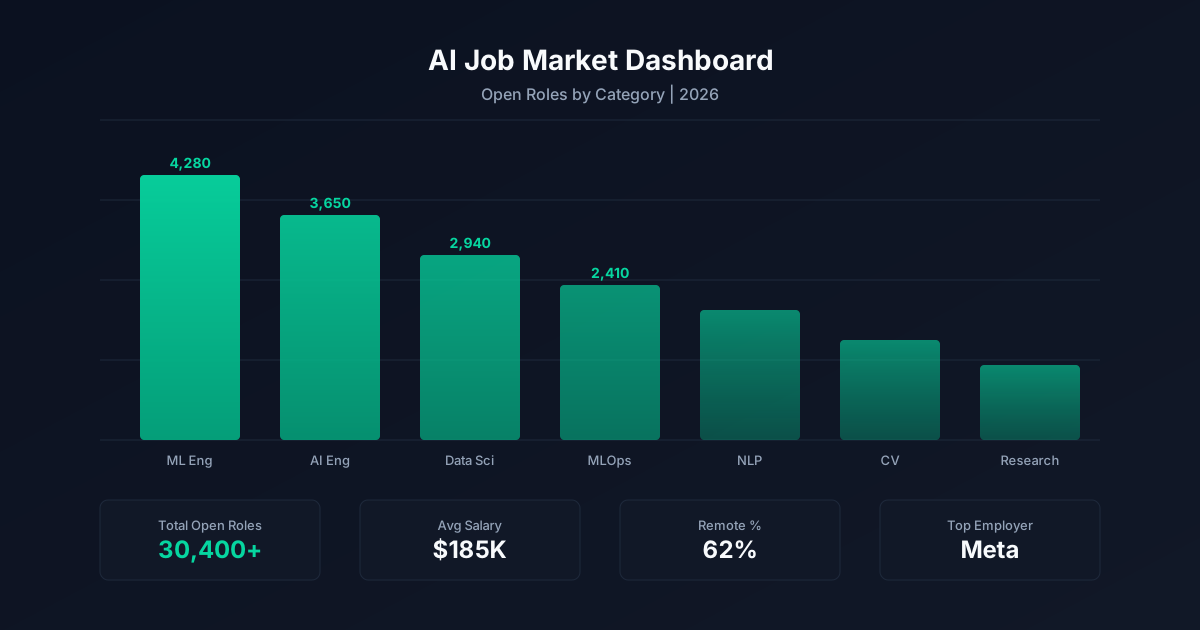
The AI job market has 3,708 open positions tracked in our dataset. By seniority: 102 entry-level, 1,705 mid-level, 1,469 senior, and 432 leadership roles (Director, VP, C-Level). Remote roles make up 14% of the market (508 positions). The remaining 3,180 roles require on-site or hybrid attendance.
The market median for AI roles is $217,500. Top-quartile compensation starts at $272,100. The 90th percentile reaches $325,000. Highest-paying categories: AI Safety ($300,000 median, 21 roles); Research Engineer ($280,000 median, 147 roles); AI Architect ($254,798 median, 67 roles).
Research Engineer roles are growing as AI labs recognize that research velocity depends on engineering quality. The role is less competitive than Research Scientist (no PhD required), but the bar for engineering skill is very high. These roles are concentrated at major labs and well-funded startups.
The AI Job Market Today
The AI job market spans 3,708 open positions across 16 role categories. The largest categories by volume: AI/ML Engineer (2,605), Data Scientist (310), AI Software Engineer (259). These three account for the majority of open positions, though smaller categories often have higher per-role compensation because of specialized skill requirements.
The seniority mix tells a story about where AI teams are in their maturity. Entry-level roles (102) are outnumbered by mid-level (1,705) and senior (1,469) positions, reflecting that most companies are past the 'build a team from scratch' phase and need experienced engineers who can ship production systems. Leadership roles (Director, VP, C-Level) total 432 positions, representing the bottleneck between technical execution and organizational strategy.
Remote work availability sits at 14% of all AI roles (508 positions), with 3,180 requiring on-site or hybrid attendance. The remote share has stabilized after the post-pandemic correction. Senior and specialized roles (Research Scientist, ML Architect) are more likely to be remote-eligible than entry-level positions, partly because experienced hires have more negotiating power and partly because these roles require less hands-on mentorship.
AI compensation is structured in clear tiers. The market median sits at $217,500. Top-quartile roles start at $272,100, and the 90th percentile reaches $325,000. These figures include base salary with disclosed compensation. Total compensation (including equity, bonuses, and sign-on) runs 20-40% higher at companies that offer those components.
Category matters for compensation. AI Safety roles lead at $300,000 median, while Prompt Engineer roles sit at $140,000. The spread between highest and lowest-paying categories reflects the premium on specialized technical skills versus broader analytical roles.
The most in-demand skills across all AI postings: Python (1,890 postings), Aws (1,103 postings), Azure (877 postings), Rag (855 postings), Gcp (631 postings), Prompt Engineering (560 postings), Pytorch (545 postings), Claude (498 postings). Python dominates, appearing in the vast majority of role descriptions regardless of category. Cloud platform experience (AWS, GCP, Azure) is the second most common requirement. The newer entrants to the top skills list (RAG, vector databases, LLM APIs) reflect the shift from traditional ML toward generative AI applications.
Frequently Asked Questions
Get Weekly AI Career Intelligence
Salary data, skills demand, and market signals from 16,000+ AI job postings. Every Monday.