
Interested in this AI/ML Engineer role at Cornell University?
Apply Now →Skills & Technologies
About This Role
### AI Engineer (Temporary)
APPLY
This position is a hybrid position, position responsibilities are a combination of those performed remotely and those performed in person on the Cornell University Campus in Ithaca, New York.
No Visa sponsorship available for this position.
What is Cornell University and what is Information Technology @ Cornell?
Cornell University, unique among peers, is the federal land\-grant institution of New York State, a private endowed university, and a member of the Ivy League. Information technologies (IT) is a strategic enabler for many functions at Cornell. Check out this link to find out more about IT Cornell.
The AI Strategy, Enablement, and Innovation team works closely with faculty, staff, students, and campus partners to build and support AI services. The team also is responsible for piloting emerging tools and platforms, guiding responsible use, and translating institutional needs into practical solutions. The team collaborates across a shared internal toolset that includes Jira, Teams, SharePoint, TDX, workflow automation platforms, LiteLLM, GitHub, Confluence, and Outlook. The team's work spans platform access and support, semester\-long projects, consulting engagements, internal tools, and training and enablement, following a structured lifecycle from intake and triage through kickoff, sprint cycles, demo and review, and offboarding/handoff to ensure continuity, quality, and responsible delivery.
What will you do:
The AI Engineer (Temporary) will be an integral part of Cornell University’s AI Program, a pioneering initiative that harnesses the power of generative AI to address real\-world challenges critical to the university's mission. Reporting to the Program Manager, this position will work at the intersection of cutting\-edge AI technologies and practical implementation, building bespoke solutions that empower university departments, faculty, and students to optimize their workflows, improve decision\-making, and unlock new opportunities for innovation. The position combines technical excellence with user\-focused development to ensure AI solutions enhance equity, accessibility, and transparency, reinforcing Cornell’s commitment to fostering inclusion and innovation across its campus.
The position will not only collaborate on transformative projects but also shape how higher education harnesses AI to do the greatest good. This is a unique opportunity to engage in high\-priority, high\-impact projects while shaping how AI transforms higher education in the years to come.
As an individual contributor you will model and support a culture of inclusion, belonging, and wellbeing and continually seek to understand how your role, behaviors, and actions impact the success of this culture.
While position responsibilities vary greatly, the Skills for Success and Leadership Skills for Success are foundational to what is expected of every employee and leader working at Cornell. These skills are essential for individual and organizational success. Staff Skills for Success; Leadership Skills for Success. Additionally, every member of our community is expected to foster a culture of belonging and a healthy work environment by communicating across differences; being cooperative, collaborative, open, and welcoming; showing respect, compassion, and empathy; engaging and supporting others regardless of background or perspective; speaking up when others are being excluded or treated inappropriately; and supporting work/life integration of oneself and others.
This role will be responsible for:
- Leveraging AI to tackle challenges such as improving academic advising processes, designing dynamic learning tools, enhancing operational efficiency, and scaling administrative tasks.
- Working on highly visible projects, from creating AI\-driven dashboards for personalized student advising to developing natural language processing (NLP) based tools that streamline faculty research searches for media inquiries.
- Collaborating closely with stakeholders across the university, including faculty, researchers, staff, and students, focusing on both immediate problem\-solving and long\-term innovation.
- Serves as Tech Lead for selected projects, translating stakeholder needs into clear, buildable solutions; facilitating sprint\-based work; supporting student engagement where applicable; and contributing to internal operational tools and offboarding documentation.
- Manages AI\-related service workflows in TDX, supports access provisioning and ticket triage, builds automation for repeatable processes, and helps deliver consultations, AI Exploration sessions, onboarding materials, guides, and reusable knowledge resources.
Note: This position is a one (1\) year temporary position with benefits, which may be ended or extended based on organizational needs, funding availability and performance.
The salary range for this temporary role is $85,000 to $95,000, based on experience
Required qualifications include:
- Bachelor’s degree in Computer Science, Information Science, or related field, with at least 1 year of relevant experience or equivalent combination of education and experience.
- Proficiency in using Python, AI APIs (OpenAI, Anthropic, Gemini, etc.), machine learning algorithms, and software development frameworks.
- Familiarity with building agentic solutions using frameworks/tools such as workflow automation platforms, agentic coding tools (Claude Code), LangChain, LangGraph, Agents SDK, etc.
- Strong understanding of advanced AI models and architectures, including generative AI models (including LLMs).
- Practical experience in deploying AI apps to production, including containerization technologies such as Docker.
- Familiarity with modern cloud platforms (AWS, GCP, Azure), MLOps pipelines, and version control (Git) to support scalable AI workflows.
- Proven ability to distill complex organizational needs into robust AI solutions.
- Experience addressing real\-world challenges using AI, ideally in academic, research, or collaborative environments.
- Strong written and verbal communication skills, with the ability to explain technical concepts to non\-technical audiences.
- Proactive stakeholder engagement skills to refine project goals and ensure user\-focused solution development.
- Demonstrated commitment to ethical AI practices, ensuring that AI tools are implemented responsibly.
- Ability to cultivate and develop inclusive working relationships with students, faculty, staff, and community members.
- Sound judgment about data risk, permissions, and architectural constraints, and the ability to communicate tradeoffs clearly while aligning work with Cornell\-approved platforms and responsible AI practices.
- A passion for translating cutting edge AI into real world solutions within a vibrant academic community.
Preferred qualifications include:
- Master’s Degree.
- Experience building conversational agents or other generative AI applications in higher education or similar environments.
- Proficiency in relational, non\-relational, or graph databases.
- Familiarity using frameworks such as TensorFlow, PyTorch, and Hugging Face.
- Familiarity with academic workflows, from course management to research collaboration tools.
- Prior contributions to academic publications, open\-source projects, or AI community initiatives.
University Job Title:
Temporary Programmer/Analyst Job Family:
Temporary Information Technology Level:
No Grade \- Annual Pay Rate Type:
Salary Pay Range:
Refer to Posting Language Remote Option Availability:
Hybrid Company:
Contact Name:
Susie Jackson Contact Email:
[email protected] Job Titles and Pay Ranges:
Non\-Union Positions
Noted pay ranges reflect the potential pay opportunity for each job profile. The hiring rate of pay for the successful candidate will be determined considering the following criteria:
- Prior relevant work or industry experience
- Education level to the extent education is relevant to the position
- Unique applicable skills
- Academic Discipline
To learn more about Cornell’s non\-union staff job titles and pay ranges, see Career Navigator.
Union Positions
The hiring rate of pay for the successful candidate will be determined in accordance with the rates in the respective collective bargaining agreement. To learn more about Cornell’s union wages, see Union Pay Rates.
Current Employees:
If you currently work at Cornell University, please exit this website and log in to Workday using your Net ID and password. Select the Career icon on your Home dashboard to view jobs at Cornell.
Online Submission Guidelines:
Most positions at Cornell will require you to apply online and submit both a resume/CV and cover letter. You can upload documents either by “dragging and dropping” them into the dropbox or by using the “upload” icon on the application page. For more detailed instructions on how to apply to a job at Cornell, visit How We Hire on the HR website.
Employment Assistance:
For general questions about the position or the application process, please contact the Recruiter listed in the job posting or email [email protected].
If you require an accommodation for a disability in order to complete an employment application or to participate in the recruiting process, you are encouraged to contact Cornell Office of Civil Rights at voice (607\) 255\-2242, or email at [email protected].
Applicants that do not have internet access are encouraged to visit your local library, or local Department of Labor. You may also request an appointment to use a dedicated workstation in the Office of Talent Attraction and Recruitment, at the Ithaca campus, by emailing [email protected].
Notice to Applicants:
Please read the required Notice to Applicants statement by clicking here. This notice contains important information about applying for a position at Cornell as well as some of your rights and responsibilities as an applicant.
EEO Statement:
Cornell welcomes students, faculty, and staff with diverse backgrounds from across the globe to pursue world\-class education and career opportunities, to further the founding principle of “... any person ... any study.” No person shall be denied employment on the basis of any legally protected status or subjected to prohibited discrimination involving, but not limited to, such factors as race, ethnic or national origin, citizenship and immigration status, color, sex, pregnancy or pregnancy\-related conditions, age, creed, religion, actual or perceived disability (including persons associated with such a person), arrest and/or conviction record, military or veteran status, sexual orientation, gender expression and/or identity, an individual’s genetic information, domestic violence victim status, familial status, marital status, or any other characteristic protected by applicable federal, state, or local law.
Cornell University embraces diversity in its workforce and seeks job candidates who will contribute to a climate that supports students, faculty, and staff of all identities and backgrounds. We hire based on merit, and encourage people from historically underrepresented and/or marginalized identities to apply. Consistent with federal law, Cornell engages in affirmative action in employment for qualified protected veterans as defined in the Vietnam Era Veterans’ Readjustment Assistance Act (VEVRAA) and qualified individuals with disabilities under Section 503 of the Rehabilitation Act. We also recognize a lawful preference in employment practices for Native Americans living on or near Indian reservations in accordance with applicable law.
2026\-07\-20
### About Us
Cornell University is an innovative Ivy League university and a great place to work. Our inclusive community of scholars, students and staff impart an uncommon sense of larger purpose and contribute creative ideas to further the university's mission of teaching, discovery and engagement. With our main campus located in Ithaca, NY, Cornell's far\-flung global presence includes the medical college's campuses on the Upper East Side of Manhattan and Doha, Qatar, as well as the Cornell Tech campus located on Roosevelt Island in the heart of New York City.
We offer a rich array of services, programs and benefits to help employees advance in their career and enhance the quality of personal life, including: employee wellness, workshops, childcare and adoption assistance, parental leave, flexible work options.
Salary Context
This $85K-$95K range is in the lower quartile for AI/ML Engineer roles in our dataset (median: $180K across 1841 roles with salary data).
View full AI/ML Engineer salary data →Role Details
About This Role
AI/ML Engineers build and deploy machine learning models in production. They work across the full ML lifecycle: data pipelines, model training, evaluation, and serving infrastructure. The role has evolved significantly over the past two years. Where ML Engineers once spent most of their time on model architecture, the job now tilts heavily toward inference optimization, cost management, and integrating LLM capabilities into existing systems. Companies want engineers who can ship production systems, and the experimenter-only role is fading fast.
Day-to-day, you're writing training pipelines, debugging data quality issues, setting up evaluation frameworks, and figuring out why your model performs differently in staging than it did on your dev set. The best ML engineers are obsessive about reproducibility and measurement. They instrument everything. They know that a model is only as good as the data feeding it and the infrastructure serving it.
Across the 3,708 AI roles we're tracking, AI/ML Engineer positions make up 70% of the market. At Cornell University, this role fits into their broader AI and engineering organization.
Demand for AI/ML Engineers has been strong and consistent. Unlike some AI roles that spike with hype cycles, ML engineering is a foundational need. Every company deploying AI models needs people who can keep them running, and the gap between research prototypes and production systems keeps growing.
What the Work Looks Like
A typical week might include: debugging a data pipeline that's silently dropping 3% of training examples, running A/B tests on a new model version, writing documentation for a feature flag system that lets you roll back model deployments, and reviewing a junior engineer's PR for a new evaluation metric. Meetings tend to be cross-functional since ML touches product, engineering, and data teams.
Demand for AI/ML Engineers has been strong and consistent. Unlike some AI roles that spike with hype cycles, ML engineering is a foundational need. Every company deploying AI models needs people who can keep them running, and the gap between research prototypes and production systems keeps growing.
Skills Required
Python and PyTorch dominate the requirements. Most roles expect experience with cloud platforms (AWS, GCP, or Azure) and familiarity with ML frameworks like TensorFlow or JAX. RAG (Retrieval-Augmented Generation) has become a top-3 skill requirement as companies integrate LLMs into their products. Docker and Kubernetes show up in about a third of postings, reflecting the production focus of the role.
Beyond the core stack, employers increasingly want experience with experiment tracking tools (MLflow, Weights & Biases), feature stores, and vector databases. Fine-tuning experience is valuable but less common than you'd think from reading Twitter. Most production LLM work is RAG and prompt engineering, not fine-tuning. If you have both, you're in a strong position.
Companies that are serious about AI/ML hiring tend to post specific infrastructure details in the job description: the frameworks they use, their model serving stack, their data pipeline tools. Vague postings that just say 'ML experience required' without specifics are often companies that haven't figured out what they need yet.
Compensation Benchmarks
AI/ML Engineer roles pay a median of $218,750 based on 3,817 positions with disclosed compensation. Mid-level AI roles across all categories have a median of $200,000. This role's midpoint ($90K) sits 59% below the category median. Disclosed range: $85K to $95K.
Across all AI roles, the market median is $217,500. Top-quartile compensation starts at $272,100. The 90th percentile reaches $325,000. For comparison, the highest-paying categories include AI Safety ($300,000) and Research Engineer ($280,000). By seniority level: Entry: $120,000; Mid: $200,000; Senior: $230,000; Director: $272,150; VP: $250,000.
Cornell University AI Hiring
Cornell University has 1 open AI role right now. They're hiring across AI/ML Engineer. Based in Ithaca, NY, US. Compensation range: $95K - $95K.
Location Context
Across all AI roles, 14% (508 positions) offer remote work, while 3,180 require on-site attendance. Top AI hiring metros: New York (1,045 roles, $220,000 median); San Francisco (810 roles, $277,088 median); Los Angeles (397 roles, $215,000 median).
Career Path
Common paths into AI/ML Engineer roles include Data Scientist, Software Engineer, Research Engineer.
From here, career progression typically leads toward ML Architect, AI Engineering Manager, Principal ML Engineer.
The fastest path into ML engineering is through software engineering with a self-directed ML education. A CS degree helps, but production engineering skills matter more than academic credentials. Build something that works, deploy it, and measure it. That portfolio project is worth more than a Coursera certificate. For career growth, the fork comes around the senior level: go deep on technical complexity (staff/principal track) or move into managing ML teams.
What to Expect in Interviews
Expect system design questions around ML pipelines: how you'd build a training pipeline for a specific use case, handle data drift, or design A/B testing infrastructure for model deployments. Coding rounds typically involve Python, with emphasis on data manipulation (pandas, numpy) and algorithm implementation. Take-home assignments often ask you to build an end-to-end ML pipeline from raw data to deployed model.
When evaluating opportunities: Companies that are serious about AI/ML hiring tend to post specific infrastructure details in the job description: the frameworks they use, their model serving stack, their data pipeline tools. Vague postings that just say 'ML experience required' without specifics are often companies that haven't figured out what they need yet.
AI Hiring Overview
The AI job market has 3,708 open positions tracked in our dataset. By seniority: 102 entry-level, 1,705 mid-level, 1,469 senior, and 432 leadership roles (Director, VP, C-Level). Remote roles make up 14% of the market (508 positions). The remaining 3,180 roles require on-site or hybrid attendance.
The market median for AI roles is $217,500. Top-quartile compensation starts at $272,100. The 90th percentile reaches $325,000. Highest-paying categories: AI Safety ($300,000 median, 21 roles); Research Engineer ($280,000 median, 147 roles); AI Architect ($254,798 median, 67 roles).
Demand for AI/ML Engineers has been strong and consistent. Unlike some AI roles that spike with hype cycles, ML engineering is a foundational need. Every company deploying AI models needs people who can keep them running, and the gap between research prototypes and production systems keeps growing.
The AI Job Market Today
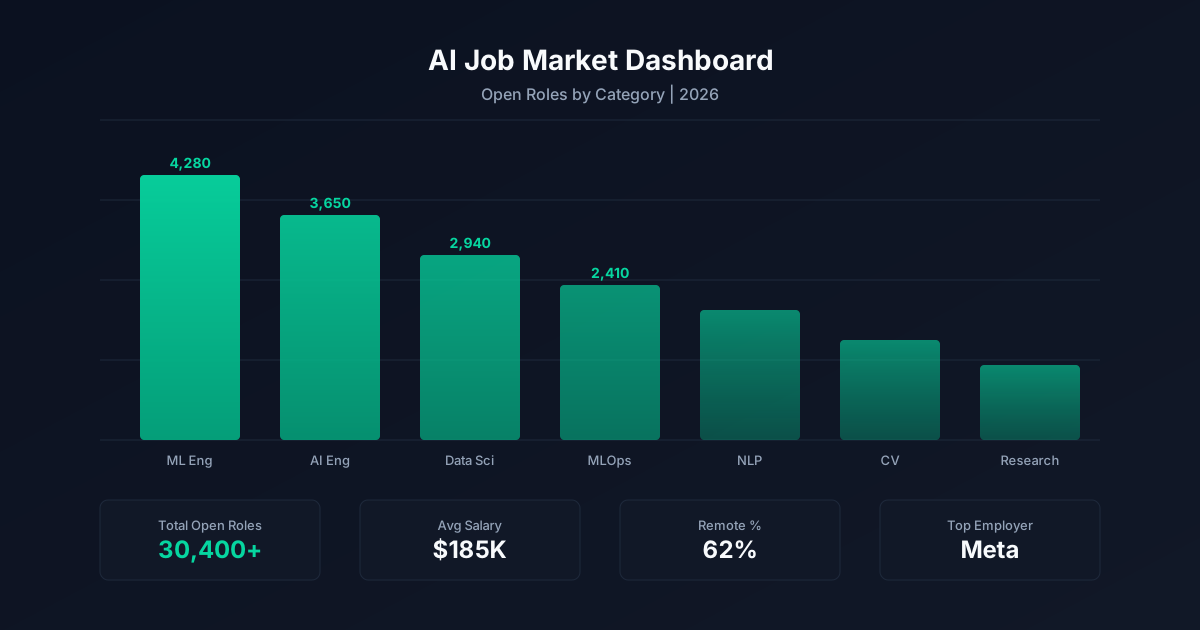
The AI job market spans 3,708 open positions across 16 role categories. The largest categories by volume: AI/ML Engineer (2,605), Data Scientist (310), AI Software Engineer (259). These three account for the majority of open positions, though smaller categories often have higher per-role compensation because of specialized skill requirements.
The seniority mix tells a story about where AI teams are in their maturity. Entry-level roles (102) are outnumbered by mid-level (1,705) and senior (1,469) positions, reflecting that most companies are past the 'build a team from scratch' phase and need experienced engineers who can ship production systems. Leadership roles (Director, VP, C-Level) total 432 positions, representing the bottleneck between technical execution and organizational strategy.
Remote work availability sits at 14% of all AI roles (508 positions), with 3,180 requiring on-site or hybrid attendance. The remote share has stabilized after the post-pandemic correction. Senior and specialized roles (Research Scientist, ML Architect) are more likely to be remote-eligible than entry-level positions, partly because experienced hires have more negotiating power and partly because these roles require less hands-on mentorship.
AI compensation is structured in clear tiers. The market median sits at $217,500. Top-quartile roles start at $272,100, and the 90th percentile reaches $325,000. These figures include base salary with disclosed compensation. Total compensation (including equity, bonuses, and sign-on) runs 20-40% higher at companies that offer those components.
Category matters for compensation. AI Safety roles lead at $300,000 median, while Prompt Engineer roles sit at $140,000. The spread between highest and lowest-paying categories reflects the premium on specialized technical skills versus broader analytical roles.
The most in-demand skills across all AI postings: Python (1,890 postings), Aws (1,103 postings), Azure (877 postings), Rag (855 postings), Gcp (631 postings), Prompt Engineering (560 postings), Pytorch (545 postings), Claude (498 postings). Python dominates, appearing in the vast majority of role descriptions regardless of category. Cloud platform experience (AWS, GCP, Azure) is the second most common requirement. The newer entrants to the top skills list (RAG, vector databases, LLM APIs) reflect the shift from traditional ML toward generative AI applications.
Frequently Asked Questions
Get Weekly AI Career Intelligence
Salary data, skills demand, and market signals from 16,000+ AI job postings. Every Monday.