
Interested in this AI/ML Engineer role at d-Matrix?
Apply Now →Skills & Technologies
About This Role
At d\-Matrix, we are focused on unleashing the potential of generative AI to power the transformation of technology. We are at the forefront of software and hardware innovation, pushing the boundaries of what is possible. Our culture is one of respect and collaboration.
We value humility and believe in direct communication. Our team is inclusive, and our differing perspectives allow for better solutions. We are seeking individuals passionate about tackling challenges and are driven by execution. Ready to come find your playground? Together, we can help shape the endless possibilities of AI.
Director, Site Reliability Engineering \- AI Accelerator Infrastructure \- Contract
About d\-Matrix
d\-Matrix designs and manufactures purpose\-built AI inference silicon. Our engineering organization spans silicon, software, hardware, QA, and research, and the infrastructure that underpins all of it must be as reliable and scalable as the chips we build.
We compete directly with Nvidia for engineering talent and hold ourselves to the same bar—the infrastructure organization is no exception. The SRE team owns the physical and virtual infrastructure layer that the entire company — and our customers — depends on. This is a high\-ownership, high\-impact role where infrastructure is a competitive differentiator, not a commodity.
The Role: 6 month contract to full\-time conversion
You will build and lead d\-Matrix’s site reliability engineering function from the ground up—owning the infrastructure that development, validation, and customer\-facing deployments run on. This spans colocation facilities, on\-premises lab clusters, cloud environments (AWS, Azure, and GCP), and the platform services customers use to collaborate with d\-Matrix on hardware and software deployments.
You are a hands\-on engineering leader. You will establish SRE as a discipline at d\-Matrix; hire and grow the team; set the technical direction; own SLOs for critical systems; and be the senior escalation point when things go wrong—all in parallel. You will partner closely with the director of DevOps engineering, whose pipelines and automation run on the infrastructure you own, and work directly with hardware and software development teams to ensure HPC infrastructure meets their workload requirements.
Leadership is not a function you delegate. It is the job.
What You Will Do
Leadership \& Organizational Build\-Out
- Own the SRE function end\-to\-end: define the team’s charter, establish SRE as a discipline within d\-Matrix’s engineering culture, and drive buy\-in across hardware, software, and executive stakeholders who have operated without a dedicated SRE team.
- Hire, develop, and retain a team of 3–5 SRE engineers; establish a culture of operational excellence, ownership, and continuous improvement from day one.
- Define the SRE technical roadmap: reliability architecture, automation priorities, capacity planning, and on\-call model—and execute against it with your hands on the keyboard where needed.
- Serve as the senior technical escalation for critical incidents—guiding cross\-team triage, driving RCA, and ensuring systemic fixes rather than point patches.
- Translate operational signals and infrastructure health into clear, actionable narratives for engineering leadership and executive stakeholders.
- Partner with the director of DevOps engineering to align infrastructure reliability with pipeline and automation delivery; the two functions must operate as a unified platform.
- Direct a dedicated data center \& lab technician team—your hands and feet across on\-premises and colocation facilities; set their work priorities, establish operational standards, and ensure physical infrastructure execution aligns with the SRE technical roadmap.
Reliability \& Observability — Building From Scratch
- Establish SRE processes from a zero baseline: define SLIs and SLOs, build error budgets, design on\-call rotations, and create the incident management framework d\-Matrix currently lacks.
- Own 24×7 reliability across colocation, on\-premises lab clusters, cloud, and customer\-facing platform services — designing for failure domains, progressive delivery, and strict change control at every tier.
- Own the full observability stack (metrics, traces, and logs) and instrument it from the ground up—Prometheus, Grafana, and/or Datadog—with SLO visibility, alert design, and E2E signal quality.
- Evolve incident and problem management into a data\-driven discipline: automated triage workflows, pattern detection across recurring failures, and every P0/P1 producing a written RCA with tracked systemic fixes.
- Own FinOps and capacity planning as a unified discipline across all three infrastructure tiers—cloud (AWS, Azure, GCP), colocation, and on\-premises: establish spend visibility and attribution across every tier, model TCO comparatively, drive workload placement decisions based on cost and performance, and anticipate infrastructure needs for new silicon programs and customer deployments.
- Own the migration from ad hoc JBOD\-based storage and point\-in\-time snapshots to an enterprise\-grade shared storage platform spanning on\-premises, colocation, and cloud tiers—covering architecture, vendor selection, data protection design (snapshots, replication, DR), and integration with HPC workloads and development environments.
Automation \& Infrastructure as Code — Establishing the Baseline
There is no automation baseline today. You will build it.
- Drive IaC\-first discipline across the team—Terraform, Ansible, and production\-quality automation for all infrastructure provisioning and lifecycle management; this capability is currently absent, and you will establish it.
- Build self\-healing infrastructure platforms: host lifecycle automation, fleet auto\-remediation, and AIOps\-driven alerting that reduce manual intervention across the operational lifecycle.
- Instrument the team’s own development practices—runbooks, change governance, and deployment pipelines for infrastructure code—establishing standards that scale as the team grows.
Documentation \& Global Collaboration
- Build a documentation culture from scratch: runbooks, architecture diagrams, and operational playbooks maintained as living artifacts—not a one\-time project.
- Design and scale a follow\-the\-sun on\-call model as d\-Matrix expands globally; the framework you build now will be the foundation the team inherits.
- Drive POC and POV evaluations for new infrastructure technologies, interconnect fabrics, and platform services relevant to d\-Matrix’s accelerator roadmap.
What You Will Bring
Required
- Bachelor’s or Master’s in Computer Science, Electrical Engineering, or a related field; 15\+ years in SRE, infrastructure engineering, or production engineering.
- 5\+ years leading SRE or infrastructure engineering teams — including experience building or significantly rebuilding a function, not just managing a steady\-state team.
- Demonstrated track record of establishing SRE as a discipline in an organization that lacked it: defining SLOs, creating on\-call frameworks, standing up observability, and driving cultural change with engineering teams that came from a reactive ops background.
- Deep Linux systems expertise: networking (TCP/IP, RDMA, and bonding), kernel tuning, and bare\-metal operations; hands\-on experience with enterprise shared storage platforms (NAS/SAN, NFS/SMB at scale, and snapshot and replication architectures) and hybrid\-cloud storage integration across on\-prem and cloud tiers.
- Proven experience operating colocation and on\-premises hardware at scale: server lifecycle, power and cooling awareness, rack\-level networking.
- IaC fluency: Terraform and Ansible at production scale — module design, remote state, environment isolation, and change governance.
- Kubernetes cluster operations: lifecycle management, workload reliability, storage, and RBAC at scale.
- Full observability stack ownership: Prometheus, Grafana, and/or Datadog — SLO definition, alert design, and E2E signal quality.
- Strong Python and/or Go — production services, not just scripts; automation that touches real infrastructure safely.
- Executive communication: translating infrastructure health and operational risk into clear narratives for senior leadership, including stakeholders with no infrastructure background.
- Ability to operate in a high\-ambiguity, low\-process environment — you build the structure, you don’t inherit it.
Strongly Preferred
- Experience operating customer\-facing infrastructure or platform services—reliability expectations beyond internal tooling.
- Knowledge of high\-speed interconnect fabrics: InfiniBand, RoCE, or NVLink — setup, troubleshooting, and performance tuning.
- HPC job scheduler experience: Slurm, LSF, or equivalent — setup, tuning, and integration with infrastructure automation.
- Multi\-cloud hybrid operations: AWS, Azure, and GCP alongside on\-prem/colo—unified observability and IaC across all tiers.
- FinOps: cloud spend attribution, TCO modeling across cloud vs. on\-prem vs. colo, and translating cost data into workload placement recommendations.
- ITIL knowledge or equivalent structured incident/problem/change management framework.
- Published technical writing, conference talks, or open\-source contributions in reliability, observability, or HPC infrastructure.
Equal Opportunity Employment Policy
d\-Matrix is proud to be an equal opportunity workplace and affirmative action employer. We’re committed to fostering an inclusive environment where everyone feels welcomed and empowered to do their best work. We hire the best talent for our teams, regardless of race, religion, color, age, disability, sex, gender identity, sexual orientation, ancestry, genetic information, marital status, national origin, political affiliation, or veteran status. Our focus is on hiring teammates with humble expertise, kindness, dedication and a willingness to embrace challenges and learn together every day.
d\-Matrix does not accept resumes or candidate submissions from external agencies. We appreciate the interest and effort of recruitment firms, but we kindly request that individual interested in opportunities with d\-Matrix apply directly through our official channels. This approach allows us to streamline our hiring processes and maintain a consistent and fair evaluation of al applicants. Thank you for your understanding and cooperation.
Compensation Range: $195K \- $285K
Salary Context
This $195K-$285K range is above the 75th percentile for AI/ML Engineer roles in our dataset (median: $180K across 1841 roles with salary data).
View full AI/ML Engineer salary data →Role Details
About This Role
AI/ML Engineers build and deploy machine learning models in production. They work across the full ML lifecycle: data pipelines, model training, evaluation, and serving infrastructure. The role has evolved significantly over the past two years. Where ML Engineers once spent most of their time on model architecture, the job now tilts heavily toward inference optimization, cost management, and integrating LLM capabilities into existing systems. Companies want engineers who can ship production systems, and the experimenter-only role is fading fast.
Day-to-day, you're writing training pipelines, debugging data quality issues, setting up evaluation frameworks, and figuring out why your model performs differently in staging than it did on your dev set. The best ML engineers are obsessive about reproducibility and measurement. They instrument everything. They know that a model is only as good as the data feeding it and the infrastructure serving it.
Across the 3,708 AI roles we're tracking, AI/ML Engineer positions make up 70% of the market. At d-Matrix, this role fits into their broader AI and engineering organization.
Demand for AI/ML Engineers has been strong and consistent. Unlike some AI roles that spike with hype cycles, ML engineering is a foundational need. Every company deploying AI models needs people who can keep them running, and the gap between research prototypes and production systems keeps growing.
What the Work Looks Like
A typical week might include: debugging a data pipeline that's silently dropping 3% of training examples, running A/B tests on a new model version, writing documentation for a feature flag system that lets you roll back model deployments, and reviewing a junior engineer's PR for a new evaluation metric. Meetings tend to be cross-functional since ML touches product, engineering, and data teams.
Demand for AI/ML Engineers has been strong and consistent. Unlike some AI roles that spike with hype cycles, ML engineering is a foundational need. Every company deploying AI models needs people who can keep them running, and the gap between research prototypes and production systems keeps growing.
Skills Required
Python and PyTorch dominate the requirements. Most roles expect experience with cloud platforms (AWS, GCP, or Azure) and familiarity with ML frameworks like TensorFlow or JAX. RAG (Retrieval-Augmented Generation) has become a top-3 skill requirement as companies integrate LLMs into their products. Docker and Kubernetes show up in about a third of postings, reflecting the production focus of the role.
Beyond the core stack, employers increasingly want experience with experiment tracking tools (MLflow, Weights & Biases), feature stores, and vector databases. Fine-tuning experience is valuable but less common than you'd think from reading Twitter. Most production LLM work is RAG and prompt engineering, not fine-tuning. If you have both, you're in a strong position.
Companies that are serious about AI/ML hiring tend to post specific infrastructure details in the job description: the frameworks they use, their model serving stack, their data pipeline tools. Vague postings that just say 'ML experience required' without specifics are often companies that haven't figured out what they need yet.
Compensation Benchmarks
AI/ML Engineer roles pay a median of $218,750 based on 3,817 positions with disclosed compensation. Director-level AI roles across all categories have a median of $272,150. This role's midpoint ($240K) sits 10% above the category median. Disclosed range: $195K to $285K.
Across all AI roles, the market median is $217,500. Top-quartile compensation starts at $272,100. The 90th percentile reaches $325,000. For comparison, the highest-paying categories include AI Safety ($300,000) and Research Engineer ($280,000). By seniority level: Entry: $120,000; Mid: $200,000; Senior: $230,000; Director: $272,150; VP: $250,000.
d-Matrix AI Hiring
d-Matrix has 2 open AI roles right now. They're hiring across AI/ML Engineer. Based in Santa Clara, CA, US. Compensation range: $235K - $285K.
Location Context
Across all AI roles, 14% (508 positions) offer remote work, while 3,180 require on-site attendance. Top AI hiring metros: New York (1,045 roles, $220,000 median); San Francisco (810 roles, $277,088 median); Los Angeles (397 roles, $215,000 median).
Career Path
Common paths into AI/ML Engineer roles include Data Scientist, Software Engineer, Research Engineer.
From here, career progression typically leads toward ML Architect, AI Engineering Manager, Principal ML Engineer.
The fastest path into ML engineering is through software engineering with a self-directed ML education. A CS degree helps, but production engineering skills matter more than academic credentials. Build something that works, deploy it, and measure it. That portfolio project is worth more than a Coursera certificate. For career growth, the fork comes around the senior level: go deep on technical complexity (staff/principal track) or move into managing ML teams.
What to Expect in Interviews
Expect system design questions around ML pipelines: how you'd build a training pipeline for a specific use case, handle data drift, or design A/B testing infrastructure for model deployments. Coding rounds typically involve Python, with emphasis on data manipulation (pandas, numpy) and algorithm implementation. Take-home assignments often ask you to build an end-to-end ML pipeline from raw data to deployed model.
When evaluating opportunities: Companies that are serious about AI/ML hiring tend to post specific infrastructure details in the job description: the frameworks they use, their model serving stack, their data pipeline tools. Vague postings that just say 'ML experience required' without specifics are often companies that haven't figured out what they need yet.
AI Hiring Overview
The AI job market has 3,708 open positions tracked in our dataset. By seniority: 102 entry-level, 1,705 mid-level, 1,469 senior, and 432 leadership roles (Director, VP, C-Level). Remote roles make up 14% of the market (508 positions). The remaining 3,180 roles require on-site or hybrid attendance.
The market median for AI roles is $217,500. Top-quartile compensation starts at $272,100. The 90th percentile reaches $325,000. Highest-paying categories: AI Safety ($300,000 median, 21 roles); Research Engineer ($280,000 median, 147 roles); AI Architect ($254,798 median, 67 roles).
Demand for AI/ML Engineers has been strong and consistent. Unlike some AI roles that spike with hype cycles, ML engineering is a foundational need. Every company deploying AI models needs people who can keep them running, and the gap between research prototypes and production systems keeps growing.
The AI Job Market Today
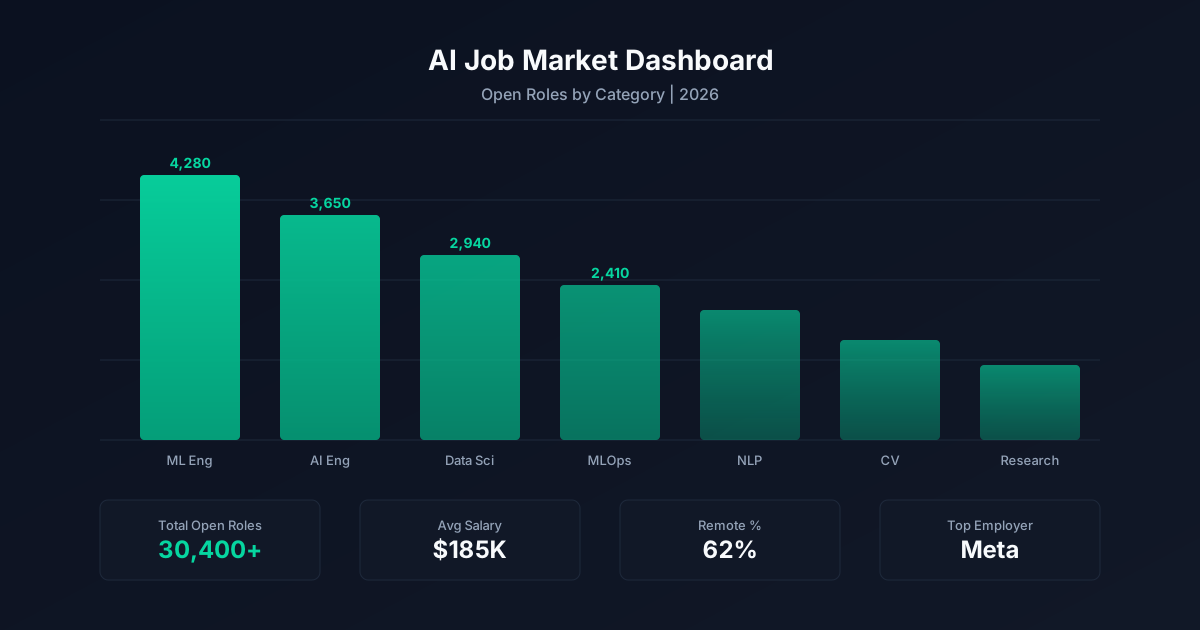
The AI job market spans 3,708 open positions across 16 role categories. The largest categories by volume: AI/ML Engineer (2,605), Data Scientist (310), AI Software Engineer (259). These three account for the majority of open positions, though smaller categories often have higher per-role compensation because of specialized skill requirements.
The seniority mix tells a story about where AI teams are in their maturity. Entry-level roles (102) are outnumbered by mid-level (1,705) and senior (1,469) positions, reflecting that most companies are past the 'build a team from scratch' phase and need experienced engineers who can ship production systems. Leadership roles (Director, VP, C-Level) total 432 positions, representing the bottleneck between technical execution and organizational strategy.
Remote work availability sits at 14% of all AI roles (508 positions), with 3,180 requiring on-site or hybrid attendance. The remote share has stabilized after the post-pandemic correction. Senior and specialized roles (Research Scientist, ML Architect) are more likely to be remote-eligible than entry-level positions, partly because experienced hires have more negotiating power and partly because these roles require less hands-on mentorship.
AI compensation is structured in clear tiers. The market median sits at $217,500. Top-quartile roles start at $272,100, and the 90th percentile reaches $325,000. These figures include base salary with disclosed compensation. Total compensation (including equity, bonuses, and sign-on) runs 20-40% higher at companies that offer those components.
Category matters for compensation. AI Safety roles lead at $300,000 median, while Prompt Engineer roles sit at $140,000. The spread between highest and lowest-paying categories reflects the premium on specialized technical skills versus broader analytical roles.
The most in-demand skills across all AI postings: Python (1,890 postings), Aws (1,103 postings), Azure (877 postings), Rag (855 postings), Gcp (631 postings), Prompt Engineering (560 postings), Pytorch (545 postings), Claude (498 postings). Python dominates, appearing in the vast majority of role descriptions regardless of category. Cloud platform experience (AWS, GCP, Azure) is the second most common requirement. The newer entrants to the top skills list (RAG, vector databases, LLM APIs) reflect the shift from traditional ML toward generative AI applications.
Frequently Asked Questions
Get Weekly AI Career Intelligence
Salary data, skills demand, and market signals from 16,000+ AI job postings. Every Monday.