
Interested in this AI/ML Engineer role at ECI Software Solutions?
Apply Now →Skills & Technologies
About This Role
Location: US \- Remote
EST/CST Business Hours
Global IT's Project Management Office runs ECI's strategic delivery portfolio — M\&A integrations, platform consolidations, compliance programs, and the cross\-cutting initiatives that ride across every function. AI\-enabled efficiency is one of the most important arcs of work on that portfolio, and we are investing in dedicated execution capacity to match the opportunity.
We believe AI transformation is built, not bought. The work that creates lasting value isn't the tool selection — it's mapping the workflow end\-to\-end, capturing the tribal knowledge that lives in people's heads, and then designing, building, and running the solution alongside the teams who own the work. That requires a different shape of role than the traditional separation of Business Analyst, developer, and Project Manager, because the handoffs between three specialists are where momentum and context tend to be lost.
The Business Analyst, AI Workflows is that integrator. The role sits inside IT PMO, partners across Platform, Engineering, Applications, Support, HR, and Finance, and is accountable for translating ECI's AI strategy into a real portfolio of measurable, shipped automations that serve our customers and our teams.
Key Focus Areas
Workflow Discovery \& Analysis (Business Analyst): Inventory ECI's highest\-effort manual workflows end\-to\-end, capture the tribal knowledge inside them, and sort each workflow into deterministic automation, agent\-handled judgment, or humans\-only work.
Hands\-On Build (Builder): Implement automations directly using low\-code, no\-code, and agentic AI tooling — Salesforce Flow, internal AI platforms, light scripting — translating specifications into running solutions rather than handing them off.
Phased Delivery \& Measurement (Project Manager): Run each automation through a disciplined sandbox shadow supervised\-production progression, with human\-in\-the\-loop checkpoints, and own the measurement story against ECI's AI workflow delivery commitments.
Key Responsibilities
As a Business Analyst
Map current\-state workflows end\-to\-end across IT, Support, Finance, HR, and Engineering — including the exceptions and edge cases that live in operators' heads, not in the documentation.
Conduct working sessions with process owners and frontline staff to capture tribal knowledge and convert it into rules, decision logic, and instructions that automation or agents can follow.
Gather requirements and write clear specifications that include success metrics, failure modes, and the exact human\-in\-the\-loop checkpoints required for safe rollout.
Apply a triage methodology to every candidate workflow — deterministic automation, agent\-handled judgment, or humans\-only — and document the rationale so triage decisions are auditable.
Establish and maintain the baseline measurement behind ECI's AI workflow commitments so progress is reported on real numbers, not estimates.
Build the candidate\-workflow portfolio against ECI's evaluation criteria: frequency, repeatability of decisions, context spread across systems, and measurable pain.
As a Builder
Implement automations directly in Salesforce Flow, low\-code and no\-code platforms (Power Automate, Zapier\-class tools, internal Abacus capabilities), and emerging agentic AI tooling.
Write light scripting (Python, JavaScript, SQL) and integrate across SaaS systems via REST APIs and webhooks where no\-code tooling does not reach.
Configure agent guardrails, evaluation prompts, and feedback loops; design for graceful failure when the agent is uncertain rather than for confident wrong answers.
Partner with Platform Engineering and Application teams to ship integrations safely on top of existing systems (Salesforce, Vonage, Workday, JSM) — without forcing migrations.
Build the instrumentation that proves an automation is working — logging, dashboards, and drift detection — so shadow\-mode and production performance can be compared on the same axes.
Maintain a clean, documented build inventory so any automation can be handed off, audited, or rolled back without tribal knowledge becoming the dependency we just removed somewhere else.
As a Project Manager
Run each workflow through a phased delivery model: sandbox build shadow mode (agent observes, humans decide) supervised production (agent acts, humans review) steady state.
Enforce human\-in\-the\-loop discipline at every phase boundary; no automation moves to the next stage without measured evidence and an owner sign\-off.
Own the regular progress reporting on AI workflow delivery, including which workflows shipped, the measured impact of each, and a credible forecast for the next quarter.
Coordinate with other technical resources when an AI workflow intersects an active Initiative — M\&A integration playbooks, platform consolidations, compliance projects.
Partner with process owners across functions to land each automation with the people who do the work — they are the success criteria, not a downstream consumer.
Maintain a single source of truth for the workflow portfolio (status, phase, baseline, current measurement, next checkpoint) and surface it on a recurring cadence to the IT leadership group.
Required Qualifications
5\+ years combined experience spanning business analysis, automation or low\-code implementation, and project or program management. Expertise in at least two of these areas is a must.
Demonstrated ability to map a cross\-functional workflow end\-to\-end, including the exceptions and undocumented decision points, and produce a specification an engineer or an agent can act on.
Hands\-on experience building automations in at least two of: Salesforce Flow, Power Automate, n8n, Zapier\-class platforms, Claude Code, or comparable low\-code tooling.
Direct experience shipping an automation or AI workflow to production with a measured before\-and\-after comparison — not a pilot that lived only in UAT.
Disciplined project cadence: writes and runs status updates, holds phase gates, measures outcomes against committed numbers, and communicates risks early.
Strong communication skills with the ability to explain a workflow, a measurement, and a tradeoff to both an engineering audience and an executive audience.
Comfort working across SaaS systems and integrating them via APIs; able to read documentation and prototype an integration without waiting for engineering support.
Preferred Qualifications
Experience with Salesforce administration and Salesforce Flow at scale.
Hands\-on work with agentic AI tooling (LLM\-backed assistants, Salesforce Agentforce, internal copilots, MCP\-style integrations) — including the operational reality of guardrails, evaluation, and failure modes.
SQL fluency; light Python or JavaScript scripting; familiarity with REST APIs and webhooks.
Familiarity with ITIL service\-management practices or PMP\-style project disciplines.
Prior experience inside a serial\-acquirer or multi\-business\-unit software company, where workflows differ meaningfully between business units.
How You'll Succeed (12\-Month Outcomes)
By the end of your first year, this role will be measured against:
A complete, prioritized inventory of ECI's highest\-effort manual workflows (completed in the first 3 months).
A defensible baseline measurement methodology established for AI workflow delivery, approved by IT leadership (i.e., how we will measure success of what we are building).
6–8 workflows live in shadow mode with instrumented before\-and\-after metrics.
4\+ workflows live in supervised production with measured manual\-effort reduction against baseline.
A quarterly report to IT leadership accounting for AI workflow delivery — what shipped, what it moved, what is next.
Reports To / Works With
Reports to: IT PMO Leadership.
Partners closely with: Platform Engineering leadership, the PMO team, and process owners across Support, Finance, HR, and Engineering.
Engages with: IT leadership on quarterly Strategic Program reviews of AI workflow delivery.
What This Role Is NOT
This is a new role for IT, so to clarify what we are not looking for:
Not a strategy\-only consultant. The deliverables are working automations, not a slide deck recommending them.
Not a pure Business Analyst who writes specs and hands off. The same person who maps the workflow is expected to build the first version of the automation.
Not a backend software engineer. This role uses low\-code, no\-code, and agentic platforms by design. Production\-grade custom engineering belongs to Platform and Engineering teams.
Not a Project Manager running ceremonies. This role delivers — phase gates, measurement, and shipped workflows are the cadence; status meetings are a byproduct, not the work.
ECI Culture \& Values
We are industry experts supporting the entrepreneurial spirit and profitable growth of small and medium\-sized businesses. Our culture is built on four core values —
CODE: Crave Greatness, Own the Outcome, Deliver Awesome, Embrace Community.
Occasional domestic travel (up to \~10%) for working sessions with process owners and IT leadership.
\#LI\-Remote
\#LI\-ND1
Role Details
About This Role
AI/ML Engineers build and deploy machine learning models in production. They work across the full ML lifecycle: data pipelines, model training, evaluation, and serving infrastructure. The role has evolved significantly over the past two years. Where ML Engineers once spent most of their time on model architecture, the job now tilts heavily toward inference optimization, cost management, and integrating LLM capabilities into existing systems. Companies want engineers who can ship production systems, and the experimenter-only role is fading fast.
Day-to-day, you're writing training pipelines, debugging data quality issues, setting up evaluation frameworks, and figuring out why your model performs differently in staging than it did on your dev set. The best ML engineers are obsessive about reproducibility and measurement. They instrument everything. They know that a model is only as good as the data feeding it and the infrastructure serving it.
Across the 3,708 AI roles we're tracking, AI/ML Engineer positions make up 70% of the market. At ECI Software Solutions, this role fits into their broader AI and engineering organization.
Demand for AI/ML Engineers has been strong and consistent. Unlike some AI roles that spike with hype cycles, ML engineering is a foundational need. Every company deploying AI models needs people who can keep them running, and the gap between research prototypes and production systems keeps growing.
What the Work Looks Like
A typical week might include: debugging a data pipeline that's silently dropping 3% of training examples, running A/B tests on a new model version, writing documentation for a feature flag system that lets you roll back model deployments, and reviewing a junior engineer's PR for a new evaluation metric. Meetings tend to be cross-functional since ML touches product, engineering, and data teams.
Demand for AI/ML Engineers has been strong and consistent. Unlike some AI roles that spike with hype cycles, ML engineering is a foundational need. Every company deploying AI models needs people who can keep them running, and the gap between research prototypes and production systems keeps growing.
Skills Required
Python and PyTorch dominate the requirements. Most roles expect experience with cloud platforms (AWS, GCP, or Azure) and familiarity with ML frameworks like TensorFlow or JAX. RAG (Retrieval-Augmented Generation) has become a top-3 skill requirement as companies integrate LLMs into their products. Docker and Kubernetes show up in about a third of postings, reflecting the production focus of the role.
Beyond the core stack, employers increasingly want experience with experiment tracking tools (MLflow, Weights & Biases), feature stores, and vector databases. Fine-tuning experience is valuable but less common than you'd think from reading Twitter. Most production LLM work is RAG and prompt engineering, not fine-tuning. If you have both, you're in a strong position.
Companies that are serious about AI/ML hiring tend to post specific infrastructure details in the job description: the frameworks they use, their model serving stack, their data pipeline tools. Vague postings that just say 'ML experience required' without specifics are often companies that haven't figured out what they need yet.
Compensation Benchmarks
AI/ML Engineer roles pay a median of $218,750 based on 3,817 positions with disclosed compensation. Mid-level AI roles across all categories have a median of $200,000.
Across all AI roles, the market median is $217,500. Top-quartile compensation starts at $272,100. The 90th percentile reaches $325,000. For comparison, the highest-paying categories include AI Safety ($300,000) and Research Engineer ($280,000). By seniority level: Entry: $120,000; Mid: $200,000; Senior: $230,000; Director: $272,150; VP: $250,000.
ECI Software Solutions AI Hiring
ECI Software Solutions has 1 open AI role right now. They're hiring across AI/ML Engineer. Based in Remote, US.
Remote Work Context
Remote AI roles pay a median of $185,334 across 717 positions. About 14% of all AI roles offer remote work.
Career Path
Common paths into AI/ML Engineer roles include Data Scientist, Software Engineer, Research Engineer.
From here, career progression typically leads toward ML Architect, AI Engineering Manager, Principal ML Engineer.
The fastest path into ML engineering is through software engineering with a self-directed ML education. A CS degree helps, but production engineering skills matter more than academic credentials. Build something that works, deploy it, and measure it. That portfolio project is worth more than a Coursera certificate. For career growth, the fork comes around the senior level: go deep on technical complexity (staff/principal track) or move into managing ML teams.
What to Expect in Interviews
Expect system design questions around ML pipelines: how you'd build a training pipeline for a specific use case, handle data drift, or design A/B testing infrastructure for model deployments. Coding rounds typically involve Python, with emphasis on data manipulation (pandas, numpy) and algorithm implementation. Take-home assignments often ask you to build an end-to-end ML pipeline from raw data to deployed model.
When evaluating opportunities: Companies that are serious about AI/ML hiring tend to post specific infrastructure details in the job description: the frameworks they use, their model serving stack, their data pipeline tools. Vague postings that just say 'ML experience required' without specifics are often companies that haven't figured out what they need yet.
AI Hiring Overview
The AI job market has 3,708 open positions tracked in our dataset. By seniority: 102 entry-level, 1,705 mid-level, 1,469 senior, and 432 leadership roles (Director, VP, C-Level). Remote roles make up 14% of the market (508 positions). The remaining 3,180 roles require on-site or hybrid attendance.
The market median for AI roles is $217,500. Top-quartile compensation starts at $272,100. The 90th percentile reaches $325,000. Highest-paying categories: AI Safety ($300,000 median, 21 roles); Research Engineer ($280,000 median, 147 roles); AI Architect ($254,798 median, 67 roles).
Demand for AI/ML Engineers has been strong and consistent. Unlike some AI roles that spike with hype cycles, ML engineering is a foundational need. Every company deploying AI models needs people who can keep them running, and the gap between research prototypes and production systems keeps growing.
The AI Job Market Today
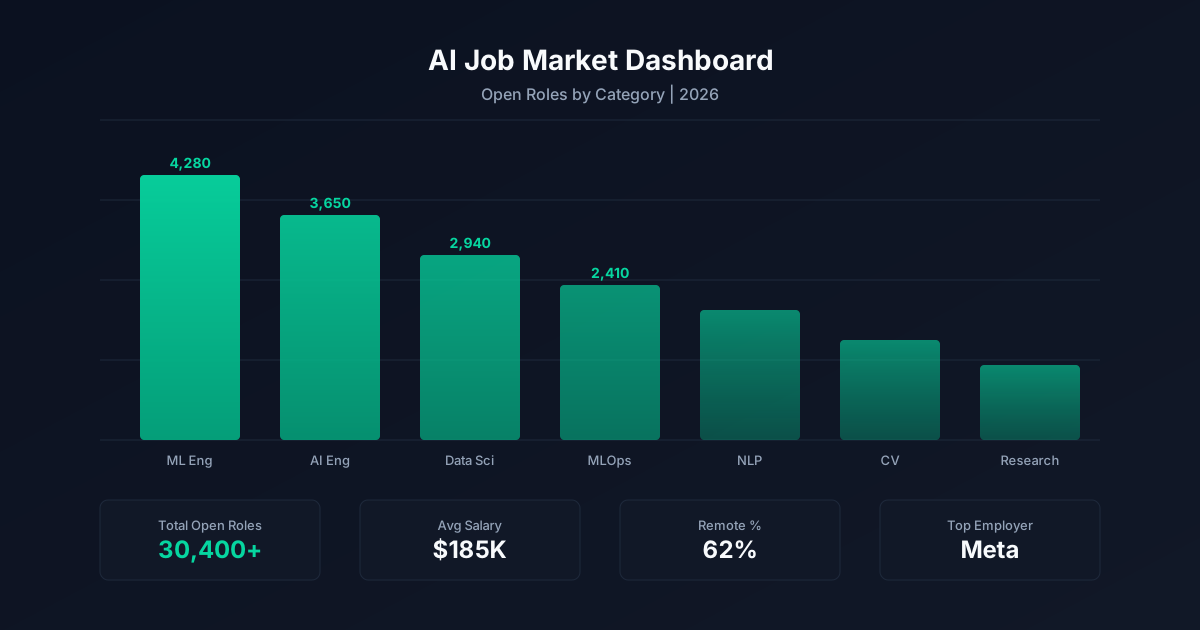
The AI job market spans 3,708 open positions across 16 role categories. The largest categories by volume: AI/ML Engineer (2,605), Data Scientist (310), AI Software Engineer (259). These three account for the majority of open positions, though smaller categories often have higher per-role compensation because of specialized skill requirements.
The seniority mix tells a story about where AI teams are in their maturity. Entry-level roles (102) are outnumbered by mid-level (1,705) and senior (1,469) positions, reflecting that most companies are past the 'build a team from scratch' phase and need experienced engineers who can ship production systems. Leadership roles (Director, VP, C-Level) total 432 positions, representing the bottleneck between technical execution and organizational strategy.
Remote work availability sits at 14% of all AI roles (508 positions), with 3,180 requiring on-site or hybrid attendance. The remote share has stabilized after the post-pandemic correction. Senior and specialized roles (Research Scientist, ML Architect) are more likely to be remote-eligible than entry-level positions, partly because experienced hires have more negotiating power and partly because these roles require less hands-on mentorship.
AI compensation is structured in clear tiers. The market median sits at $217,500. Top-quartile roles start at $272,100, and the 90th percentile reaches $325,000. These figures include base salary with disclosed compensation. Total compensation (including equity, bonuses, and sign-on) runs 20-40% higher at companies that offer those components.
Category matters for compensation. AI Safety roles lead at $300,000 median, while Prompt Engineer roles sit at $140,000. The spread between highest and lowest-paying categories reflects the premium on specialized technical skills versus broader analytical roles.
The most in-demand skills across all AI postings: Python (1,890 postings), Aws (1,103 postings), Azure (877 postings), Rag (855 postings), Gcp (631 postings), Prompt Engineering (560 postings), Pytorch (545 postings), Claude (498 postings). Python dominates, appearing in the vast majority of role descriptions regardless of category. Cloud platform experience (AWS, GCP, Azure) is the second most common requirement. The newer entrants to the top skills list (RAG, vector databases, LLM APIs) reflect the shift from traditional ML toward generative AI applications.
Frequently Asked Questions
Get Weekly AI Career Intelligence
Salary data, skills demand, and market signals from 16,000+ AI job postings. Every Monday.