
Interested in this AI Software Engineer role at Epiq?
Apply Now →Skills & Technologies
About This Role
At Epiq , your work contributes to complex, global legal outcomes. You’ll join a values‑driven community where integrity guides decisions, relentless service sets the bar, and we thrive on big challenges together. We invest in your growth with enterprise‑wide learning and mobility. We celebrate who you are, and we respect life beyond work with flexibility that’s recognized externally. Enabled by modern platforms and AI, you’ll do the most meaningful work of your career and see your impact at scale.
Job Description:
Epiq is seeking a highly skilled Lead AI Software Engineer to join our Operations Engineering team. This role is ideal for candidates who are passionate about building applied AI systems—not just writing code, but designing intelligent solutions that drive automation, efficiency, and innovation across legal operations.
You’ll work at the intersection of software engineering and AI, leveraging modern technologies such as GenAI , LLMs , MCP servers , and agentic frameworks to build scalable, production\-ready solutions. This role will also champion modern development practices and utilize Azure DevOps for agile delivery and ticketing.
Key Responsibilities
- Design, develop, and deploy AI\-driven features and intelligent agents for real\-world use cases.
- Integrate GenAI and LLMs into applications via APIs and microservices.
- Collaborate with product owners, architects, and engineers to transition prototypes into scalable production systems.
- Drive hyper automation initiatives by modernizing legacy automations using MCP servers and agentic frameworks.
- Engineer robust, reusable components and services with a focus on performance, scalability, and cost\-efficiency.
- Apply prompt engineering techniques to optimize model interactions and outcomes.
- Ensure compliance, security, and ethical standards in all AI development.
- Document processes, architectures, and best practices in Epiq’s internal knowledge base.
- Integrate external products with Epiq’s proprietary solutions.
- Stay current with AI advancements and recommend tools, frameworks, and methodologies.
Qualifications \& Experience
- Hands\-on experience with GenAI, model training, evaluation, and hyperparameter tuning.
- Experience with MCP servers, agentic frameworks, and Retrieval\-Augmented Generation (RAG).
- Strong programming skills in Python, C\# (.NET/ASP.NET), Java, or similar languages.
- Familiarity with cloud platforms (Azure/AWS) and their AI services.
- Experience with API development, microservices architecture, and CI/CD pipelines.
- Knowledge of tools like Docker, Kubernetes, MLFlow, and Azure DevOps.
- Solid understanding of software engineering principles, data structures, and algorithms.
- Excellent communication skills and ability to present technical concepts to non\-technical stakeholders.
- Bachelor’s degree in Computer Science or related field (or equivalent experience).
\#LI\-KS1 \#LI\-Remote
The Compensation range for this role is 120,000 to 170,000 USD annually and may be eligible for an annual bonus.
In compliance with federal law, all persons hired will be required to verify identity and eligibility to work in the United States and to complete the required employment eligibility verification form upon hire.
Must be authorized to work in the United States for any employer.
Your specific salary will be determined based on several factors:
- Location\-based market rate for the role
- Your abilities in relation to the job specification
- Performance during screening and interview
- Pay parity with the wider team in the considered location
Further details about the package will be provided during the initial screening call with the Talent Acquisition Team.
Epiq Leadership Compass
Fosters Relationships \& Collaboration
Builds trust and alignment through open communication, shared goals, and strong partnerships to drive collective success.
- Build trust\-based partnerships
- Nurture long\-term relationships
- Remove collaboration barriers
- Celebrate cross\-team success
Engages \& Influences
Inspires action and alignment through clear communication, purposeful influence, and a compelling vision.
- Use storytelling to build buy\-in
- Align communication with organizational goals
- Guild alignment through strong engagement
Maximizes Performance
Sets and reinforces performance standards that drive results, ensure accountability, and align with Epiq’s goals.
- Use data to identify improvement opportunities
- Make informed decisions
- Align team goals with boarder strategy
- Empower teams to manage their own goals
- Translate vision into clear priorities
- Prepare for disruptions with strong change management
Achieves Operational Success
Drives continuous improvement and operational excellence through smart processes, data insights, and quality execution.
- Improve workflows for team efficiency
- Use clear documentation and expectations
- Resolve issues quickly using data and feedback
It is Epiq’s policy to comply with all applicable equal employment opportunity laws by making all employment decisions without unlawful regard or consideration of any individual’s race, religion, ethnicity, color, sex, sexual orientation, gender identity or expressions, transgender status, sexual and other reproductive health decisions, marital status, age, national origin, genetic information, ancestry, citizenship, physical or mental disability, veteran or family status or any other basis protected by applicable national, federal, state, provincial or local law. Epiq’s policy prohibits unlawful discrimination based on any of these impermissible bases, as well as any bases or grounds protected by applicable law in each jurisdiction. In addition Epiq will take affirmative action for minorities, women, covered veterans and individuals with disabilities. If you need assistance or an accommodation during the application process because of a disability, it is available upon request. Epiq is pleased to provide such assistance and no applicant will be penalized as a result of such a request. Pursuant to relevant law, where applicable, Epiq will consider for employment qualified applicants with arrest and conviction records.
Salary Context
This $120K-$170K range is in the lower quartile for AI Software Engineer roles in our dataset (median: $183K across 194 roles with salary data).
Role Details
About This Role
AI Software Engineers build the applications and systems that AI models run inside. They own the API layers, data pipelines, frontend integrations, and infrastructure that turn a model into a product users interact with. Every AI company needs engineers who can build the software around the AI.
The challenge is building reliable systems around inherently unreliable components. Models are probabilistic. They'll give different answers to the same question. They hallucinate. They're slow. They're expensive. Your job is to build an application layer that handles all of this gracefully while delivering a product that users trust and enjoy.
Across the 3,708 AI roles we're tracking, AI Software Engineer positions make up 7% of the market. At Epiq, this role fits into their broader AI and engineering organization.
AI Software Engineer roles are among the most numerous in the AI job market. Every company deploying AI needs software engineers who understand AI integration patterns. The demand is broad, spanning startups to enterprises, across every industry adopting AI capabilities.
What the Work Looks Like
A typical week includes: building API endpoints that serve model inference with caching and fallback logic, designing the data pipeline that feeds context to a RAG system, implementing streaming responses in the frontend, debugging a race condition in the async inference pipeline, and optimizing database queries for the vector search layer. It's full-stack engineering with AI at the center.
AI Software Engineer roles are among the most numerous in the AI job market. Every company deploying AI needs software engineers who understand AI integration patterns. The demand is broad, spanning startups to enterprises, across every industry adopting AI capabilities.
Skills Required
Full-stack engineering skills with AI integration experience. Python and TypeScript are the most common requirements. You'll need to understand API design, database architecture, and how to build reliable systems around probabilistic outputs. Experience with streaming, async processing, and caching patterns is increasingly important as real-time AI applications proliferate.
Knowledge of vector databases, embedding APIs, and LLM integration patterns (function calling, structured outputs, retry logic) differentiates AI software engineers from general software engineers. Understanding cost optimization (caching strategies, model routing, batched inference) is valuable since inference costs can dominate application economics.
Strong postings describe the product you'll be building, the AI integration patterns you'll work with, and the scale requirements. Look for companies that have existing AI features and need engineers to improve and expand them, not companies that are 'planning to add AI' someday.
Compensation Benchmarks
AI Software Engineer roles pay a median of $219,250 based on 424 positions with disclosed compensation. Senior-level AI roles across all categories have a median of $230,000. This role's midpoint ($145K) sits 34% below the category median. Disclosed range: $120K to $170K.
Across all AI roles, the market median is $217,500. Top-quartile compensation starts at $272,100. The 90th percentile reaches $325,000. For comparison, the highest-paying categories include AI Safety ($300,000) and Research Engineer ($280,000). By seniority level: Entry: $120,000; Mid: $200,000; Senior: $230,000; Director: $272,150; VP: $250,000.
Epiq AI Hiring
Epiq has 2 open AI roles right now. They're hiring across AI Software Engineer, AI/ML Engineer. Positions span Overland Park, KS, US, New York, NY, US. Compensation range: $125K - $170K.
Location Context
Across all AI roles, 14% (508 positions) offer remote work, while 3,180 require on-site attendance. Top AI hiring metros: New York (1,045 roles, $220,000 median); San Francisco (810 roles, $277,088 median); Los Angeles (397 roles, $215,000 median).
Career Path
Common paths into AI Software Engineer roles include Software Engineer, Full-Stack Developer, Backend Engineer.
From here, career progression typically leads toward Staff Engineer, AI Architect, Engineering Manager.
If you're a software engineer, you're already 80% there. Learn the AI integration patterns: RAG, streaming inference, function calling, structured outputs. Build a project that demonstrates you can wrap an AI model in a production-quality application with proper error handling, caching, and user experience. That's the portfolio piece that gets you hired.
What to Expect in Interviews
Technical screens look like standard software engineering interviews with an AI twist. Expect system design questions about building reliable applications around probabilistic models: handling streaming responses, implementing retry logic for API failures, and designing caching strategies for LLM outputs. Coding rounds test standard algorithms plus practical integration patterns like async processing and rate limiting.
When evaluating opportunities: Strong postings describe the product you'll be building, the AI integration patterns you'll work with, and the scale requirements. Look for companies that have existing AI features and need engineers to improve and expand them, not companies that are 'planning to add AI' someday.
AI Hiring Overview
The AI job market has 3,708 open positions tracked in our dataset. By seniority: 102 entry-level, 1,705 mid-level, 1,469 senior, and 432 leadership roles (Director, VP, C-Level). Remote roles make up 14% of the market (508 positions). The remaining 3,180 roles require on-site or hybrid attendance.
The market median for AI roles is $217,500. Top-quartile compensation starts at $272,100. The 90th percentile reaches $325,000. Highest-paying categories: AI Safety ($300,000 median, 21 roles); Research Engineer ($280,000 median, 147 roles); AI Architect ($254,798 median, 67 roles).
AI Software Engineer roles are among the most numerous in the AI job market. Every company deploying AI needs software engineers who understand AI integration patterns. The demand is broad, spanning startups to enterprises, across every industry adopting AI capabilities.
The AI Job Market Today
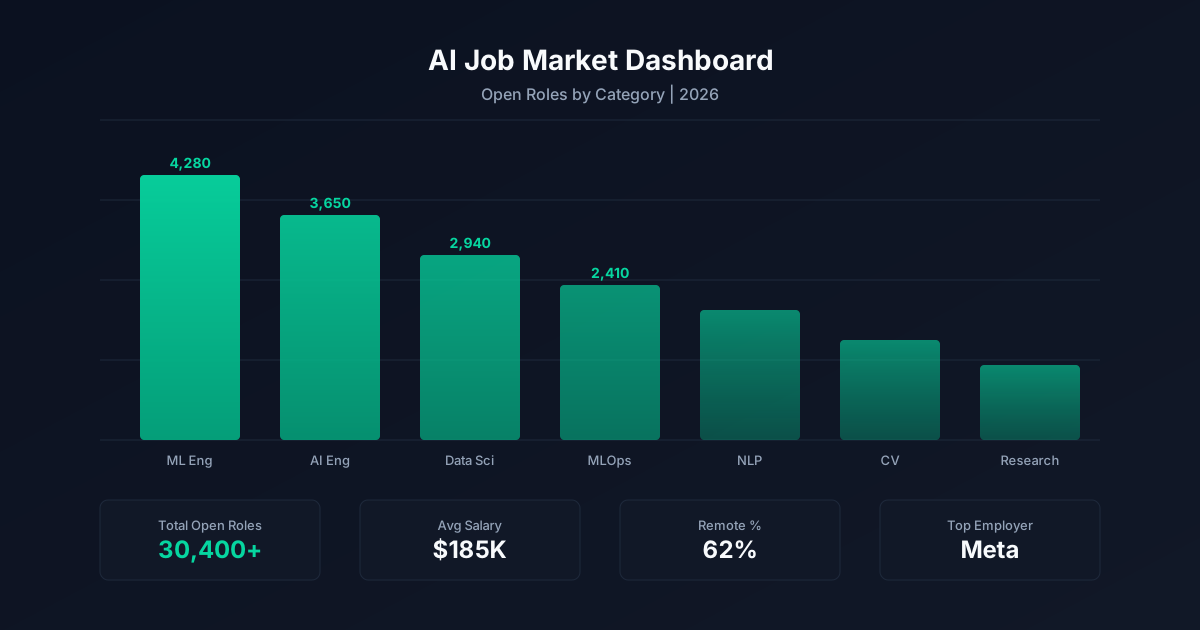
The AI job market spans 3,708 open positions across 16 role categories. The largest categories by volume: AI/ML Engineer (2,605), Data Scientist (310), AI Software Engineer (259). These three account for the majority of open positions, though smaller categories often have higher per-role compensation because of specialized skill requirements.
The seniority mix tells a story about where AI teams are in their maturity. Entry-level roles (102) are outnumbered by mid-level (1,705) and senior (1,469) positions, reflecting that most companies are past the 'build a team from scratch' phase and need experienced engineers who can ship production systems. Leadership roles (Director, VP, C-Level) total 432 positions, representing the bottleneck between technical execution and organizational strategy.
Remote work availability sits at 14% of all AI roles (508 positions), with 3,180 requiring on-site or hybrid attendance. The remote share has stabilized after the post-pandemic correction. Senior and specialized roles (Research Scientist, ML Architect) are more likely to be remote-eligible than entry-level positions, partly because experienced hires have more negotiating power and partly because these roles require less hands-on mentorship.
AI compensation is structured in clear tiers. The market median sits at $217,500. Top-quartile roles start at $272,100, and the 90th percentile reaches $325,000. These figures include base salary with disclosed compensation. Total compensation (including equity, bonuses, and sign-on) runs 20-40% higher at companies that offer those components.
Category matters for compensation. AI Safety roles lead at $300,000 median, while Prompt Engineer roles sit at $140,000. The spread between highest and lowest-paying categories reflects the premium on specialized technical skills versus broader analytical roles.
The most in-demand skills across all AI postings: Python (1,890 postings), Aws (1,103 postings), Azure (877 postings), Rag (855 postings), Gcp (631 postings), Prompt Engineering (560 postings), Pytorch (545 postings), Claude (498 postings). Python dominates, appearing in the vast majority of role descriptions regardless of category. Cloud platform experience (AWS, GCP, Azure) is the second most common requirement. The newer entrants to the top skills list (RAG, vector databases, LLM APIs) reflect the shift from traditional ML toward generative AI applications.
Frequently Asked Questions
Get Weekly AI Career Intelligence
Salary data, skills demand, and market signals from 16,000+ AI job postings. Every Monday.