
Interested in this AI Software Engineer role at General Motors (GM)?
Apply Now →Skills & Technologies
About This Role
Job Description
Work Arrangement: Remot e : This role is based remo t e ly but if you live within a 50\-mile radius of Mountain View , you are expected to report to that location three times a week, at minimum.
The Role
As a Principal Software Engineer in the Vehicle AI division, you will be the technical cornerstone of our smart cabin initiatives. You will architect, design, and deploy low\-latency, high\-performance AI software that runs directly on edge hardware within the vehicle.
You won't just be writing code; you will define the technical roadmap, mentor senior engineers, and collaborate across hardware, UI/UX, and vehicle software teams to bring intelligent features—like natural language voice assistants, driver monitoring systems (DMS), and predictive cabin personalization—to life.
What You'll Do
- Architectural Leadership: Design scalable, secure, and real\-time software architectures for AI\-driven features running on automotive\-grade compute platforms (e.g., Qualcomm Snapdragon Digital Chassis, NVIDIA DRIVE).
- Edge AI Optimization: Lead the deployment and optimization of machine learning models (LLMs, computer vision, audio processing) for resource\-constrained edge devices using TensorRT, ONNX, or similar frameworks.
- System Integration: Oversee the integration of AI pipelines with foundational infotainment operating systems, particularly Android Automotive OS (AAOS) and QNX.
- Cross\-Functional Strategy: Partner with product managers, data scientists, and hardware engineers to balance feature ambition with compute constraints.
- Mentorship \& Excellence: Elevate the engineering culture by establishing best practices for code quality, CI/CD, rigorous testing, and system performance profiling. Set the standard for technical excellence within the division.
- Prototyping: Rapidly prototype new AI concepts and evaluate emerging frameworks to keep GM at the cutting edge of automotive technology.
Your Skills \& Abilities (Required Qualifications)
- Experience: 10\+ years of professional software engineering experience, with at least 3\+ years in a technical leadership or architectural role.
- Programming: Expert\-level proficiency in modern C\+\+ (C\+\+14/17/20\) and Python.
- Domain Expertise: Proven track record of shipping commercial software in automotive infotainment, robotics, consumer electronics, or other deeply embedded systems.
- AI/ML Deployment: Hands\-on experience optimizing and deploying ML models to edge hardware (NPU/GPU/DSP utilization, quantization, pruning).
- OS Knowledge: Deep understanding of POSIX\-compliant operating systems, Linux internals, or RTOS (QNX, VxWorks).
- Education: Bachelor’s degree in Computer Science, Computer Engineering, or a related technical field (or equivalent practical experience).
What Will Give You a Competitive Edge (Preferred
Qualifications)
- Extensive experience with Android Automotive OS (AAOS) , specifically Vehicle HAL (VHAL) and native C\+\+ services.
- Experience building or integrating advanced Voice Assistants (ASR, NLU, TTS) or Driver Monitoring Systems (DMS) into embedded environments.
- Familiarity with automotive functional safety standards (ISO 26262, ASIL) and cybersecurity protocols.
- Advanced degree (Master’s or Ph.D.) focusing on Artificial Intelligence, Machine Learning, or Embedded Systems.
Compensation : The compensation information is a good faith estimate only. It is based on what a successful applicant might be paid in accordance with applicable state laws. The compensation may not be representative for positions located outside of the California Bay Area.
- The salary range for this role is ($216,400 \- 331,600\). The actual base salary a successful candidate will be offered within this range will vary based on factors relevant to the position.
- Bonus Potential: An incentive pay program offers payouts based on company performance, job level, and individual performance.
Company Vehicle : Upon successful completion of a motor vehicle report review, you will be eligible to participate in a company vehicle evaluation program, through which you will be assigned a General Motors vehicle to drive and evaluate. Note: program participants are required to purchase/lease a qualifying GM vehicle every four years unless one of a limited number of exceptions applies.
This Job may be eligible for relocation benefits.
\#LI\-SA2
\&\#xa;\&\#xa;\&\#xa;\&\#xa;This role is based remotely, but if the selected candidate lives within a specific mile radius of a GM hub, they will be expected to report to the location three times a week {or other frequency dictated by your manager}.\&\#xa;\&\#xa;The selected candidate will be required to travel \<25% for this role.\&\#xa;\&\#xa;This job may be eligible for relocation benefits.\&\#xa;\&\#xa;
About GM
Our vision is a world with Zero Crashes, Zero Emissions and Zero Congestion and we embrace the responsibility to lead the change that will make our world better, safer and more equitable for all.
Why Join Us
We believe we all must make a choice every day – individually and collectively – to drive meaningful change through our words, our deeds and our culture. Every day, we want every employee to feel they belong to one General Motors team.
Benefits Overview
From day one, we're looking out for your well\-being–at work and at home–so you can focus on realizing your ambitions. Learn how GM supports a rewarding career that rewards you personally by visiting Total Rewards resources .
Non\-Discrimination and Equal Employment Opportunities (U.S.)
General Motors is committed to being a workplace that is not only free of unlawful discrimination, but one that genuinely fosters inclusion and belonging. We strongly believe that providing an inclusive workplace creates an environment in which our employees can thrive and develop better products for our customers.
All employment decisions are made on a non\-discriminatory basis without regard to sex, race, color, national origin, citizenship status, religion, age, disability, pregnancy or maternity status, sexual orientation, gender identity, status as a veteran or protected veteran, or any other similarly protected status in accordance with federal, state and local laws.
We encourage interested candidates to review the key responsibilities and qualifications for each role and apply for any positions that match their skills and capabilities. Applicants in the recruitment process may be required, where applicable, to successfully complete a role\-related assessment(s) and/or a pre\-employment screening prior to beginning employment. To learn more, visit How we Hire .
Accommodations
General Motors offers opportunities to all job seekers including individuals with disabilities. If you need a reasonable accommodation to assist with your job search or application for employment, email us or call us at 1\-800\-865\-7580\. In your email, please include a description of the specific accommodation you are requesting as well as the job title and requisition number of the position for which you are applying.
Salary Context
This $216K-$331K range is above the 75th percentile for AI Software Engineer roles in our dataset (median: $183K across 194 roles with salary data).
Role Details
About This Role
AI Software Engineers build the applications and systems that AI models run inside. They own the API layers, data pipelines, frontend integrations, and infrastructure that turn a model into a product users interact with. Every AI company needs engineers who can build the software around the AI.
The challenge is building reliable systems around inherently unreliable components. Models are probabilistic. They'll give different answers to the same question. They hallucinate. They're slow. They're expensive. Your job is to build an application layer that handles all of this gracefully while delivering a product that users trust and enjoy.
Across the 3,708 AI roles we're tracking, AI Software Engineer positions make up 7% of the market. At General Motors (GM), this role fits into their broader AI and engineering organization.
AI Software Engineer roles are among the most numerous in the AI job market. Every company deploying AI needs software engineers who understand AI integration patterns. The demand is broad, spanning startups to enterprises, across every industry adopting AI capabilities.
What the Work Looks Like
A typical week includes: building API endpoints that serve model inference with caching and fallback logic, designing the data pipeline that feeds context to a RAG system, implementing streaming responses in the frontend, debugging a race condition in the async inference pipeline, and optimizing database queries for the vector search layer. It's full-stack engineering with AI at the center.
AI Software Engineer roles are among the most numerous in the AI job market. Every company deploying AI needs software engineers who understand AI integration patterns. The demand is broad, spanning startups to enterprises, across every industry adopting AI capabilities.
Skills Required
Full-stack engineering skills with AI integration experience. Python and TypeScript are the most common requirements. You'll need to understand API design, database architecture, and how to build reliable systems around probabilistic outputs. Experience with streaming, async processing, and caching patterns is increasingly important as real-time AI applications proliferate.
Knowledge of vector databases, embedding APIs, and LLM integration patterns (function calling, structured outputs, retry logic) differentiates AI software engineers from general software engineers. Understanding cost optimization (caching strategies, model routing, batched inference) is valuable since inference costs can dominate application economics.
Strong postings describe the product you'll be building, the AI integration patterns you'll work with, and the scale requirements. Look for companies that have existing AI features and need engineers to improve and expand them, not companies that are 'planning to add AI' someday.
Compensation Benchmarks
AI Software Engineer roles pay a median of $219,250 based on 424 positions with disclosed compensation. Senior-level AI roles across all categories have a median of $230,000. This role's midpoint ($274K) sits 25% above the category median. Disclosed range: $216K to $331K.
Across all AI roles, the market median is $217,500. Top-quartile compensation starts at $272,100. The 90th percentile reaches $325,000. For comparison, the highest-paying categories include AI Safety ($300,000) and Research Engineer ($280,000). By seniority level: Entry: $120,000; Mid: $200,000; Senior: $230,000; Director: $272,150; VP: $250,000.
General Motors (GM) AI Hiring
General Motors (GM) has 6 open AI roles right now. They're hiring across AI/ML Engineer, AI Software Engineer. Positions span Sunnyvale, CA, US, Mountain View, CA, US, Remote, US. Compensation range: $198K - $331K.
Location Context
Across all AI roles, 14% (508 positions) offer remote work, while 3,180 require on-site attendance. Top AI hiring metros: New York (1,045 roles, $220,000 median); San Francisco (810 roles, $277,088 median); Los Angeles (397 roles, $215,000 median).
Career Path
Common paths into AI Software Engineer roles include Software Engineer, Full-Stack Developer, Backend Engineer.
From here, career progression typically leads toward Staff Engineer, AI Architect, Engineering Manager.
If you're a software engineer, you're already 80% there. Learn the AI integration patterns: RAG, streaming inference, function calling, structured outputs. Build a project that demonstrates you can wrap an AI model in a production-quality application with proper error handling, caching, and user experience. That's the portfolio piece that gets you hired.
What to Expect in Interviews
Technical screens look like standard software engineering interviews with an AI twist. Expect system design questions about building reliable applications around probabilistic models: handling streaming responses, implementing retry logic for API failures, and designing caching strategies for LLM outputs. Coding rounds test standard algorithms plus practical integration patterns like async processing and rate limiting.
When evaluating opportunities: Strong postings describe the product you'll be building, the AI integration patterns you'll work with, and the scale requirements. Look for companies that have existing AI features and need engineers to improve and expand them, not companies that are 'planning to add AI' someday.
AI Hiring Overview
The AI job market has 3,708 open positions tracked in our dataset. By seniority: 102 entry-level, 1,705 mid-level, 1,469 senior, and 432 leadership roles (Director, VP, C-Level). Remote roles make up 14% of the market (508 positions). The remaining 3,180 roles require on-site or hybrid attendance.
The market median for AI roles is $217,500. Top-quartile compensation starts at $272,100. The 90th percentile reaches $325,000. Highest-paying categories: AI Safety ($300,000 median, 21 roles); Research Engineer ($280,000 median, 147 roles); AI Architect ($254,798 median, 67 roles).
AI Software Engineer roles are among the most numerous in the AI job market. Every company deploying AI needs software engineers who understand AI integration patterns. The demand is broad, spanning startups to enterprises, across every industry adopting AI capabilities.
The AI Job Market Today
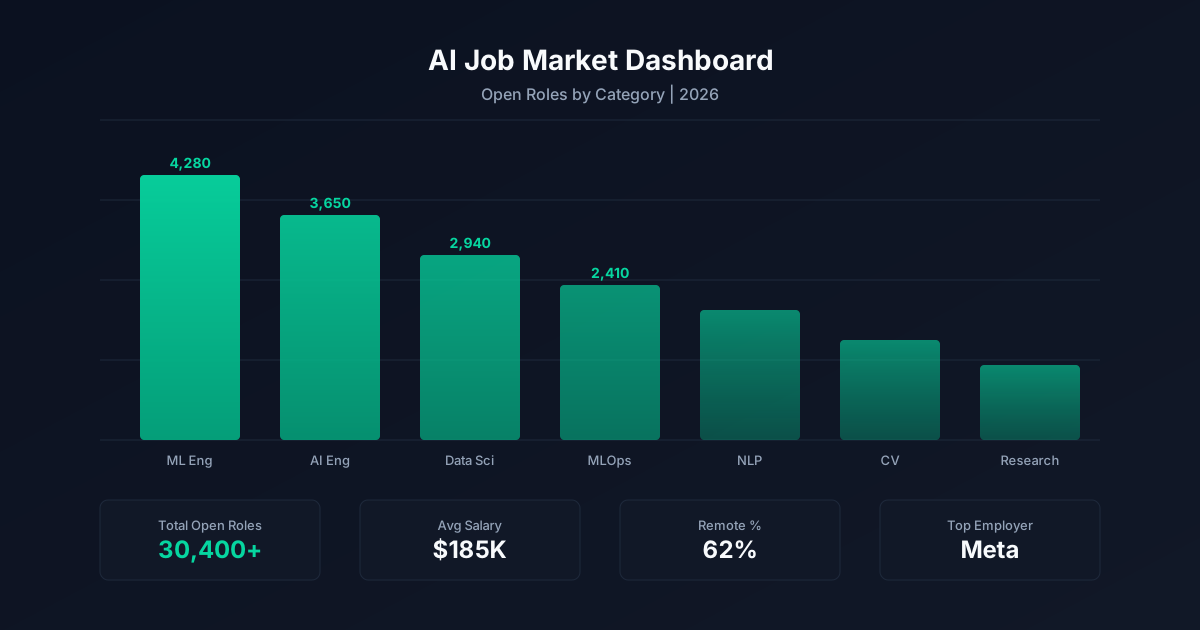
The AI job market spans 3,708 open positions across 16 role categories. The largest categories by volume: AI/ML Engineer (2,605), Data Scientist (310), AI Software Engineer (259). These three account for the majority of open positions, though smaller categories often have higher per-role compensation because of specialized skill requirements.
The seniority mix tells a story about where AI teams are in their maturity. Entry-level roles (102) are outnumbered by mid-level (1,705) and senior (1,469) positions, reflecting that most companies are past the 'build a team from scratch' phase and need experienced engineers who can ship production systems. Leadership roles (Director, VP, C-Level) total 432 positions, representing the bottleneck between technical execution and organizational strategy.
Remote work availability sits at 14% of all AI roles (508 positions), with 3,180 requiring on-site or hybrid attendance. The remote share has stabilized after the post-pandemic correction. Senior and specialized roles (Research Scientist, ML Architect) are more likely to be remote-eligible than entry-level positions, partly because experienced hires have more negotiating power and partly because these roles require less hands-on mentorship.
AI compensation is structured in clear tiers. The market median sits at $217,500. Top-quartile roles start at $272,100, and the 90th percentile reaches $325,000. These figures include base salary with disclosed compensation. Total compensation (including equity, bonuses, and sign-on) runs 20-40% higher at companies that offer those components.
Category matters for compensation. AI Safety roles lead at $300,000 median, while Prompt Engineer roles sit at $140,000. The spread between highest and lowest-paying categories reflects the premium on specialized technical skills versus broader analytical roles.
The most in-demand skills across all AI postings: Python (1,890 postings), Aws (1,103 postings), Azure (877 postings), Rag (855 postings), Gcp (631 postings), Prompt Engineering (560 postings), Pytorch (545 postings), Claude (498 postings). Python dominates, appearing in the vast majority of role descriptions regardless of category. Cloud platform experience (AWS, GCP, Azure) is the second most common requirement. The newer entrants to the top skills list (RAG, vector databases, LLM APIs) reflect the shift from traditional ML toward generative AI applications.
Frequently Asked Questions
Get Weekly AI Career Intelligence
Salary data, skills demand, and market signals from 16,000+ AI job postings. Every Monday.