
Interested in this Research Engineer role at Georgia Tech?
Apply Now →About This Role
About Us
Georgia Tech prides itself on its technological resources, collaborations, high\-quality student body, and its commitment to building an outstanding and diverse community of learning, discovery, and creation. We strongly encourage applicants whose values align with our institutional values, as outlined in our strategic plan. These values include academic excellence, diversity of thought and experience, inquiry and innovation, collaboration and community, and ethical behavior and stewardship. Georgia Tech has policies to promote a healthy work\-life balance and is aware that attracting faculty may require meeting the needs of two careers.
About Georgia Tech
Georgia Tech is a top\-ranked public research university situated in the heart of Atlanta, a diverse and vibrant city with numerous economic and cultural strengths. The Institute serves more than 45,000 students through top\-ranked undergraduate, graduate, and executive programs in engineering, computing, science, business, design, and liberal arts. Georgia Tech's faculty attracted more than $1\.4 billion in research awards this past year in fields ranging from biomedical technology to artificial intelligence, energy, sustainability, semiconductors, neuroscience, and national security. Georgia Tech ranks among the nation's top 20 universities for research and development spending and No. 1 among institutions without a medical school.
Georgia Tech's Mission and Values
Georgia Tech's mission is to develop leaders who advance technology and improve the human condition. The Institute has nine key values that are foundational to everything we do:
1\. Students are our top priority.
2\. We strive for excellence.
3\. We thrive on diversity.
4\. We celebrate collaboration.
5\. We champion innovation.
6\. We safeguard freedom of inquiry and expression.
7\. We nurture the wellbeing of our community.
8\. We act ethically.
9\. We are responsible stewards.
Over the next decade, Georgia Tech will become an example of inclusive innovation, a leading technological research university of unmatched scale, relentlessly committed to serving the public good; breaking new ground in addressing the biggest local, national, and global challenges and opportunities of our time; making technology broadly accessible; and developing exceptional, principled leaders from all backgrounds ready to produce novel ideas and create solutions with real human impact.
Location
Forest Park, GA
Department Information
About the School of Electrical and Computer Engineering (ECE) at the Georgia Institute of Technology
The School of Electrical and Computer Engineering (ECE) at the Georgia Institute of Technology is one of the largest producers of electrical engineers and computer engineers in the United States. Almost 2,600 students are enrolled in the School's graduate and undergraduate programs, and in the last academic year, 801 degrees were awarded. All ECE undergraduate and graduate programs are in the top five of the most recent college rankings by U.S. News \& World Report.
In addition to the main campus in Atlanta, Georgia, ECE also has permanent operations at Georgia Tech\-Lorraine in France. Graduate students who spend at least one semester each at of the Georgia Tech locations (Atlanta, Lorraine, on two continents, North America and Europe) can earn the Georgia Tech Global Engineering Immersion Program (GEIP) Certificate when they receive the Georgia Tech M.S. degree.
Over 110 ECE faculty members are involved in 11 areas of research and education: bioengineering, computer systems and software, digital signal processing, electrical energy, electromagnetics, electronic design and applications, nanotechnology, optics and photonics, systems and controls, telecommunications, and VLSI systems and digital design: and the School is either home to or a key player in almost 20 research centers and consortia.
ECE is key to Georgia Tech's growing reputation as an internationally recognized educational and research and development university. ECE is firmly committed to sustaining excellence in traditional areas of strength and venturing into burgeoning areas of opportunity.
Job Summary
The National Electric Energy Testing, Research and Applications Center (NEETRAC) is looking for an experienced mechanical engineer to develop and conduct applied research projects in its high voltage and medium voltage testing laboratories located in Forest Park, GA, just south of downtown Atlanta.
NEETRAC strives to be a globally recognized center of excellence in electric power research and applications by advancing industry knowledge. The center operates as a membership focused consortium that includes electric utilities, equipment manufacturers and related entities in the electric energy arena. The diverse interests of the consortium enable NEETRAC personnel to participate in a dynamic work environment that has extensive interaction with real world issues and opportunities.
You will work at the limits of knowledge in the electric power transmission and distribution industry. Electric utility and product manufacturers call NEETRAC when they need to solve unique non\-standard problems for which they do not have in\-house capabilities. Engineers at NEETRAC become internationally recognized experts, providing unbiased, fact\-based information that increases the safety and reliability of the electric grid.
As a part of the School of Electrical and Computer Engineering at the Georgia Institute of Technology, NEETRAC provides solid benefits and competitive compensation packages. The job level will depend on the relevance of the candidate's skills, experience and degree(s).
Visit www.neetrac.gatech.edu for more information about our impact on the power delivery industry.
Responsibilities
Develop and manage research and testing projects, which involves:
Serving as Principal Investigator of research projects
Conceptualizing and developing scopes, schedules, and budgets
Writing detailed test plans and following international standards
Coordinating testing activities, schedules, resources, technicians, etc.
Coordinating project activities with other NEETRAC engineers as needed (projects are frequently multifaceted, requiring multiple experts on a project)
In many cases, you will be actively involved in the testing itself, so you should be hands\-on and capable of working in a laboratory setting
Analyzing test data
Writing test reports
Writing extensive research reports
Preparing and delivering technical presentations to groups 45\+ engineers
Communicating with customers on project status and results
Develop as an industry expert in your field, which involves:
Building a book of work addressing real world power delivery issues
Consulting with Member utilities and manufacturers on individual topics
Presenting work at board meetings, forums, and international committee meetings
Attending or serving in leadership positions on various standards development committees¿ meetings (IEEE, ASTM, ANSI, etc.)
Publishing technical papers and articles
Serving as a NEETRAC representative at industry conferences and events
Required Qualifications
This position vacancy is an open rank announcement. Final job offer will be dependent on candidate qualifications in alignment with Research Faculty ranks as outlined in section 3\.2\.1 of the Georgia Tech Faculty Handbook ( https://www.policylibrary.gatech.edu/faculty\-handbook/3\.2\.1\-research\-faculty\-hiring\-and\-promotion\-guidelines )
Research Engineer I
A Bachelor's degree
Research Engineer II
A Master's degree and three (3\) years of relevant full\-time experience after completion of that degree, or
A Master's degree and five (5\) years of relevant full\-time experience after completion of a Bachelor's degree, or
A Doctoral degree.
Senior Research Engineer
A Master's degree in related area, and seven (7\) years of relevant full\-time experience after completion of that degree, or
A Master's degree in related area, and nine (9\) years of relevant full\-time experience after completion of a Bachelor's degree, or
A Doctoral degree in related area, and four (4\) years of relevant full\-time experience after completion of a Bachelor's degree.
Preferred Qualifications
Education and licenses
A Bachelors, Masters (preferred), or PhD degree in mechanical engineering or a closely related degree
An engineering license in any state or territory or the ability to obtain a license within one year
Experience
Experience in electric utility standards, line design, line operations, operations and maintenance, research, protection and controls, testing, or other areas
Experience in a test laboratory including environmental, mechanical, high voltage, medium voltage, and high power
Experience in design of electric utility products
Experience in failure analysis and component evaluation
Experience in asset management or operations research with an emphasis on component population statistics, managing physical infrastructure, risk characterization and mitigation, etc.
Experience using standards and specifications, with a preference for standards development with standards development organizations (IEEE, ASCE, ASTM, UL, CSA or similar). Experience serving/contributing on standards development committees would be valuable.
Experience using hand tools and instruments, as well as a willingness to perform hands on work
Knowledge, Skills, \& Abilities
Skills
Ability to work in a team, leveraging other engineers¿ expertise
Ability to work at depth and breadth
Depth in test procedure design, methods and data analysis
Breadth in types products tested
Ability to design custom/unique test methods
Ability to work on multiple projects in parallel
Ability to explain complex technical issues to pseudo\-technical audiences in reports and presentations
Ability to travel to standards development committee meetings at least two weeks per year. Candidates with more international standards development involvement and/or customer business development involvement will be able to travel more frequently.
Contact Information
For additional information about this job opening, please contact:
Linda Dillon: [email protected]
Shalonda Williams: [email protected]
Lucretia Allen: [email protected]
USG Core Values
The University System of Georgia is comprised of our 25 institutions of higher education and learning as well as the System Office. Our USG Statement of Core Values are Integrity, Excellence, Accountability, and Respect. These values serve as the foundation for all that we do as an organization, and each USG community member is responsible for demonstrating and upholding these standards. More details on the USG Statement of Core Values and Code of Conduct are available in USG Board Policy 8\.2\.18\.1\.2 and can be found on\-line at https://www.usg.edu/policymanual/section8/C224/\#p8\.2\.18\_personnel\_conduct .
Additionally, USG supports Freedom of Expression as stated in Board Policy 6\.5 Freedom of Expression and Academic Freedom found on\-line at https://www.usg.edu/policymanual/section6/C2653 .
Equal Employment Opportunity
The Georgia Institute of Technology (Georgia Tech) is an Equal Employment Opportunity Employer. The Institute is committed to maintaining a fair and respectful environment for all. To that end, and in accordance with federal and state law, Board of Regents policy, and Institute policy, Georgia Tech provides equal opportunity to all faculty, staff, students, and all other members of the Georgia Tech community, including applicants for admission and/or employment, contractors, volunteers, and participants in institutional programs, activities, or services. Georgia Tech complies with all applicable laws and regulations governing equal opportunity in the workplace and in educational activities.
Equal opportunity and decisions based on merit are fundamental values of the University System of Georgia ("USG") and Georgia Tech. Georgia Tech prohibits discrimination, including discriminatory harassment, on the basis of an individual's race, ethnicity, ancestry, color, religion, sex (including pregnancy), national origin, age, disability, genetics, or veteran status in its programs, activities, employment, and admissions. Further, Georgia Tech prohibits citizenship status, immigration status, and national origin discrimination in hiring, firing, and recruitment, except where such restrictions are required in order to comply with law, regulation, executive order, or Attorney General directive, or where they are required by Federal, State, or local government contract.
Background Check
A successful candidate must be able to pass a background check. Please visit: https://usg.policystat.com/policy/19298143/latest
Role Details
About This Role
Research Engineers bridge the gap between research and production. They implement papers, build experiment infrastructure, optimize training pipelines, and make research prototypes production-ready. They're the engineers who make research work at scale.
The role sits at a unique intersection. You need to understand the math well enough to implement novel architectures correctly, and you need the engineering chops to make them run efficiently on distributed systems. When a research scientist has a breakthrough idea, you're the person who turns it from a notebook prototype into a training pipeline that runs on 256 GPUs.
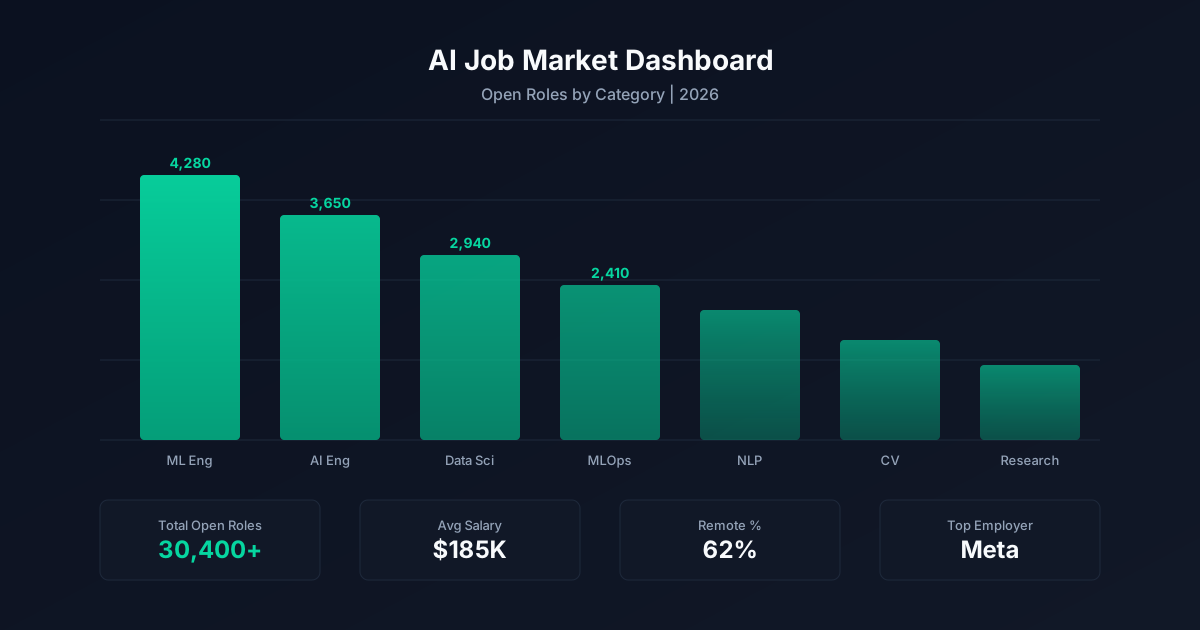
Across the 3,708 AI roles we're tracking, Research Engineer positions make up 2% of the market. At Georgia Tech, this role fits into their broader AI and engineering organization.
Research Engineer roles are growing as AI labs recognize that research velocity depends on engineering quality. The role is less competitive than Research Scientist (no PhD required), but the bar for engineering skill is very high. These roles are concentrated at major labs and well-funded startups.
What the Work Looks Like
A typical week involves: implementing a new attention mechanism from a recent paper, profiling and optimizing a training pipeline that's bottlenecked on data loading, building evaluation infrastructure for a new benchmark, debugging distributed training issues across a GPU cluster, and pair-programming with a research scientist on their latest experiment. The work is deeply technical.
Research Engineer roles are growing as AI labs recognize that research velocity depends on engineering quality. The role is less competitive than Research Scientist (no PhD required), but the bar for engineering skill is very high. These roles are concentrated at major labs and well-funded startups.
Skills in Demand for This Role
Strong software engineering fundamentals plus ML knowledge. Python, C++, and CUDA experience are common requirements. You'll need to read papers and turn ideas into working code. Distributed systems experience (especially distributed training) is highly valued. Performance optimization skills separate great candidates from good ones.
Experience with large-scale training infrastructure (FSDP, DeepSpeed, Megatron), GPU programming (CUDA, Triton), and the internals of ML frameworks (PyTorch internals, custom autograd functions) is what makes candidates stand out. The best research engineers can debug issues that span the full stack from GPU memory management to numerical precision to algorithmic correctness.
Strong postings mention the team's recent research, the infrastructure scale, and the specific technical challenges. They often list the research areas you'd support. Look for roles that emphasize both implementation quality and research understanding.
Compensation Benchmarks
Research Engineer roles pay a median of $280,000 based on 147 positions with disclosed compensation. Mid-level AI roles across all categories have a median of $200,000.
Across all AI roles, the market median is $217,500. Top-quartile compensation starts at $272,100. The 90th percentile reaches $325,000. For comparison, the highest-paying categories include AI Safety ($300,000) and AI Architect ($254,798). By seniority level: Entry: $120,000; Mid: $200,000; Senior: $230,000; Director: $272,150; VP: $250,000.
Georgia Tech AI Hiring
Georgia Tech has 4 open AI roles right now. They're hiring across Research Engineer, AI/ML Engineer. Positions span Forest Park, GA, US, Atlanta, GA, US.
Location Context
Across all AI roles, 14% (508 positions) offer remote work, while 3,180 require on-site attendance. Top AI hiring metros: New York (1,045 roles, $220,000 median); San Francisco (810 roles, $277,088 median); Los Angeles (397 roles, $215,000 median).
Career Path
Common paths into Research Engineer roles include Software Engineer, ML Engineer, Research Intern.
From here, career progression typically leads toward Senior Research Engineer, Research Scientist, ML Architect.
This is one of the best entry points into AI research without a PhD. Build a strong engineering portfolio with ML projects, contribute to open-source ML frameworks, and demonstrate that you can implement complex ideas correctly and efficiently. The transition to Research Scientist is possible with published first-author work, which some research engineer roles support.
What to Expect in Interviews
Technical screens test both engineering skill and research understanding. Expect coding rounds with performance-critical implementations (GPU optimization, efficient data loading). Be prepared to discuss papers relevant to the team's research area and explain how you'd implement key ideas. System design questions focus on training infrastructure: distributed training, experiment tracking, and compute resource management.
When evaluating opportunities: Strong postings mention the team's recent research, the infrastructure scale, and the specific technical challenges. They often list the research areas you'd support. Look for roles that emphasize both implementation quality and research understanding.
AI Hiring Overview
The AI job market has 3,708 open positions tracked in our dataset. By seniority: 102 entry-level, 1,705 mid-level, 1,469 senior, and 432 leadership roles (Director, VP, C-Level). Remote roles make up 14% of the market (508 positions). The remaining 3,180 roles require on-site or hybrid attendance.
The market median for AI roles is $217,500. Top-quartile compensation starts at $272,100. The 90th percentile reaches $325,000. Highest-paying categories: AI Safety ($300,000 median, 21 roles); Research Engineer ($280,000 median, 147 roles); AI Architect ($254,798 median, 67 roles).
Research Engineer roles are growing as AI labs recognize that research velocity depends on engineering quality. The role is less competitive than Research Scientist (no PhD required), but the bar for engineering skill is very high. These roles are concentrated at major labs and well-funded startups.
The AI Job Market Today
The AI job market spans 3,708 open positions across 16 role categories. The largest categories by volume: AI/ML Engineer (2,605), Data Scientist (310), AI Software Engineer (259). These three account for the majority of open positions, though smaller categories often have higher per-role compensation because of specialized skill requirements.
The seniority mix tells a story about where AI teams are in their maturity. Entry-level roles (102) are outnumbered by mid-level (1,705) and senior (1,469) positions, reflecting that most companies are past the 'build a team from scratch' phase and need experienced engineers who can ship production systems. Leadership roles (Director, VP, C-Level) total 432 positions, representing the bottleneck between technical execution and organizational strategy.
Remote work availability sits at 14% of all AI roles (508 positions), with 3,180 requiring on-site or hybrid attendance. The remote share has stabilized after the post-pandemic correction. Senior and specialized roles (Research Scientist, ML Architect) are more likely to be remote-eligible than entry-level positions, partly because experienced hires have more negotiating power and partly because these roles require less hands-on mentorship.
AI compensation is structured in clear tiers. The market median sits at $217,500. Top-quartile roles start at $272,100, and the 90th percentile reaches $325,000. These figures include base salary with disclosed compensation. Total compensation (including equity, bonuses, and sign-on) runs 20-40% higher at companies that offer those components.
Category matters for compensation. AI Safety roles lead at $300,000 median, while Prompt Engineer roles sit at $140,000. The spread between highest and lowest-paying categories reflects the premium on specialized technical skills versus broader analytical roles.
The most in-demand skills across all AI postings: Python (1,890 postings), Aws (1,103 postings), Azure (877 postings), Rag (855 postings), Gcp (631 postings), Prompt Engineering (560 postings), Pytorch (545 postings), Claude (498 postings). Python dominates, appearing in the vast majority of role descriptions regardless of category. Cloud platform experience (AWS, GCP, Azure) is the second most common requirement. The newer entrants to the top skills list (RAG, vector databases, LLM APIs) reflect the shift from traditional ML toward generative AI applications.
Frequently Asked Questions
Get Weekly AI Career Intelligence
Salary data, skills demand, and market signals from 16,000+ AI job postings. Every Monday.