
Interested in this AI Engineering Manager role at GitLab Inc?
Apply Now →About This Role
GitLab is the intelligent orchestration platform for DevSecOps. GitLab enables organizations to increase developer productivity, improve operational efficiency, reduce security and compliance risk, and accelerate digital transformation. More than 50 million registered users and more than 50% of the Fortune 100\* trust GitLab to ship better, more secure software faster.
The same principles built into our products are reflected in how our team works: we embrace AI as a core productivity multiplier, with all team members expected to incorporate AI into their daily workflows to drive efficiency, innovation, and impact. GitLab is where careers accelerate, innovation flourishes, and every voice is valued. Our high\-performance culture is driven by our values and continuous knowledge exchange, enabling our team members to reach their full potential while collaborating with industry leaders to solve complex problems. Co\-create the future with us as we build technology that transforms how the world develops software.
- *Fortune 500® is a registered trademark of Fortune Media IP Limited, used under license. Claim based on GitLab data. Fortune 100 refers to the top 20% ranked companies in the 2025 Fortune 500 list, published in June 2025\. Fortune and Fortune Media IP Limited are not affiliated with, and do not endorse products or services of GitLab.*
An overview of this role
----------------------------
The Engineering Manager on the Duo Chat team helps shape the core AI capabilities behind GitLab Duo Chat, so customers can work faster and more securely across the GitLab DevSecOps platform. In this role, you will manage a team of engineers building AI\-powered product experiences that span the software development lifecycle, while staying close to the technical work that informs strong engineering judgment. You will play a key role in how the team delivers scalable, reliable, and high\-quality AI features, from roadmap execution to stronger testing, performance, and developer clarity.
Some examples of our projects:
- Extend capabilities of the Duo Agent Platform agentic chat regarding agentic capabilities, UI and context management
- Integrate new agentic generative AI models and providers into GitLab Duo Chat to expand capabilities and improve answer quality
- Improve debugging, observability, and test coverage for AI\-powered chat workflows to maintain reliability at scale
What you'll do
------------------
- Manage a team of experienced frontend, backend, and AI engineers to deliver GitLab Duo Chat roadmap commitments across the DevSecOps lifecycle.
- Partner with product and UX teams to define requirements and deliver AI features that address customer needs and improve answer quality.
- Participate in technical architecture and development work for systems that run AI agents at scale, with a focus on reliability, performance, and maintainability.
- Guide day\-to\-day execution by setting clear direction, tracking progress against milestones, and removing blockers to keep delivery on schedule.
- Coach engineers through feedback, guidance, and development conversations that foster each engineer's growth and overall team performance.
- Promote a team culture grounded in curiosity, inclusion, accountability, and steady delivery against team goals.
- Improve quality, testing, and performance practices that increase coverage, strengthen observability, and keep AI\-powered chat workflows reliable in production.
What you'll bring
---------------------
- Experience managing engineering teams in a distributed environment and enabling strong team execution.
- Strong software engineering foundation with the ability to contribute to technical discussions and evaluate engineering tradeoffs.
- Hands\-on familiarity with agentic AI or generative AI applied to software development workflows.
- Ability to work effectively through ambiguity, changing requirements, and fast\-moving product development.
- Clear communication and collaboration skills across engineering, product, design, and other stakeholders.
- Dedication to coaching engineers and creating an inclusive, constructive team environment.
- Comfort balancing people management with technical involvement in day\-to\-day development.
- Openness to transferable experience from different technical backgrounds if it aligns with managing AI\-powered product teams.
About the team
------------------
We are part of GitLab's AI Engineering organization and own the AI\-powered chat experience embedded across the GitLab platform. We include backend, frontend, and AI specialists who work asynchronously across time zones using issues, merge requests, and documentation as core collaboration tools. Our focus is to expand generative AI capabilities, improve the performance and reliability of chat workflows, and strengthen the debugging and testing foundations needed to enable AI features safely at scale. For more on how we work, see the Team Handbook Page.
#### How GitLab Supports Full\-Time Employees
- Benefits to support your health, finances, and well\-being
- Flexible Paid Time Off
- Team Member Resource Groups
- Equity Compensation \& Employee Stock Purchase Plan
- Growth and Development Fund
- Parental Leave
Please note that we welcome interest from candidates with varying levels of experience; many successful candidates do not meet every single requirement. Additionally, studies have shown that people from underrepresented groups are less likely to apply to a job unless they meet every single qualification. If you're excited about this role, please apply and allow our recruiters to assess your application.
Country Hiring Guidelines: GitLab hires new team members in countries around the world. All of our roles are remote, however some roles may carry specific location\-based eligibility requirements. Our Talent Acquisition team can help answer any questions about location after starting the recruiting process.
Privacy Policy: Please review our Recruitment Privacy Policy. Your privacy is important to us.
GitLab is proud to be an equal opportunity workplace and is an affirmative action employer. GitLab's policies and practices relating to recruitment, employment, career development and advancement, promotion, and retirement are based solely on merit, regardless of race, color, religion, ancestry, sex (including pregnancy, lactation, sexual orientation, gender identity, or gender expression), national origin, age, citizenship, marital status, mental or physical disability, genetic information (including family medical history), discharge status from the military, protected veteran status (which includes disabled veterans, recently separated veterans, active duty wartime or campaign badge veterans, and Armed Forces service medal veterans), or any other basis protected by law. GitLab will not tolerate discrimination or harassment based on any of these characteristics. See also GitLab's EEO Policy and EEO is the Law. If you have a disability or special need that requires accommodation, please let us know during the recruiting process.
Role Details
About This Role
This role sits at the intersection of AI and engineering, building systems that bring machine learning capabilities into production environments. The scope varies by company, but the common thread is applying AI technology to solve real business problems at scale. Most AI roles today require a combination of software engineering fundamentals and domain-specific ML knowledge, with the exact mix depending on the team's maturity and the product they're building.
The AI job market is evolving fast. New role categories emerge as companies figure out what they need to ship AI-powered products. What matters most is the ability to learn quickly, build working systems, and iterate based on real-world performance data. The specific title matters less than the skills you bring and the problems you can solve. Companies are past the experimentation phase and want engineers who can deliver production-quality systems that work reliably at scale.
Across the 3,708 AI roles we're tracking, AI Engineering Manager positions make up 0% of the market. At GitLab Inc, this role fits into their broader AI and engineering organization.
AI hiring keeps growing across industries. Companies in tech, finance, healthcare, and retail are all building AI teams. The strongest demand is for people who can bridge the gap between AI research and production engineering. The shift toward generative AI has created new role types (LLM Engineer, Prompt Engineer, AI Agent Developer) that didn't exist three years ago, while traditional roles (Data Scientist, ML Engineer) have evolved to incorporate LLM capabilities.
What the Work Looks Like
Day-to-day work involves a mix of building, debugging, and collaborating. You'll write code, review pull requests, participate in design discussions, and work with cross-functional teams (product, design, data) to define what AI features should do and how they should behave. Expect to spend time on both technical implementation and communication. Most AI teams operate in two-week sprint cycles, with regular demos and retrospectives. The ratio of heads-down coding to meetings and reviews varies by seniority, with senior roles spending more time on architecture decisions and mentorship.
AI hiring keeps growing across industries. Companies in tech, finance, healthcare, and retail are all building AI teams. The strongest demand is for people who can bridge the gap between AI research and production engineering. The shift toward generative AI has created new role types (LLM Engineer, Prompt Engineer, AI Agent Developer) that didn't exist three years ago, while traditional roles (Data Scientist, ML Engineer) have evolved to incorporate LLM capabilities.
Skills in Demand for This Role
Python and cloud platform experience are common requirements. Specific skill needs vary by company and focus area, but familiarity with ML frameworks, data pipelines, and API design covers the basics for most roles. RAG (Retrieval-Augmented Generation), vector databases, and LLM API integration are increasingly standard requirements across role types.
Beyond the core stack, communication skills matter more than many technical candidates realize. The ability to explain AI capabilities and limitations to non-technical stakeholders is a differentiator at every level. Technical writing, documentation, and clear thinking about tradeoffs are underrated skills in AI roles. Experience with evaluation methodology (how to measure whether an AI system is working well) is becoming a core requirement, especially for roles that involve LLM integration.
Look for job postings that specify the problems you'll work on, the tech stack, and the team structure. Vague postings that list every AI buzzword are often a sign the company hasn't figured out what they need. Strong postings describe the product context, the team you'd join, and the specific challenges you'd tackle.
Compensation Benchmarks
AI Engineering Manager roles pay a median of $249,650 based on 10 positions with disclosed compensation. Mid-level AI roles across all categories have a median of $200,000.
Across all AI roles, the market median is $217,500. Top-quartile compensation starts at $272,100. The 90th percentile reaches $325,000. For comparison, the highest-paying categories include AI Safety ($300,000) and Research Engineer ($280,000). By seniority level: Entry: $120,000; Mid: $200,000; Senior: $230,000; Director: $272,150; VP: $250,000.
GitLab Inc AI Hiring
GitLab Inc has 3 open AI roles right now. They're hiring across AI/ML Engineer, AI Engineering Manager. Based in Remote, US.
Remote Work Context
Remote AI roles pay a median of $185,334 across 717 positions. About 14% of all AI roles offer remote work.
Career Path
Common paths into AI Engineering Manager roles include Software Engineer, Data Scientist, Data Analyst.
From here, career progression typically leads toward Senior Engineer, AI Architect, Engineering Manager, Principal Engineer.
Focus on building things that work. A deployed project that solves a real problem is worth more than any certification. Contribute to open-source, build portfolio projects, and invest in fundamentals (software engineering, statistics, systems design) rather than chasing the latest framework. The AI field moves fast, but the engineers who succeed long-term are the ones with strong fundamentals who can adapt to new tools and paradigms as they emerge.
What to Expect in Interviews
AI interviews typically combine coding challenges (Python-focused), system design questions tailored to the role, and discussions about your experience with relevant tools and frameworks. Strong candidates demonstrate both technical depth and the ability to make pragmatic engineering tradeoffs. Prepare portfolio projects that demonstrate end-to-end capability rather than isolated skills.
When evaluating opportunities: Look for job postings that specify the problems you'll work on, the tech stack, and the team structure. Vague postings that list every AI buzzword are often a sign the company hasn't figured out what they need. Strong postings describe the product context, the team you'd join, and the specific challenges you'd tackle.
AI Hiring Overview
The AI job market has 3,708 open positions tracked in our dataset. By seniority: 102 entry-level, 1,705 mid-level, 1,469 senior, and 432 leadership roles (Director, VP, C-Level). Remote roles make up 14% of the market (508 positions). The remaining 3,180 roles require on-site or hybrid attendance.
The market median for AI roles is $217,500. Top-quartile compensation starts at $272,100. The 90th percentile reaches $325,000. Highest-paying categories: AI Safety ($300,000 median, 21 roles); Research Engineer ($280,000 median, 147 roles); AI Architect ($254,798 median, 67 roles).
AI hiring keeps growing across industries. Companies in tech, finance, healthcare, and retail are all building AI teams. The strongest demand is for people who can bridge the gap between AI research and production engineering. The shift toward generative AI has created new role types (LLM Engineer, Prompt Engineer, AI Agent Developer) that didn't exist three years ago, while traditional roles (Data Scientist, ML Engineer) have evolved to incorporate LLM capabilities.
The AI Job Market Today
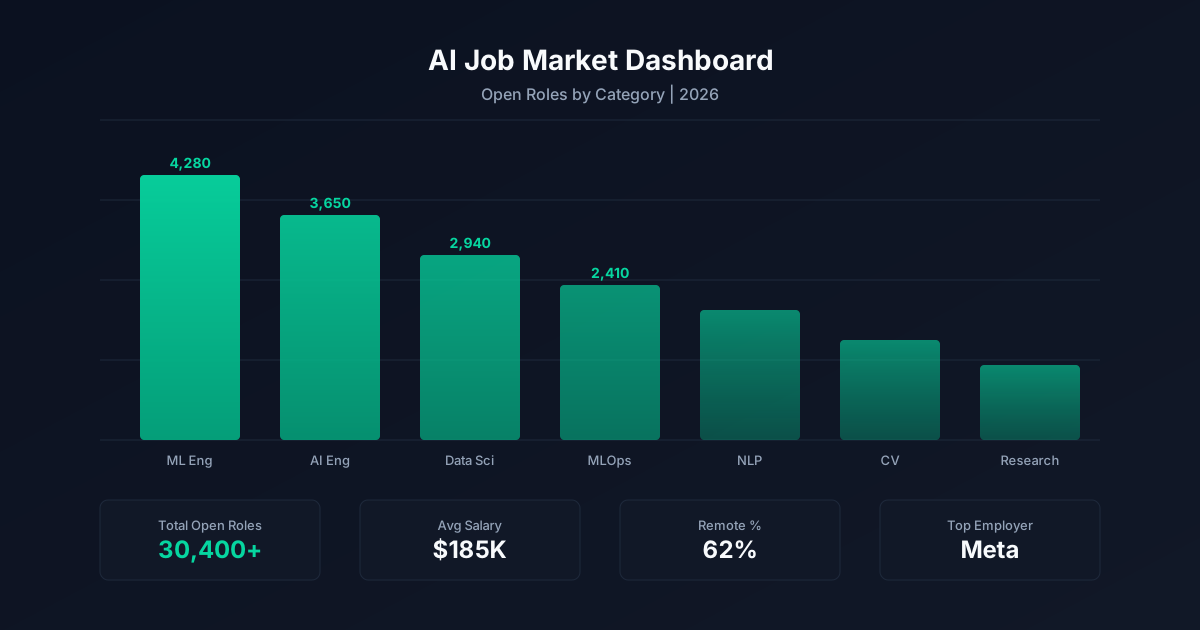
The AI job market spans 3,708 open positions across 16 role categories. The largest categories by volume: AI/ML Engineer (2,605), Data Scientist (310), AI Software Engineer (259). These three account for the majority of open positions, though smaller categories often have higher per-role compensation because of specialized skill requirements.
The seniority mix tells a story about where AI teams are in their maturity. Entry-level roles (102) are outnumbered by mid-level (1,705) and senior (1,469) positions, reflecting that most companies are past the 'build a team from scratch' phase and need experienced engineers who can ship production systems. Leadership roles (Director, VP, C-Level) total 432 positions, representing the bottleneck between technical execution and organizational strategy.
Remote work availability sits at 14% of all AI roles (508 positions), with 3,180 requiring on-site or hybrid attendance. The remote share has stabilized after the post-pandemic correction. Senior and specialized roles (Research Scientist, ML Architect) are more likely to be remote-eligible than entry-level positions, partly because experienced hires have more negotiating power and partly because these roles require less hands-on mentorship.
AI compensation is structured in clear tiers. The market median sits at $217,500. Top-quartile roles start at $272,100, and the 90th percentile reaches $325,000. These figures include base salary with disclosed compensation. Total compensation (including equity, bonuses, and sign-on) runs 20-40% higher at companies that offer those components.
Category matters for compensation. AI Safety roles lead at $300,000 median, while Prompt Engineer roles sit at $140,000. The spread between highest and lowest-paying categories reflects the premium on specialized technical skills versus broader analytical roles.
The most in-demand skills across all AI postings: Python (1,890 postings), Aws (1,103 postings), Azure (877 postings), Rag (855 postings), Gcp (631 postings), Prompt Engineering (560 postings), Pytorch (545 postings), Claude (498 postings). Python dominates, appearing in the vast majority of role descriptions regardless of category. Cloud platform experience (AWS, GCP, Azure) is the second most common requirement. The newer entrants to the top skills list (RAG, vector databases, LLM APIs) reflect the shift from traditional ML toward generative AI applications.
Frequently Asked Questions
Get Weekly AI Career Intelligence
Salary data, skills demand, and market signals from 16,000+ AI job postings. Every Monday.