
Interested in this AI/ML Engineer role at Grafana Labs?
Apply Now →Skills & Technologies
About This Role
Grafana Labs, the company behind the open observability cloud, is founded on the principles of open source, open standards, open ecosystems, and open culture. Grafana Cloud, our fully managed observability platform, is flexible and built for scale. With Grafana Cloud's actually useful AI, organizations can see, understand, and act on all their disparate data to move at the speed of their ambitions. Today, more than 35 million users and 7,000\+ customers – including Anthropic, Bloomberg, NVIDIA, Microsoft, and Salesforce – trust Grafana Labs to ensure reliability of their applications and systems, resolve incidents quickly, and optimize their telemetry to reduce noise and cost. We are a 100% remote company with 1,600\+ team members across 40\+ countries, and we’re backed by leading investors including Lightspeed Venture Partners, Sequoia Capital, GIC, Coatue, J.P. Morgan, CapitalG, and Lead Edge Capital. Learn more at grafana.com and follow us on LinkedIn and X.
We’re scaling fast and staying true to what makes us different: an open\-source legacy, a global collaborative culture, and a passion for meaningful work. Our team thrives in an innovation\-driven environment where transparency, autonomy, and trust fuel everything we do.
You may not meet every requirement, and that’s okay. If this role excites you, we’d love you to raise your hand for what could be a truly career\-defining opportunity.
### Senior ML Engineer Recommender Systems, Developer Advocacy \| US \| Remote
This is a fully remote position and we're considering candidates in the US.
The Opportunity:
Grafana Labs is building an Interactive Learning system, an open source, in\-product learning experience that helps users learn and succeed without leaving Grafana. A central part of that vision is a personalized recommendation system that helps each user discover the next guide, action, or product experience most likely to help them succeed.
Today, the Interactive Learning tool includes a rule\-based recommendation engine that provides useful contextual recommendations. We are hiring an ML Engineer to lead its evolution into an increasingly personalized, continuously improving system driven by real\-time product behavior, content metadata, customer context, and experimentation.
This is an applied product data science role. You will personally build, deploy, and operate recommendation models, design experiments, establish evaluation methodology, and define the scientific roadmap. You will partner closely with software engineers who own the production recommender codebase and with an existing Data Analyst who supports measurement, instrumentation, and analysis across Developer Advocacy.
What You’ll Be Doing:
The long\-term vision is ambitious, but we do not expect it to arrive in one release. We are looking for someone who can understand the whole problem, establish strong foundations, and ship measurable improvements into the existing recommender one iteration at a time.
- Evolve the Interactive Learning Plugin's recommendation system
- + Develop increasingly personalized approaches to candidate selection, ranking, sequencing, and next\-best\-action recommendations.
+ You’ll own a real\-time recommendation service
- Build and operate applied models
- + Develop, validate, version, monitor, and iterate on models used by the recommendation system.
+ You’ll own model training \& serving
- Define what recommendation quality means
- + Develop offline, online, and longitudinal measures of recommendation performance.
+ You’ll own feature pipelines, monitoring of the model and architecture
- Ship incremental improvements
- + Use the data and infrastructure available today while identifying the instrumentation and platform capabilities needed tomorrow.
+ Integrate improvements into the existing recommender rather than waiting for a complete replacement system.
- Partner across disciplines
- + Work closely with software engineers \& data analysts to productionize models and integrate them safely into the recommender service.
+ Partner with the Product Analytics team on metric definitions, instrumentation, data quality, dashboards, and experiment analysis.
+ Collaborate with Developer Advocacy, Docs, Product, Engineering, GTM, and other teams to translate ambiguous needs into testable hypotheses and measurable product decisions.
+ Explain modeling choices, tradeoffs, uncertainty, and results clearly to both technical and non\-technical audiences.
What Makes You a Great Fit:
We know it is rare to find everything. Strong candidates should demonstrate credible ability across all three core areas below and be particularly strong in at least two.
- Recommendation and personalization science: you have built recommendation, ranking, search, matching, propensity, or next\-best\-action systems. You are comfortable beginning with simple, explainable approaches when they are the best way to learn.
- HTTP/gRPC, streaming, Go/TypeScript previous experience in distributed systems
- Applied model ownership. You have personally built, validated, monitored, and iterated on models used in a product or operational environment. You can work effectively in version\-controlled codebases and collaborate with engineers on production implementation.
You should also be a strong product thinker and technical communicator. You can take an ambitious and ambiguous objective, identify the most important unknowns, and create a sequence of models and experiments that steadily improves the product.
Bonus Points For:
- Experience with content, education, onboarding, or learning recommendation systems
- Experience with SaaS product telemetry and customer\-account data
- Experience using warehouse\-scale behavioral data
- Experience with directed graphs, sequence models, or prerequisite\-aware recommendations
- Experience with contextual bandits or other exploration strategies
- Familiarity with Grafana or the broader observability ecosystem
- Experience with open source software or transparent development practices
- Experience working with privacy, fairness, explainability, or responsible personalization constraints
Compensation \& Rewards:
*In the United States, the base compensation range for this role is $154,445\- $185,334. Actual compensation may vary based on level, experience, and skillset as assessed throughout the interview process. All of our roles include Restricted Stock Units (RSUs), giving every team member ownership in Grafana Labs' success. We believe in shared outcomes—RSUs help us stay aligned and invested as we scale globally.*
- *Compensation ranges are country specific. If you are applying for this role from a different location than listed above, your recruiter will discuss your specific market’s defined pay range \& benefits at the beginning of the process.*
Why You’ll Thrive at Grafana Labs:
- 100% Remote, Global Culture \- As a remote\-only company, we bring together talent from around the world, united by a culture of collaboration and shared purpose.
- Scaling Organization – Tackle meaningful work in a high\-growth, ever\-evolving environment.
- Transparent Communication – Expect open decision\-making and regular company\-wide updates.
- Innovation\-Driven – Autonomy and support to ship great work and try new things.
- Open Source Roots – Built on community\-driven values that shape how we work.
- Empowered Teams – High trust, low ego culture that values outcomes over optics.
- Career Growth Pathways – Defined opportunities to grow and develop your career.
- Approachable Leadership – Transparent execs who are involved, visible, and human.
- Passionate People – Join a team of smart, supportive folks who care deeply about what they do.
- In\-Person onboarding \- We want you to thrive from day 1 with your fellow new ‘Grafanistas’ to learn all about what we do and how we do it.
- Balance is Key \- We operate a global annual leave policy of 30 days per annum. 3 days of your annual leave entitlement are reserved for Grafana Shutdown Days to allow the team to really disconnect. *\*We will comply with local legislation where applicable.*
Equal Opportunity Employer: *Grafana Labs is an equal opportunities employer. We welcome applications from everyone regardless of race, colour, nationality, origin, caste, sex, gender reassignment identity or expression, sexual orientation, age, religion or belief, disability, veteran status, genetic information, pregnancy, maternity, marital, family or carer status, or any other characteristic which is protected by local law. We believe that equality and diversity build a strong organisation, and we work hard to ensure that is the foundation of our organisation as we grow.*
*Grafana Labs may utilize AI tools in its recruitment process to assist in matching information provided in CVs to job postings. The recruitment team will continue to review inbound CVs manually to identify alignment with current openings.*
\#LI\-Remote
*For information about how your personal data is used once you’ve applied to a job, check out our* *privacy policy**.*
Salary Context
This $154K-$185K range is below the median for AI/ML Engineer roles in our dataset (median: $180K across 1841 roles with salary data).
View full AI/ML Engineer salary data →Role Details
About This Role
AI/ML Engineers build and deploy machine learning models in production. They work across the full ML lifecycle: data pipelines, model training, evaluation, and serving infrastructure. The role has evolved significantly over the past two years. Where ML Engineers once spent most of their time on model architecture, the job now tilts heavily toward inference optimization, cost management, and integrating LLM capabilities into existing systems. Companies want engineers who can ship production systems, and the experimenter-only role is fading fast.
Day-to-day, you're writing training pipelines, debugging data quality issues, setting up evaluation frameworks, and figuring out why your model performs differently in staging than it did on your dev set. The best ML engineers are obsessive about reproducibility and measurement. They instrument everything. They know that a model is only as good as the data feeding it and the infrastructure serving it.
Across the 3,708 AI roles we're tracking, AI/ML Engineer positions make up 70% of the market. At Grafana Labs, this role fits into their broader AI and engineering organization.
Demand for AI/ML Engineers has been strong and consistent. Unlike some AI roles that spike with hype cycles, ML engineering is a foundational need. Every company deploying AI models needs people who can keep them running, and the gap between research prototypes and production systems keeps growing.
What the Work Looks Like
A typical week might include: debugging a data pipeline that's silently dropping 3% of training examples, running A/B tests on a new model version, writing documentation for a feature flag system that lets you roll back model deployments, and reviewing a junior engineer's PR for a new evaluation metric. Meetings tend to be cross-functional since ML touches product, engineering, and data teams.
Demand for AI/ML Engineers has been strong and consistent. Unlike some AI roles that spike with hype cycles, ML engineering is a foundational need. Every company deploying AI models needs people who can keep them running, and the gap between research prototypes and production systems keeps growing.
Skills Required
Python and PyTorch dominate the requirements. Most roles expect experience with cloud platforms (AWS, GCP, or Azure) and familiarity with ML frameworks like TensorFlow or JAX. RAG (Retrieval-Augmented Generation) has become a top-3 skill requirement as companies integrate LLMs into their products. Docker and Kubernetes show up in about a third of postings, reflecting the production focus of the role.
Beyond the core stack, employers increasingly want experience with experiment tracking tools (MLflow, Weights & Biases), feature stores, and vector databases. Fine-tuning experience is valuable but less common than you'd think from reading Twitter. Most production LLM work is RAG and prompt engineering, not fine-tuning. If you have both, you're in a strong position.
Companies that are serious about AI/ML hiring tend to post specific infrastructure details in the job description: the frameworks they use, their model serving stack, their data pipeline tools. Vague postings that just say 'ML experience required' without specifics are often companies that haven't figured out what they need yet.
Compensation Benchmarks
AI/ML Engineer roles pay a median of $218,750 based on 3,817 positions with disclosed compensation. Senior-level AI roles across all categories have a median of $230,000. This role's midpoint ($169K) sits 22% below the category median. Disclosed range: $154K to $185K.
Across all AI roles, the market median is $217,500. Top-quartile compensation starts at $272,100. The 90th percentile reaches $325,000. For comparison, the highest-paying categories include AI Safety ($300,000) and Research Engineer ($280,000). By seniority level: Entry: $120,000; Mid: $200,000; Senior: $230,000; Director: $272,150; VP: $250,000.
Grafana Labs AI Hiring
Grafana Labs has 2 open AI roles right now. They're hiring across AI/ML Engineer. Based in Remote, US. Compensation range: $185K - $194K.
Remote Work Context
Remote AI roles pay a median of $185,334 across 717 positions. About 14% of all AI roles offer remote work.
Career Path
Common paths into AI/ML Engineer roles include Data Scientist, Software Engineer, Research Engineer.
From here, career progression typically leads toward ML Architect, AI Engineering Manager, Principal ML Engineer.
The fastest path into ML engineering is through software engineering with a self-directed ML education. A CS degree helps, but production engineering skills matter more than academic credentials. Build something that works, deploy it, and measure it. That portfolio project is worth more than a Coursera certificate. For career growth, the fork comes around the senior level: go deep on technical complexity (staff/principal track) or move into managing ML teams.
What to Expect in Interviews
Expect system design questions around ML pipelines: how you'd build a training pipeline for a specific use case, handle data drift, or design A/B testing infrastructure for model deployments. Coding rounds typically involve Python, with emphasis on data manipulation (pandas, numpy) and algorithm implementation. Take-home assignments often ask you to build an end-to-end ML pipeline from raw data to deployed model.
When evaluating opportunities: Companies that are serious about AI/ML hiring tend to post specific infrastructure details in the job description: the frameworks they use, their model serving stack, their data pipeline tools. Vague postings that just say 'ML experience required' without specifics are often companies that haven't figured out what they need yet.
AI Hiring Overview
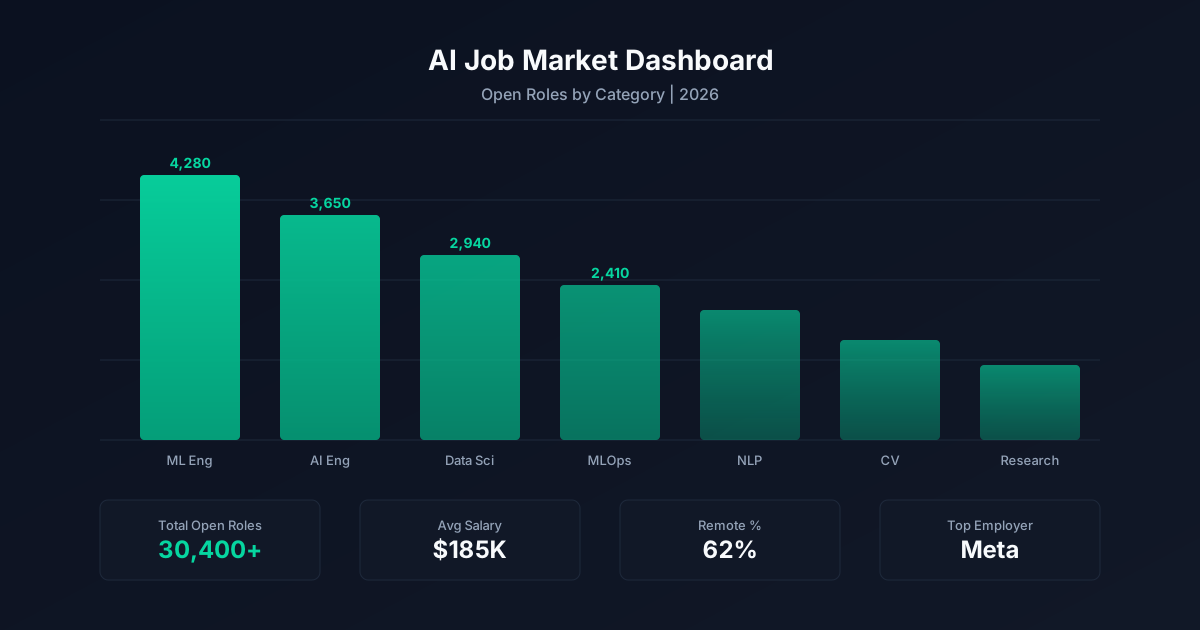
The AI job market has 3,708 open positions tracked in our dataset. By seniority: 102 entry-level, 1,705 mid-level, 1,469 senior, and 432 leadership roles (Director, VP, C-Level). Remote roles make up 14% of the market (508 positions). The remaining 3,180 roles require on-site or hybrid attendance.
The market median for AI roles is $217,500. Top-quartile compensation starts at $272,100. The 90th percentile reaches $325,000. Highest-paying categories: AI Safety ($300,000 median, 21 roles); Research Engineer ($280,000 median, 147 roles); AI Architect ($254,798 median, 67 roles).
Demand for AI/ML Engineers has been strong and consistent. Unlike some AI roles that spike with hype cycles, ML engineering is a foundational need. Every company deploying AI models needs people who can keep them running, and the gap between research prototypes and production systems keeps growing.
The AI Job Market Today
The AI job market spans 3,708 open positions across 16 role categories. The largest categories by volume: AI/ML Engineer (2,605), Data Scientist (310), AI Software Engineer (259). These three account for the majority of open positions, though smaller categories often have higher per-role compensation because of specialized skill requirements.
The seniority mix tells a story about where AI teams are in their maturity. Entry-level roles (102) are outnumbered by mid-level (1,705) and senior (1,469) positions, reflecting that most companies are past the 'build a team from scratch' phase and need experienced engineers who can ship production systems. Leadership roles (Director, VP, C-Level) total 432 positions, representing the bottleneck between technical execution and organizational strategy.
Remote work availability sits at 14% of all AI roles (508 positions), with 3,180 requiring on-site or hybrid attendance. The remote share has stabilized after the post-pandemic correction. Senior and specialized roles (Research Scientist, ML Architect) are more likely to be remote-eligible than entry-level positions, partly because experienced hires have more negotiating power and partly because these roles require less hands-on mentorship.
AI compensation is structured in clear tiers. The market median sits at $217,500. Top-quartile roles start at $272,100, and the 90th percentile reaches $325,000. These figures include base salary with disclosed compensation. Total compensation (including equity, bonuses, and sign-on) runs 20-40% higher at companies that offer those components.
Category matters for compensation. AI Safety roles lead at $300,000 median, while Prompt Engineer roles sit at $140,000. The spread between highest and lowest-paying categories reflects the premium on specialized technical skills versus broader analytical roles.
The most in-demand skills across all AI postings: Python (1,890 postings), Aws (1,103 postings), Azure (877 postings), Rag (855 postings), Gcp (631 postings), Prompt Engineering (560 postings), Pytorch (545 postings), Claude (498 postings). Python dominates, appearing in the vast majority of role descriptions regardless of category. Cloud platform experience (AWS, GCP, Azure) is the second most common requirement. The newer entrants to the top skills list (RAG, vector databases, LLM APIs) reflect the shift from traditional ML toward generative AI applications.
Frequently Asked Questions
Get Weekly AI Career Intelligence
Salary data, skills demand, and market signals from 16,000+ AI job postings. Every Monday.