
Interested in this MLOps Engineer role at GRVTY?
Apply Now →Skills & Technologies
About This Role
Charles River Analytics, a GRVTY company, creates solutions and technology to tackle the world's most challenging problems. Our team of technological entrepreneurs works together to push at the forefront of enhanced AI, robotics, smart sensing, and human\-centered computing. The resulting research and development help to continuously advance government programs and discover new possibilities in the commercial marketplace. At Charles River, we take great pride in our success at attracting and retaining the most talented and creative problem\-solvers in our field. Now as part of GRVTY, we offer the same trusted capabilities with increased organizational depth and expanded capacity across mission\-critical national security domains. Are you ready to accelerate our mission\-focused innovations? We'd love to hear from you!
What You'll be Owning:
We have an exciting opportunity for an MLOps Software Engineer to join a customer on\-site as an embedded technical analyst. In this role, you will be responsible for customizing AI agent training configurations and tailoring agent\-based simulation backends to support military wargaming and analysis. Your responsibilities will include helping customers define analytical problems, coding agent behavior and decision\-making logic, configuring the agent backend, evaluating agent outputs, and identifying any shortcomings in the domain\-specific language or agent architecture for the product development team.
Our ideal candidate is much more than a typical data analyst or AI researcher. We are looking for a customer\-facing applied AI and wargaming analyst who can effectively represent military decision problems, behaviors, constraints, objectives, and workflows within a proprietary agent\-based simulation architecture. If you're interested in answering this challenge, we'd love to hear from you. Join our mission and innovate with purpose.
What You Must Have:
- Bachelor's degree in computer science or a related field; a graduate\-level degree is preferred
- Experience in artificial intelligence, with a focus on AI agent reinforcement learning \-and agent\-based simulation
- Proficiency in understanding and configuring agent roles, goals, behaviors, interactions, state, decision logic, and emergent behavior within a simulation environment
- Capability to read, write, customize, test, and document a specialized language or configuration grammar used to express wargaming logic
- Experience with deployment engineering (e.g., build systems and containerization), Docker, Kubernetes, cloud\-deployment (e.g., AWS gov cloud), and proficient with logging and monitoring systems to maintain high up time.
- Experience working with customers to define analytical questions, decision contexts, assumptions, measures, constraints, and experimental designs
- Skills in testing agent behaviors, inspecting traces, debugging unexpected outcomes, documenting uncertainties, and clearly communicating limitations
- Ability to configure agent runtime settings, data/context sources, tool access, execution parameters, integration points, and versioned baselines
- Proficient in explaining complex agent behaviors and domain\-specific language (DSL) logic to non\-developer military users, as well as communicating field issues to engineering teams
- Capacity to translate customer needs and observed shortfalls into product requirements, bug reports, feature requests, and acceptance criteria
- Active or eligible for a security clearance, as required by contract
What Would be Nice to Have:
- 5\+ years of experience in artificial intelligence, with a focus on agent\-based simulation
- Experience with agent\-based modeling, AI\-enabled simulations, decision\-support tools, wargaming systems, and human\-machine teaming
- Proficient in domain\-specific languages (DSLs), scripting languages, behavior trees, rule engines, planning systems, multi\-agent systems, and simulation configuration languages
- Skilled in Python, YAML/JSON, SQL, Git, CI/CD pipelines, testing frameworks, logging, tracing, and configuration management
- Familiar with large language model (LLM)\-enabled agents, symbolic AI, planning algorithms, reinforcement learning, behavior modeling, and cognitive architectures, as they pertain to architecture
- Experience in military analysis, campaign analysis, mission analysis, operational planning, or experimentation
- Knowledge of AI risk management, model evaluation, traceability, human oversight, and responsible AI documentation
Why Choose GRVTY
The toughest national security challenges demand vision and ingenuity, not just resources. We deliver mission and technical expertise to outpace our adversaries. We're purpose\-built to tackle the most entrenched, systemic national security issues around the world.
We partner with our customers to help them overcome challenges in every corner of technology and defense—including the ones still being explored. Our growing capabilities create complementary advantages, giving on\-the\-ground operations the edge they need to succeed. We muster everything we have to answer every challenge presented, every day of our lives.
At GRVTY, we believe that when our employees thrive, our company thrives. That's why we offer a comprehensive and competitive benefits package designed to support your well\-being, growth, and work\-life balance.
- Robust health plan including medical, dental, and vision
- Health Savings Account with company contribution
- Annual Paid Time Off and Paid Holidays
- Paid Parental Leave
- 401k with generous company match
- Training and Development Opportunities
- Award Programs
- Variety of Company Sponsored Events
EEO Statement
GRVTY, is an Equal Opportunity Employer. All qualified applicants will receive consideration for employment without regard to race, color, religion, sex, sexual orientation, gender identity, national origin, disability, or status as a protected veteran and will not be discriminated against on the basis of disability.
Anyone requiring reasonable accommodations should email [email protected] or call 703\-544\-7930 with requested details. A member of the HR team will respond to your request within 2 business days.
Know Your Rights: Workplace Discrimination is Illegal (eeoc.gov)
Please review our current job openings and apply for the positions you believe may be a fit. If you are not an immediate fit, we will also keep your resume in our database for future opportunities.
Salary Context
This $140K-$225K range is above the median for MLOps Engineer roles in our dataset (median: $177K across 20 roles with salary data).
View full MLOps Engineer salary data →Role Details
About This Role
MLOps Engineers build the infrastructure that keeps ML models running in production. They own CI/CD pipelines for model deployment, monitoring for data drift and model degradation, and the tooling that lets data scientists ship faster. If ML Engineers build the models, MLOps Engineers build the roads those models travel on.
The job is fundamentally about reliability and velocity. Data scientists want to iterate fast. Product teams want stable predictions. Your job is to make both happen simultaneously. That means building deployment pipelines that catch regressions before they hit production, monitoring systems that alert on data drift before it degrades model performance, and self-service tooling that lets data scientists deploy without filing a ticket.
Across the 3,708 AI roles we're tracking, MLOps Engineer positions make up 1% of the market. At GRVTY, this role fits into their broader AI and engineering organization.
MLOps demand tracks closely with production ML adoption. As more companies move models from notebooks to production, the need for MLOps grows. The role is well-established at large tech companies and growing fast at mid-stage startups that are hitting the 'our models work in notebooks but break in production' phase.
What the Work Looks Like
A typical week involves: debugging a model deployment that's serving stale predictions, building a new monitoring dashboard for a feature team, writing Terraform for GPU-enabled inference clusters, reviewing pull requests for the ML platform's CI/CD pipeline, and meeting with data scientists to understand their pain points. You're the bridge between ML and infrastructure.
MLOps demand tracks closely with production ML adoption. As more companies move models from notebooks to production, the need for MLOps grows. The role is well-established at large tech companies and growing fast at mid-stage startups that are hitting the 'our models work in notebooks but break in production' phase.
Skills Required
Kubernetes, Docker, and cloud infrastructure are baseline. Most roles want experience with ML-specific tooling: MLflow, Kubeflow, Weights & Biases, or similar. Strong DevOps fundamentals matter more than ML theory. You need to understand model serving (TorchServe, Triton, vLLM), monitoring (Prometheus, Grafana), and infrastructure-as-code (Terraform, Pulumi).
GPU infrastructure knowledge is increasingly valuable as LLM inference becomes a major cost center. Understanding GPU scheduling, multi-node training setups, and inference optimization (quantization, batching, caching) puts you in the top tier. Experience with model registries and feature stores rounds out the profile.
Good MLOps postings specify their ML stack, infrastructure scale, and the problems they're solving (deployment velocity, cost optimization, monitoring gaps). Red flag: companies that want MLOps but don't have any models in production yet. You'll end up doing general DevOps instead.
Compensation Benchmarks
MLOps Engineer roles pay a median of $220,000 based on 47 positions with disclosed compensation. Mid-level AI roles across all categories have a median of $200,000. This role's midpoint ($182K) sits 17% below the category median. Disclosed range: $140K to $225K.
Across all AI roles, the market median is $217,500. Top-quartile compensation starts at $272,100. The 90th percentile reaches $325,000. For comparison, the highest-paying categories include AI Safety ($300,000) and Research Engineer ($280,000). By seniority level: Entry: $120,000; Mid: $200,000; Senior: $230,000; Director: $272,150; VP: $250,000.
GRVTY AI Hiring
GRVTY has 6 open AI roles right now. They're hiring across AI/ML Engineer, AI Software Engineer, Research Scientist, Data Scientist. Positions span Cambridge, MA, US, Honolulu, HI, US, McLean, VA, US. Compensation range: $220K - $225K.
Location Context
Across all AI roles, 14% (508 positions) offer remote work, while 3,180 require on-site attendance. Top AI hiring metros: New York (1,045 roles, $220,000 median); San Francisco (810 roles, $277,088 median); Los Angeles (397 roles, $215,000 median).
Career Path
Common paths into MLOps Engineer roles include DevOps Engineer, Platform Engineer, Data Engineer.
From here, career progression typically leads toward ML Platform Lead, Infrastructure Architect, Engineering Manager.
DevOps engineers with ML curiosity have the shortest path. You already understand deployment, monitoring, and infrastructure. Add ML-specific knowledge (model serving, data pipelines, experiment tracking) and you're competitive. The career ceiling is high: ML Platform Lead roles at top companies pay well because the infrastructure complexity is enormous.
What to Expect in Interviews
Interviews emphasize infrastructure and reliability. Expect questions about CI/CD for ML models, monitoring for data drift, and how you'd design a model serving platform that handles 10K requests per second. Coding rounds focus on Python and infrastructure-as-code (Terraform, Helm). Be ready to discuss tradeoffs between different model serving frameworks and how you'd handle rollback when a new model degrades performance.
When evaluating opportunities: Good MLOps postings specify their ML stack, infrastructure scale, and the problems they're solving (deployment velocity, cost optimization, monitoring gaps). Red flag: companies that want MLOps but don't have any models in production yet. You'll end up doing general DevOps instead.
AI Hiring Overview
The AI job market has 3,708 open positions tracked in our dataset. By seniority: 102 entry-level, 1,705 mid-level, 1,469 senior, and 432 leadership roles (Director, VP, C-Level). Remote roles make up 14% of the market (508 positions). The remaining 3,180 roles require on-site or hybrid attendance.
The market median for AI roles is $217,500. Top-quartile compensation starts at $272,100. The 90th percentile reaches $325,000. Highest-paying categories: AI Safety ($300,000 median, 21 roles); Research Engineer ($280,000 median, 147 roles); AI Architect ($254,798 median, 67 roles).
MLOps demand tracks closely with production ML adoption. As more companies move models from notebooks to production, the need for MLOps grows. The role is well-established at large tech companies and growing fast at mid-stage startups that are hitting the 'our models work in notebooks but break in production' phase.
The AI Job Market Today
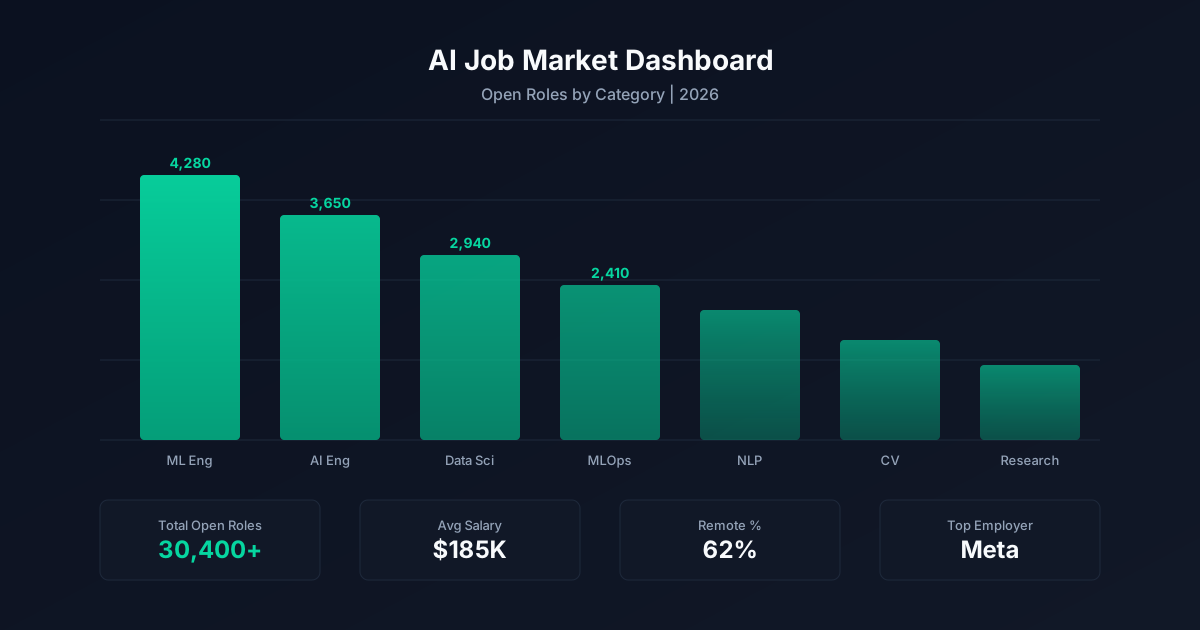
The AI job market spans 3,708 open positions across 16 role categories. The largest categories by volume: AI/ML Engineer (2,605), Data Scientist (310), AI Software Engineer (259). These three account for the majority of open positions, though smaller categories often have higher per-role compensation because of specialized skill requirements.
The seniority mix tells a story about where AI teams are in their maturity. Entry-level roles (102) are outnumbered by mid-level (1,705) and senior (1,469) positions, reflecting that most companies are past the 'build a team from scratch' phase and need experienced engineers who can ship production systems. Leadership roles (Director, VP, C-Level) total 432 positions, representing the bottleneck between technical execution and organizational strategy.
Remote work availability sits at 14% of all AI roles (508 positions), with 3,180 requiring on-site or hybrid attendance. The remote share has stabilized after the post-pandemic correction. Senior and specialized roles (Research Scientist, ML Architect) are more likely to be remote-eligible than entry-level positions, partly because experienced hires have more negotiating power and partly because these roles require less hands-on mentorship.
AI compensation is structured in clear tiers. The market median sits at $217,500. Top-quartile roles start at $272,100, and the 90th percentile reaches $325,000. These figures include base salary with disclosed compensation. Total compensation (including equity, bonuses, and sign-on) runs 20-40% higher at companies that offer those components.
Category matters for compensation. AI Safety roles lead at $300,000 median, while Prompt Engineer roles sit at $140,000. The spread between highest and lowest-paying categories reflects the premium on specialized technical skills versus broader analytical roles.
The most in-demand skills across all AI postings: Python (1,890 postings), Aws (1,103 postings), Azure (877 postings), Rag (855 postings), Gcp (631 postings), Prompt Engineering (560 postings), Pytorch (545 postings), Claude (498 postings). Python dominates, appearing in the vast majority of role descriptions regardless of category. Cloud platform experience (AWS, GCP, Azure) is the second most common requirement. The newer entrants to the top skills list (RAG, vector databases, LLM APIs) reflect the shift from traditional ML toward generative AI applications.
Frequently Asked Questions
Get Weekly AI Career Intelligence
Salary data, skills demand, and market signals from 16,000+ AI job postings. Every Monday.