
Interested in this Data Scientist role at Hitachi Rail?
Apply Now →Skills & Technologies
About This Role
Location:
(HTA) NCP (Hillsboro, OR)
Job ID:
R0128931
Date Posted:
2026\-05\-01
Company Name:
HITACHI HIGH\-TECH AMERICA, INC.
Profession (Job Category):
Data Analytics/Business Intelligence
Job Schedule:
Full time
Remote:
No
Job Description:
POSITION: Data Scientist I or II
DIVISION: Metrology and Analysis Systems Division (MAD)
COMPANY: Hitachi High\-Tech America, Inc. (“HTA”)
TRAVEL: Up to 5% (internationally)
REMOTE WORK: Hybrid (\+50% Remote) – Remote 60% / Onsite 40%
EXPECTED PAY RANGE: Data Scientist I: $99,608 \- $136,961 annually
Data Scientist II: $121,673 \- $167,301 annually
*This pay range is for the position’s base pay only. This position may be eligible for other compensation including bonus pay and/or allowances. Candidates will receive additional information during the interview and selection process.*
Position Level: The best fit candidate selected for this position will be offered a job title/level (Data Scientist I vs. Data Scientist II) that is most appropriate after evaluating the person's education, experience, training, knowledge, skills, and abilities.
POSITION SUMMARY
Data Scientists are responsible for the development and maintenance of Artificial Intelligence (AI) software and systems for Hitachi High\-Tech America, Inc. (HTA) products.
PRIMARY RESPONSIBILITIES
- Hands\-on development and write algorithms in machine learning, statistical modelling, neural nets, and pattern recognition from data exploration
- Develop, train, and deploy ML models for Time\-series forecasting and anomaly detection. Classification and regression on tabular and sensor data, predictive maintenance and failure prediction
- Design end\-to\-end ML pipelines including Data ingestion, feature engineering, model training, evaluation, and deployment
- Lead and support Root Cause Analysis (RCA) investigations using data\-driven approaches
- Build frameworks for Fault Tree Analysis (FTA) and failure mode identification
- Collaborate with domain experts (engineering, operations) to translate failure patterns into ML features and models
- Design and develop Agentic AI systems capable of:
+ Autonomous reasoning over structured and unstructured data
+ Tool usage (query engines, APIs, analytics pipelines)
+ Multi\-step decision making and diagnostics workflows
- Implement LLM\-based systems with:
+ Tool\-calling frameworks
+ Retrieval\-Augmented Generation (RAG)
+ Structured outputs and validation pipelines
- Partner with cross\-functional teams (Data Engineers, Software Engineers, Domain Experts)
- Build scalable, production\-ready solutions using:
+ Python\-based ML frameworks (e.g., TensorFlow, PyTorch, Scikit\-learn)
+ Data processing tools (Pandas, Spark, SQL)
- Deploy models and services using:
+ REST APIs (FastAPI, Flask)
+ Containerization (Docker, Kubernetes)
- Work with modern data platforms:
+ Time\-series DBs (e.g., Prometheus, InfluxDB)
+ Analytical DBs (e.g., ClickHouse, PostgreSQL)
+ Vector DBs (e.g., Qdrant, FAISS)
- Translate business problems into technical solutions
- Creating architecture and complex designs independently and documenting them
- Integrate and test software to confirm compliance with specifications
- Developing functional specifications
- Participate in design reviews, code reviews of peers and test reviews
- Performing functional tests
- Other duties as assigned
EDUCATION, LICENSES, and/or CERTIFICATION REQUIREMENTS
- Master of Science degree in Data Science, Statistics, Computer Science, or similar quantitative field
EXPERIENCE and TRAVEL REQUIREMENTS
- Must have at least five (5\) years of practical experience in writing algorithms in Machine Learning, Statistical Modelling, Neural Nets, and Pattern Recognition from data exploration
- Five (5\) years of experience in Data Science / Machine Learning
- Strong programming skills in Python
- Proven experience with:
+ Time\-series analysis and anomaly detection
+ Statistical modeling and machine learning algorithms
- Hands\-on experience with:
+ Root Cause Analysis (RCA)
+ Fault Tree Analysis (FTA) or failure modeling
- Experience working with real\-world, noisy, and large\-scale datasets
- Experience with Agentic AI / LLM systems, including:
+ Tool\-calling architecture
+ RAG pipelines
+ Prompt engineering and evaluation frameworks
- Familiarity with:
+ Distributed systems and scalable ML infrastructure
+ MLOps practices (CI/CD, monitoring, model versioning)
- Knowledge of:
+ Signal processing or physics\-based modeling
+ Graph\-based reasoning or causal inference
- Full software development lifecycle experience, must be comfortable working using Agile as well as iterative methodologies
- Experience with Test\-driven development using tools to spot performance issues and memory leaks.
- This position requires international travel for business purposes – up to 5%
SKILLS and ABILITIES REQUIREMENTS / SAFETY REQUIREMENTS
- Ability to investigate and apply new technologies
- Effective oral and written communication skills, including ability to effectively communicate challenging or technical concepts.
- Excellent relationship building skills
- General technical knowledge of semiconductor metrology equipment
- Strong engineering analytical and problem\-solving skills
- Proactively undertake R\&D activities and deliver tangible results under deadlines
- Ability to manage multiple tasks and prioritize work accordingly
- Work longer than normal hours as needed during releases and customer escalations
- Self\-sufficient, self\-reliant, and self\-disciplined, but also able to operate effectively as part of a team
- Ability to comprehend and enforce safety policies
*Equal Opportunity Employer (EOE)*
*Hitachi High\-Tech America, Inc. is an equal opportunity* *employer. Hitachi* *High\-Tech America, Inc. is committed to equal employment opportunities for qualified applicants without discrimination on the basis of actual or perceived of race (including traits historically associated with race, such as natural hairstyle), color, national origin, ancestry, religious creed, age, sex, sexual orientation, gender (including gender expression and gender identity), marital status, registered domestic partner status, family status, military and veteran status, domestic violence victim status, medical condition (including genetic characteristics), physical or mental disability, pregnancy, or any other legally protected characteristic or status.*
*If you require reasonable accommodation in completing this application, interviewing, completing any pre\-employment testing, or otherwise participating in the employee selection process, please direct your inquiries to* *HTA\-AccommodationRequests@hitachi\-hightech.com*
Salary Context
This $99K-$167K range is below the median for Data Scientist roles in our dataset (median: $155K across 226 roles with salary data).
View full Data Scientist salary data →Role Details
About This Role
Data Scientists extract insights and build predictive models from data. In the AI era, many roles now include LLM-powered analytics, automated reporting, and integration with generative AI tools. The role has evolved from 'the person who runs SQL queries' to 'the person who builds AI-powered data products.'
Modern data science roles fall into two camps: analytics-focused (insights, dashboards, experimentation) and ML-focused (building predictive models, recommendation systems, NLP features). The best data scientists can operate in both modes. The AI shift means that even analytics-focused roles now involve building automated insight pipelines using LLMs, going well beyond one-off reports.
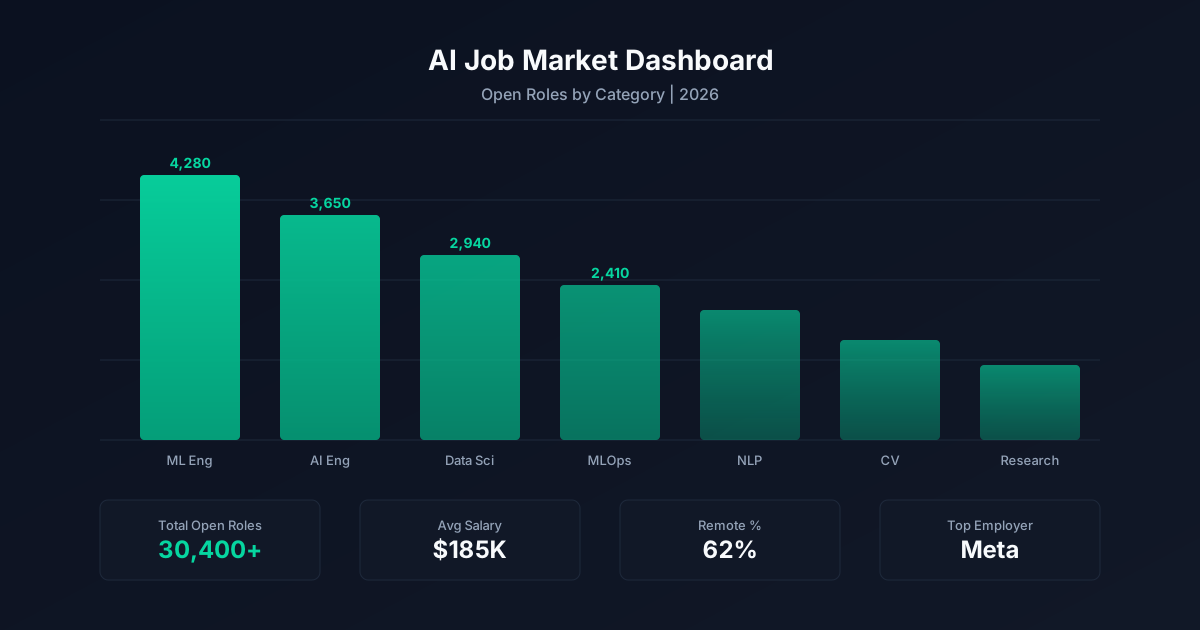
Across the 3,708 AI roles we're tracking, Data Scientist positions make up 8% of the market. At Hitachi Rail, this role fits into their broader AI and engineering organization.
Data Scientist roles remain in high demand, though the definition keeps shifting. Companies increasingly want candidates who can bridge traditional statistics with modern ML and LLM capabilities. The 'pure insights' data scientist role is consolidating into analytics engineering, while the 'build models' data scientist role is merging with ML engineering.
What the Work Looks Like
A typical week includes: analyzing experiment results for a product feature launch, building a predictive model for customer churn, creating an automated reporting pipeline using LLM-powered summarization, presenting insights to stakeholders, and cleaning data (always cleaning data). The ratio of analysis to engineering varies by company, but expect both.
Data Scientist roles remain in high demand, though the definition keeps shifting. Companies increasingly want candidates who can bridge traditional statistics with modern ML and LLM capabilities. The 'pure insights' data scientist role is consolidating into analytics engineering, while the 'build models' data scientist role is merging with ML engineering.
Skills Required
Python, SQL, and statistical modeling are the foundation. Increasingly, roles want experience with LLMs for data analysis, automated insight generation, and building AI-powered data products. Familiarity with cloud data platforms (Snowflake, BigQuery, Databricks) and ML frameworks (scikit-learn, PyTorch) covers most job requirements.
Experimentation design and causal inference are underrated skills that separate strong candidates. Companies care about whether their product changes cause improvements, and can distinguish causation from correlation. A/B testing methodology, Bayesian statistics, and the ability to communicate uncertainty to non-technical stakeholders are high-value skills.
Good postings specify the data stack, the types of problems you'll work on, and the team structure. Look for companies that differentiate between analytics and ML data science. Vague 'data scientist' postings that list every skill under the sun usually mean the company doesn't know what they need.
Compensation Benchmarks
Data Scientist roles pay a median of $192,890 based on 463 positions with disclosed compensation. Mid-level AI roles across all categories have a median of $200,000. This role's midpoint ($133K) sits 31% below the category median. Disclosed range: $99K to $167K.
Across all AI roles, the market median is $217,500. Top-quartile compensation starts at $272,100. The 90th percentile reaches $325,000. For comparison, the highest-paying categories include AI Safety ($300,000) and Research Engineer ($280,000). By seniority level: Entry: $120,000; Mid: $200,000; Senior: $230,000; Director: $272,150; VP: $250,000.
Hitachi Rail AI Hiring
Hitachi Rail has 1 open AI role right now. They're hiring across Data Scientist. Based in Hillsboro, OR, US. Compensation range: $167K - $167K.
Location Context
Across all AI roles, 14% (508 positions) offer remote work, while 3,180 require on-site attendance. Top AI hiring metros: New York (1,045 roles, $220,000 median); San Francisco (810 roles, $277,088 median); Los Angeles (397 roles, $215,000 median).
Career Path
Common paths into Data Scientist roles include Data Analyst, Statistician, Quantitative Researcher.
From here, career progression typically leads toward Senior Data Scientist, ML Engineer, AI Product Manager.
Start with statistics and SQL. Build a real analysis project on public data that demonstrates insight generation alongside model building. The market values data scientists who can communicate findings clearly to business stakeholders. If you want to move toward ML engineering, invest in software engineering fundamentals and production deployment skills.
What to Expect in Interviews
Interviews combine statistics, coding, and business acumen. SQL is almost always tested, often with complex joins and window functions. Expect a case study round where you're given a business problem and asked to design an analysis plan. Coding rounds focus on pandas, statistical modeling, and visualization. The strongest differentiator is how well you communicate insights to non-technical stakeholders during presentation rounds.
When evaluating opportunities: Good postings specify the data stack, the types of problems you'll work on, and the team structure. Look for companies that differentiate between analytics and ML data science. Vague 'data scientist' postings that list every skill under the sun usually mean the company doesn't know what they need.
AI Hiring Overview
The AI job market has 3,708 open positions tracked in our dataset. By seniority: 102 entry-level, 1,705 mid-level, 1,469 senior, and 432 leadership roles (Director, VP, C-Level). Remote roles make up 14% of the market (508 positions). The remaining 3,180 roles require on-site or hybrid attendance.
The market median for AI roles is $217,500. Top-quartile compensation starts at $272,100. The 90th percentile reaches $325,000. Highest-paying categories: AI Safety ($300,000 median, 21 roles); Research Engineer ($280,000 median, 147 roles); AI Architect ($254,798 median, 67 roles).
Data Scientist roles remain in high demand, though the definition keeps shifting. Companies increasingly want candidates who can bridge traditional statistics with modern ML and LLM capabilities. The 'pure insights' data scientist role is consolidating into analytics engineering, while the 'build models' data scientist role is merging with ML engineering.
The AI Job Market Today
The AI job market spans 3,708 open positions across 16 role categories. The largest categories by volume: AI/ML Engineer (2,605), Data Scientist (310), AI Software Engineer (259). These three account for the majority of open positions, though smaller categories often have higher per-role compensation because of specialized skill requirements.
The seniority mix tells a story about where AI teams are in their maturity. Entry-level roles (102) are outnumbered by mid-level (1,705) and senior (1,469) positions, reflecting that most companies are past the 'build a team from scratch' phase and need experienced engineers who can ship production systems. Leadership roles (Director, VP, C-Level) total 432 positions, representing the bottleneck between technical execution and organizational strategy.
Remote work availability sits at 14% of all AI roles (508 positions), with 3,180 requiring on-site or hybrid attendance. The remote share has stabilized after the post-pandemic correction. Senior and specialized roles (Research Scientist, ML Architect) are more likely to be remote-eligible than entry-level positions, partly because experienced hires have more negotiating power and partly because these roles require less hands-on mentorship.
AI compensation is structured in clear tiers. The market median sits at $217,500. Top-quartile roles start at $272,100, and the 90th percentile reaches $325,000. These figures include base salary with disclosed compensation. Total compensation (including equity, bonuses, and sign-on) runs 20-40% higher at companies that offer those components.
Category matters for compensation. AI Safety roles lead at $300,000 median, while Prompt Engineer roles sit at $140,000. The spread between highest and lowest-paying categories reflects the premium on specialized technical skills versus broader analytical roles.
The most in-demand skills across all AI postings: Python (1,890 postings), Aws (1,103 postings), Azure (877 postings), Rag (855 postings), Gcp (631 postings), Prompt Engineering (560 postings), Pytorch (545 postings), Claude (498 postings). Python dominates, appearing in the vast majority of role descriptions regardless of category. Cloud platform experience (AWS, GCP, Azure) is the second most common requirement. The newer entrants to the top skills list (RAG, vector databases, LLM APIs) reflect the shift from traditional ML toward generative AI applications.
Frequently Asked Questions
Get Weekly AI Career Intelligence
Salary data, skills demand, and market signals from 16,000+ AI job postings. Every Monday.