
Interested in this Data Scientist role at Innodata?
Apply Now →Skills & Technologies
About This Role
Innodata (Nasdaq: INOD) is a global data engineering company. We believe that data and Artificial Intelligence (AI) are inextricably linked. Our mission is to enable the responsible advancement of artificial intelligence by providing the data, evaluation frameworks, and human expertise required to build AI systems that can be trusted at scale. We provide a range of transferable solutions, platforms, and services for Generative AI / AI builders and adopters. In every relationship, we honor our 36\+ year legacy delivering the highest quality data and outstanding outcomes for our customers.
Scope of the Role:
Financial services is one of the highest\-stakes domains for generative AI. Numerical accuracy, regulatory compliance, model risk management, auditability, and customer harm prevention, among other concerns, are the bar for shipping anything real. Innodata partners with foundation model labs, banks, asset managers, fintechs, and other enterprise AI teams building LLMs, multimodal systems, and AI agents for financial workflows.
As an Applied Data Scientist, Financial AI Evaluation \& Datasets, you own the design, measurement quality, and domain validity of the datasets used to train, fine\-tune, evaluate, and monitor financial\-domain LLMs, vision\-language models, multimodal document models, and AI agents. You bring financial\-domain fluency and data science rigor: you can read a risk policy, financial statement, or customer transcript, among other financial\-services documents; turn it into a measurable dataset and evaluation specification; define what correct, grounded, compliant, and safe mean for the use case; and produce evidence that sophisticated financial\-services customers, model\-risk teams, and AI governance stakeholders can trust.
This role has a special emphasis on unstructured and multimodal financial data — PDFs, scanned documents, spreadsheets, charts, call transcripts, and other mixed\-document workflows where text, numbers, visuals, and metadata all matter. You will work in a pod with a Technical Solutions Architect (scopes the engagement), an Applied Research Scientist (shapes evaluation methodology), an AI/ML Research Engineer (builds training and evaluation infrastructure), and Language Data Scientists (run annotation at scale), making sure what the team produces is domain\-valid, statistically defensible, compliant, auditable, and useful for evaluation and post\-training.
What You'll Own:
- Translate customer goals — such as improving financial reasoning, building an eval suite for earnings\-call summarization, or evaluating an AML/fraud copilot — into concrete dataset specifications, taxonomies, rubrics, and acceptance criteria.
- Design training and evaluation datasets across the financial AI surface: financial QA, filings and earnings analysis, credit and underwriting, fraud/AML investigation, and compliance, among other financial workflows.
- Foreground unstructured and multimodal financial data in dataset design — PDFs, scanned statements, tables, charts, and call transcripts — used by analysts, advisors, compliance reviewers, and operations teams.
- Design datasets and evaluations for retrieval\-augmented and source\-grounded systems: evidence citation and faithfulness to source documents, data freshness, conflict resolution across sources, and failure modes caused by incomplete or incorrectly parsed context.
- Evaluate agentic and workflow\-integrated financial AI systems: tool use, retrieval, transaction boundaries, escalation behavior, and controls that prevent unsafe or unauthorized actions.
- Develop evaluation methodology that goes beyond surface accuracy — numerical consistency, hallucination rates on high\-risk claims, refusal and escalation appropriateness, robustness under ambiguity, and fairness across protected or sensitive customer segments.
- Define sampling strategies, label schemas, and adjudication workflows with Language Data Scientists and finance SMEs; write annotation guidelines that make subjective finance\-domain judgments explicit, calibratable, and auditable.
- Build the statistical and ML tooling that makes large financial datasets trustworthy: stratified sampling across products, markets, and modalities; bias analysis; leakage detection; and distribution shift checks, among other reliability checks.
- Build evaluation and dataset\-quality evidence to support financial\-services model risk management: assumptions, limitations, validation results, and residual risks, packaged as reproducible evidence.
- Partner with the AI/ML Research Engineer to instrument datasets into training, evaluation, and monitoring pipelines — rubric\-grounded LLM\-as\-judge prompts, regression suites, and continuous monitoring.
- Own data quality end\-to\-end, from intake through delivery: PII handling, provenance tracking, versioning, and modality\-specific QA checks.
- Reason about financial workflow context: where AI outputs enter analyst, advisor, compliance, risk, or customer\-facing workflows; what evidence a reviewer needs to trust them; and when uncertainty must be surfaced.
- Support the Technical Solutions Architect during customer discovery and proposals: scoping dataset programs, sizing annotation effort, and explaining methodology to client stakeholders.
- Stay current on the financial AI landscape: regulatory developments, benchmark releases, and emerging evaluation methodology for finance\-domain models.
- Contribute to Innodata internal IP: reusable taxonomies, evaluation rubrics, golden datasets, and methodology templates.
You'll Thrive in This Role If You Have:
- 5\+ years of data science experience, with at least 2\+ years in financial services, fintech, banking, or a comparable regulated data environment.
- Real working knowledge of financial data and workflows: financial statements, SEC filings, transaction data, and other common financial\-services document types.
- Hands\-on experience with unstructured and multimodal financial data — some combination of PDFs, scanned documents, spreadsheets, charts, or call transcripts.
- Familiarity with financial standards or protocols such as XBRL, ISO 20022, or GAAP/IFRS reporting concepts, etc. is strongly preferred.
- Hands\-on experience designing datasets for ML — not just consuming them. You have written annotation guidelines, sized cohorts, set quality thresholds, and shipped data that downstream teams could actually train, evaluate, or monitor on.
- Familiarity with LLM\-based and multimodal financial AI workflows: prompt design, rubric\-based evaluation, RAG, LLM\-as\-judge methods, and the limitations of automated evaluation in high\-stakes contexts.
- Strong Python and SQL; comfort with pandas, scikit\-learn, or equivalent; working familiarity with Hugging Face, PyTorch, or model APIs.
- Statistical literacy: sampling design, inter\-annotator agreement metrics (e.g., Cohen's kappa), confidence intervals, and the ability to push back when a number is being over\-interpreted.
- Solid grasp of financial services privacy, compliance, and governance: PII handling, GLBA or equivalent privacy regimes, MNPI sensitivity, and documentation fit for regulated AI programs.
- Excellent collaboration skills — upstream with a Technical Solutions Architect, sideways with research scientists and engineers, and downstream with SME annotators and quality teams.
- A bias toward financial workflow realism. You would rather build a smaller dataset that reflects what analysts, advisors, or customers actually see than a larger one that looks impressive on paper but fails in practice.
- Degree in a relevant field — statistics, data science, economics, finance, or a related quantitative field, or equivalent demonstrated experience. Formal finance credentials aren't required, but CFA, FRM, or MBA backgrounds, etc. are especially encouraged.
- Experience designing evaluations for LLMs, VLMs, or multimodal models in financial reasoning, filings analysis, or fraud/AML contexts.
- Experience with document AI, OCR/post\-OCR quality, or table and chart extraction for complex financial documents.
- Familiarity with agentic evaluation, AI observability, experiment tracking, or tools such as Weights \& Biases or LangFuse.
- Familiarity with model risk management frameworks, validation documentation, fairness/bias auditing, or consumer protection analysis.
- Experience with multilingual or cross\-border financial data, or published/open\-source work in financial AI or model governance.
*The expected salary range for this position is $150,000 – $175,000 USD per year, based on experience, skills, and qualifications.*
*Please be aware of recruitment scams involving individuals or organizations falsely claiming to represent employers. Innodata will never ask for payment, banking details, or sensitive personal information during the application process. To learn more on how to recognize job scams, please visit the Federal Trade Commission's guide at* https://consumer.ftc.gov/articles/job\-scams.
*If you believe you've been targeted by a recruitment scam, please report it to Innodata at* [email protected] *and consider reporting it to the FTC at* ReportFraud.ftc.gov*.*
Salary Context
This $150K-$175K range is above the median for Data Scientist roles in our dataset (median: $155K across 226 roles with salary data).
View full Data Scientist salary data →Role Details
About This Role
Data Scientists extract insights and build predictive models from data. In the AI era, many roles now include LLM-powered analytics, automated reporting, and integration with generative AI tools. The role has evolved from 'the person who runs SQL queries' to 'the person who builds AI-powered data products.'
Modern data science roles fall into two camps: analytics-focused (insights, dashboards, experimentation) and ML-focused (building predictive models, recommendation systems, NLP features). The best data scientists can operate in both modes. The AI shift means that even analytics-focused roles now involve building automated insight pipelines using LLMs, going well beyond one-off reports.
Across the 3,708 AI roles we're tracking, Data Scientist positions make up 8% of the market. At Innodata, this role fits into their broader AI and engineering organization.
Data Scientist roles remain in high demand, though the definition keeps shifting. Companies increasingly want candidates who can bridge traditional statistics with modern ML and LLM capabilities. The 'pure insights' data scientist role is consolidating into analytics engineering, while the 'build models' data scientist role is merging with ML engineering.
What the Work Looks Like
A typical week includes: analyzing experiment results for a product feature launch, building a predictive model for customer churn, creating an automated reporting pipeline using LLM-powered summarization, presenting insights to stakeholders, and cleaning data (always cleaning data). The ratio of analysis to engineering varies by company, but expect both.
Data Scientist roles remain in high demand, though the definition keeps shifting. Companies increasingly want candidates who can bridge traditional statistics with modern ML and LLM capabilities. The 'pure insights' data scientist role is consolidating into analytics engineering, while the 'build models' data scientist role is merging with ML engineering.
Skills Required
Python, SQL, and statistical modeling are the foundation. Increasingly, roles want experience with LLMs for data analysis, automated insight generation, and building AI-powered data products. Familiarity with cloud data platforms (Snowflake, BigQuery, Databricks) and ML frameworks (scikit-learn, PyTorch) covers most job requirements.
Experimentation design and causal inference are underrated skills that separate strong candidates. Companies care about whether their product changes cause improvements, and can distinguish causation from correlation. A/B testing methodology, Bayesian statistics, and the ability to communicate uncertainty to non-technical stakeholders are high-value skills.
Good postings specify the data stack, the types of problems you'll work on, and the team structure. Look for companies that differentiate between analytics and ML data science. Vague 'data scientist' postings that list every skill under the sun usually mean the company doesn't know what they need.
Compensation Benchmarks
Data Scientist roles pay a median of $192,890 based on 463 positions with disclosed compensation. Mid-level AI roles across all categories have a median of $200,000. This role's midpoint ($162K) sits 16% below the category median. Disclosed range: $150K to $175K.
Across all AI roles, the market median is $217,500. Top-quartile compensation starts at $272,100. The 90th percentile reaches $325,000. For comparison, the highest-paying categories include AI Safety ($300,000) and Research Engineer ($280,000). By seniority level: Entry: $120,000; Mid: $200,000; Senior: $230,000; Director: $272,150; VP: $250,000.
Innodata AI Hiring
Innodata has 3 open AI roles right now. They're hiring across AI/ML Engineer, Data Scientist. Positions span Tysons Corner, VA, US, Ridgefield Park, NJ, US. Compensation range: $166K - $175K.
Location Context
Across all AI roles, 14% (508 positions) offer remote work, while 3,180 require on-site attendance. Top AI hiring metros: New York (1,045 roles, $220,000 median); San Francisco (810 roles, $277,088 median); Los Angeles (397 roles, $215,000 median).
Career Path
Common paths into Data Scientist roles include Data Analyst, Statistician, Quantitative Researcher.
From here, career progression typically leads toward Senior Data Scientist, ML Engineer, AI Product Manager.
Start with statistics and SQL. Build a real analysis project on public data that demonstrates insight generation alongside model building. The market values data scientists who can communicate findings clearly to business stakeholders. If you want to move toward ML engineering, invest in software engineering fundamentals and production deployment skills.
What to Expect in Interviews
Interviews combine statistics, coding, and business acumen. SQL is almost always tested, often with complex joins and window functions. Expect a case study round where you're given a business problem and asked to design an analysis plan. Coding rounds focus on pandas, statistical modeling, and visualization. The strongest differentiator is how well you communicate insights to non-technical stakeholders during presentation rounds.
When evaluating opportunities: Good postings specify the data stack, the types of problems you'll work on, and the team structure. Look for companies that differentiate between analytics and ML data science. Vague 'data scientist' postings that list every skill under the sun usually mean the company doesn't know what they need.
AI Hiring Overview
The AI job market has 3,708 open positions tracked in our dataset. By seniority: 102 entry-level, 1,705 mid-level, 1,469 senior, and 432 leadership roles (Director, VP, C-Level). Remote roles make up 14% of the market (508 positions). The remaining 3,180 roles require on-site or hybrid attendance.
The market median for AI roles is $217,500. Top-quartile compensation starts at $272,100. The 90th percentile reaches $325,000. Highest-paying categories: AI Safety ($300,000 median, 21 roles); Research Engineer ($280,000 median, 147 roles); AI Architect ($254,798 median, 67 roles).
Data Scientist roles remain in high demand, though the definition keeps shifting. Companies increasingly want candidates who can bridge traditional statistics with modern ML and LLM capabilities. The 'pure insights' data scientist role is consolidating into analytics engineering, while the 'build models' data scientist role is merging with ML engineering.
The AI Job Market Today
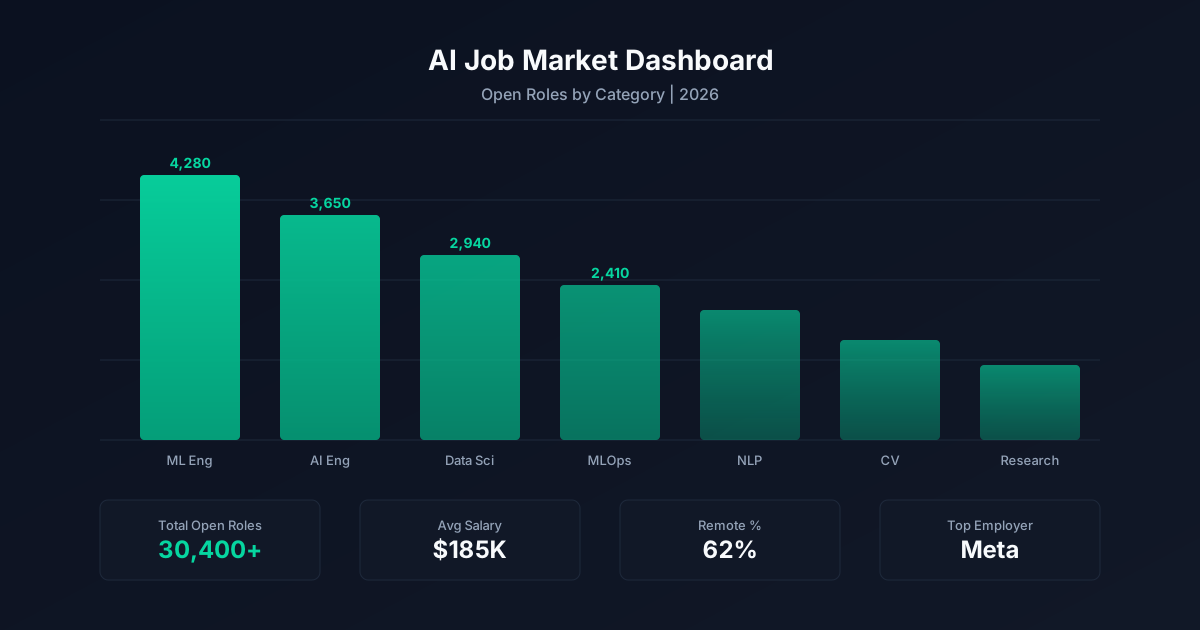
The AI job market spans 3,708 open positions across 16 role categories. The largest categories by volume: AI/ML Engineer (2,605), Data Scientist (310), AI Software Engineer (259). These three account for the majority of open positions, though smaller categories often have higher per-role compensation because of specialized skill requirements.
The seniority mix tells a story about where AI teams are in their maturity. Entry-level roles (102) are outnumbered by mid-level (1,705) and senior (1,469) positions, reflecting that most companies are past the 'build a team from scratch' phase and need experienced engineers who can ship production systems. Leadership roles (Director, VP, C-Level) total 432 positions, representing the bottleneck between technical execution and organizational strategy.
Remote work availability sits at 14% of all AI roles (508 positions), with 3,180 requiring on-site or hybrid attendance. The remote share has stabilized after the post-pandemic correction. Senior and specialized roles (Research Scientist, ML Architect) are more likely to be remote-eligible than entry-level positions, partly because experienced hires have more negotiating power and partly because these roles require less hands-on mentorship.
AI compensation is structured in clear tiers. The market median sits at $217,500. Top-quartile roles start at $272,100, and the 90th percentile reaches $325,000. These figures include base salary with disclosed compensation. Total compensation (including equity, bonuses, and sign-on) runs 20-40% higher at companies that offer those components.
Category matters for compensation. AI Safety roles lead at $300,000 median, while Prompt Engineer roles sit at $140,000. The spread between highest and lowest-paying categories reflects the premium on specialized technical skills versus broader analytical roles.
The most in-demand skills across all AI postings: Python (1,890 postings), Aws (1,103 postings), Azure (877 postings), Rag (855 postings), Gcp (631 postings), Prompt Engineering (560 postings), Pytorch (545 postings), Claude (498 postings). Python dominates, appearing in the vast majority of role descriptions regardless of category. Cloud platform experience (AWS, GCP, Azure) is the second most common requirement. The newer entrants to the top skills list (RAG, vector databases, LLM APIs) reflect the shift from traditional ML toward generative AI applications.
Frequently Asked Questions
Get Weekly AI Career Intelligence
Salary data, skills demand, and market signals from 16,000+ AI job postings. Every Monday.