
Interested in this AI/ML Engineer role at Meta?
Apply Now →About This Role
Creative Audio is looking for an experienced Voice Producer to drive AI voice and production projects. This role combines voice production expertise with proven experience in organizational skills and operational leadership, providing strategic guidance and hands\-on support to our voice, conversation, and sound designers. You will play a critical role in driving the success of voice and audio experiences by ensuring seamless collaboration, effective communication, and efficient project execution across multiple Executive stakeholders.
### AI Voice Producer Responsibilities:
- Manage all phases of voice production—casting, production, asset delivery, implementation, and quality control—tracking multiple projects and initiatives across internal teams and vendors
- Work closely with partner teams to define casting briefs and script requirements
- Partner closely with the Voice Design Lead to manage creative alignment and to direct voice over recording sessions as needed
- Manage vendor relationships, budgets, talent agreements, and ensure contracts are executed to meet Meta's standards and guidelines
- Support hardware and software voice prototyping efforts and testing
- Lead voice production operations that directly contribute to the execution of the team's product roadmap
- Taking initiative to develop production program and operational strategy
- scope and prioritize resources and workload while identifying gaps and creating solutions
- Build scalable operational support frameworks—project planning, resource allocation, risk management, workback schedules, and sprint plans—to ensure projects are delivered on time and within budget
- Identify and deliver work in highly complex areas that have many dependencies, working with cross\-functional stakeholders to get buy\-in and feedback at the appropriate production stages
- Drive cross\-functional teams—including research, product design, engineering, and product management—to ensure alignment and successful project outcomes, adapting communication style and maintaining effective channels to keep stakeholders informed
- Navigate complex product and design organizations
- understand interconnectedness of problems, features, or products within larger systems
- Work with Cross Functional Partners to create schedules to target partner milestones and engage directly with external studio(s) to ensure timelines and deliverables are met
- Establish and maintain production best practices, including support documentation
- Proactively identify opportunities for process improvements and implement changes to increase efficiency and quality
- Foster an environment of innovation, creativity, and continuous learning within the team
- Make AI the default approach to reduce operational toil and improve decision velocity and predictability across Wearables NPI execution
- Deploy/scale AI\-enabled workflows such as: plan \& status synthesis, meeting\-to\-actions, risk signal extraction, dependency mapping, change\-log summarization—paired with traceability and quality controls
- Direct Voice Talent for voice data capture for U.S. and international session
### Minimum Qualifications:
- 10\+ years of professional experience in production, with an emphasis on voice production
- Demonstrated experience working with voice talent and directing voice talent
- Experience handling complexity and navigating ambiguity on large\-scale or 0\-to\-1 projects
- Experience leading feature launches from concept through delivery
- Hands\-on experience managing voice production or audio post\-production projects, including casting, recording and delivery schedules, and budgeting
- Experience managing complex projects with vendors, contractors, or cross\-functional teams
- Demonstrated experience of drafting clear and giving clear and concise communication, collaboration, and building trusted partnerships
- Demonstrated problem\-solving and analytical skills, to think critically and creatively
- Experience working in a task or project management system such as Jira, Asana, Trello, etc
- Familiarity with generative AI systems, AI design tools and industry trends
- Knowledge of Agile development methodologies and design sprints
- Experience using data to identify problems and communicate solutions
- Understanding of design principles and human\-centered design methodologies
- Experience with text\-to\-speech voice production and development
- Experience with audio tools and software, such as Pro Tools, Nuendo, Logic, etc
- Experience with UX Product Design, especially as it relates to audio and voice UX
- Comprehensive understanding of DSP, audio synthesis, and digital audio concepts and formats
- Proven problem solving and analytical skills leveraging AI tools and techniques
### Preferred Qualifications:
- Demonstrated ability to integrate AI tools to optimize/redesign workflows and drive measurable impact (e.g., efficiency gains, quality improvements)
- Experience adhering to and implementing responsible, ethical AI practices (e.g., risk assessment, bias mitigation, quality and accuracy reviews)
- Demonstrated ongoing AI skill development (e.g., prompt/context engineering, agent orchestration) and staying current with emerging AI technologies
- Experience with digital asset management systems for organizing, tagging, and versioning large\-scale audio and voice asset libraries
- Experience launching voice\-first interaction features
- Experience with modern voice synthesis technologies, voice cloning, neural speech synthesis, and structured voice quality evaluation methods
- Experience with multilingual voice production including localization, accent and dialect casting, and foundational knowledge of phonetics, prosody, and speech patterns
- Experience navigating voice talent agreements (union and non\-union), voice likeness rights, AI usage provisions, and responsible AI principles including consent, bias, and voice data privacy
- Experience with conversational AI and dialogue design, including persona development and various, accessible voice experiences
### About Meta:
Meta builds technologies that help people connect, find communities, and grow businesses. When Facebook launched in 2004, it changed the way people connect. Apps like Messenger, Instagram and WhatsApp further empowered billions around the world. Now, Meta is moving beyond 2D screens toward immersive experiences like augmented and virtual reality to help build the next evolution in social technology. People who choose to build their careers by building with us at Meta help shape a future that will take us beyond what digital connection makes possible today—beyond the constraints of screens, the limits of distance, and even the rules of physics.
Meta is proud to be an Equal Employment Opportunity and Affirmative Action employer. We do not discriminate based upon race, religion, color, national origin, sex (including pregnancy, childbirth, or related medical conditions), sexual orientation, gender, gender identity, gender expression, transgender status, sexual stereotypes, age, status as a protected veteran, status as an individual with a disability, or other applicable legally protected characteristics. We also consider qualified applicants with criminal histories, consistent with applicable federal, state and local law. Meta participates in the E\-Verify program in certain locations, as required by law. Please note that Meta may leverage artificial intelligence and machine learning technologies in connection with applications for employment.
Meta is committed to providing reasonable accommodations for candidates with disabilities in our recruiting process. If you need any assistance or accommodations due to a disability, please let us know at accommodations\[email protected].
$142,000/year to $195,000/year \+ bonus \+ equity \+ benefits
Individual compensation is determined by skills, qualifications, experience, and location. Compensation details listed in this posting reflect the base hourly rate, monthly rate, or annual salary only, and do not include bonus, equity or sales incentives, if applicable. In addition to base compensation, Meta offers benefits. Learn more about benefits at Meta.
Salary Context
This $142K-$195K range is below the median for AI/ML Engineer roles in our dataset (median: $180K across 1841 roles with salary data).
View full AI/ML Engineer salary data →Role Details
About This Role
AI/ML Engineers build and deploy machine learning models in production. They work across the full ML lifecycle: data pipelines, model training, evaluation, and serving infrastructure. The role has evolved significantly over the past two years. Where ML Engineers once spent most of their time on model architecture, the job now tilts heavily toward inference optimization, cost management, and integrating LLM capabilities into existing systems. Companies want engineers who can ship production systems, and the experimenter-only role is fading fast.
Day-to-day, you're writing training pipelines, debugging data quality issues, setting up evaluation frameworks, and figuring out why your model performs differently in staging than it did on your dev set. The best ML engineers are obsessive about reproducibility and measurement. They instrument everything. They know that a model is only as good as the data feeding it and the infrastructure serving it.
Across the 3,708 AI roles we're tracking, AI/ML Engineer positions make up 70% of the market. At Meta, this role fits into their broader AI and engineering organization.
Demand for AI/ML Engineers has been strong and consistent. Unlike some AI roles that spike with hype cycles, ML engineering is a foundational need. Every company deploying AI models needs people who can keep them running, and the gap between research prototypes and production systems keeps growing.
What the Work Looks Like
A typical week might include: debugging a data pipeline that's silently dropping 3% of training examples, running A/B tests on a new model version, writing documentation for a feature flag system that lets you roll back model deployments, and reviewing a junior engineer's PR for a new evaluation metric. Meetings tend to be cross-functional since ML touches product, engineering, and data teams.
Demand for AI/ML Engineers has been strong and consistent. Unlike some AI roles that spike with hype cycles, ML engineering is a foundational need. Every company deploying AI models needs people who can keep them running, and the gap between research prototypes and production systems keeps growing.
Skills in Demand for This Role
Python and PyTorch dominate the requirements. Most roles expect experience with cloud platforms (AWS, GCP, or Azure) and familiarity with ML frameworks like TensorFlow or JAX. RAG (Retrieval-Augmented Generation) has become a top-3 skill requirement as companies integrate LLMs into their products. Docker and Kubernetes show up in about a third of postings, reflecting the production focus of the role.
Beyond the core stack, employers increasingly want experience with experiment tracking tools (MLflow, Weights & Biases), feature stores, and vector databases. Fine-tuning experience is valuable but less common than you'd think from reading Twitter. Most production LLM work is RAG and prompt engineering, not fine-tuning. If you have both, you're in a strong position.
Companies that are serious about AI/ML hiring tend to post specific infrastructure details in the job description: the frameworks they use, their model serving stack, their data pipeline tools. Vague postings that just say 'ML experience required' without specifics are often companies that haven't figured out what they need yet.
Compensation Benchmarks
AI/ML Engineer roles pay a median of $218,750 based on 3,817 positions with disclosed compensation. Mid-level AI roles across all categories have a median of $200,000. This role's midpoint ($168K) sits 23% below the category median. Disclosed range: $142K to $195K.
Across all AI roles, the market median is $217,500. Top-quartile compensation starts at $272,100. The 90th percentile reaches $325,000. For comparison, the highest-paying categories include AI Safety ($300,000) and Research Engineer ($280,000). By seniority level: Entry: $120,000; Mid: $200,000; Senior: $230,000; Director: $272,150; VP: $250,000.
Meta AI Hiring
Meta has 26 open AI roles right now. They're hiring across Research Engineer, AI/ML Engineer, AI Product Manager, LLM Engineer. Positions span Menlo Park, CA, US, Burlingame, CA, US, New York, NY, US. Compensation range: $181K - $356K.
Location Context
Across all AI roles, 14% (508 positions) offer remote work, while 3,180 require on-site attendance. Top AI hiring metros: New York (1,045 roles, $220,000 median); San Francisco (810 roles, $277,088 median); Los Angeles (397 roles, $215,000 median).
Career Path
Common paths into AI/ML Engineer roles include Data Scientist, Software Engineer, Research Engineer.
From here, career progression typically leads toward ML Architect, AI Engineering Manager, Principal ML Engineer.
The fastest path into ML engineering is through software engineering with a self-directed ML education. A CS degree helps, but production engineering skills matter more than academic credentials. Build something that works, deploy it, and measure it. That portfolio project is worth more than a Coursera certificate. For career growth, the fork comes around the senior level: go deep on technical complexity (staff/principal track) or move into managing ML teams.
What to Expect in Interviews
Expect system design questions around ML pipelines: how you'd build a training pipeline for a specific use case, handle data drift, or design A/B testing infrastructure for model deployments. Coding rounds typically involve Python, with emphasis on data manipulation (pandas, numpy) and algorithm implementation. Take-home assignments often ask you to build an end-to-end ML pipeline from raw data to deployed model.
When evaluating opportunities: Companies that are serious about AI/ML hiring tend to post specific infrastructure details in the job description: the frameworks they use, their model serving stack, their data pipeline tools. Vague postings that just say 'ML experience required' without specifics are often companies that haven't figured out what they need yet.
AI Hiring Overview
The AI job market has 3,708 open positions tracked in our dataset. By seniority: 102 entry-level, 1,705 mid-level, 1,469 senior, and 432 leadership roles (Director, VP, C-Level). Remote roles make up 14% of the market (508 positions). The remaining 3,180 roles require on-site or hybrid attendance.
The market median for AI roles is $217,500. Top-quartile compensation starts at $272,100. The 90th percentile reaches $325,000. Highest-paying categories: AI Safety ($300,000 median, 21 roles); Research Engineer ($280,000 median, 147 roles); AI Architect ($254,798 median, 67 roles).
Demand for AI/ML Engineers has been strong and consistent. Unlike some AI roles that spike with hype cycles, ML engineering is a foundational need. Every company deploying AI models needs people who can keep them running, and the gap between research prototypes and production systems keeps growing.
The AI Job Market Today
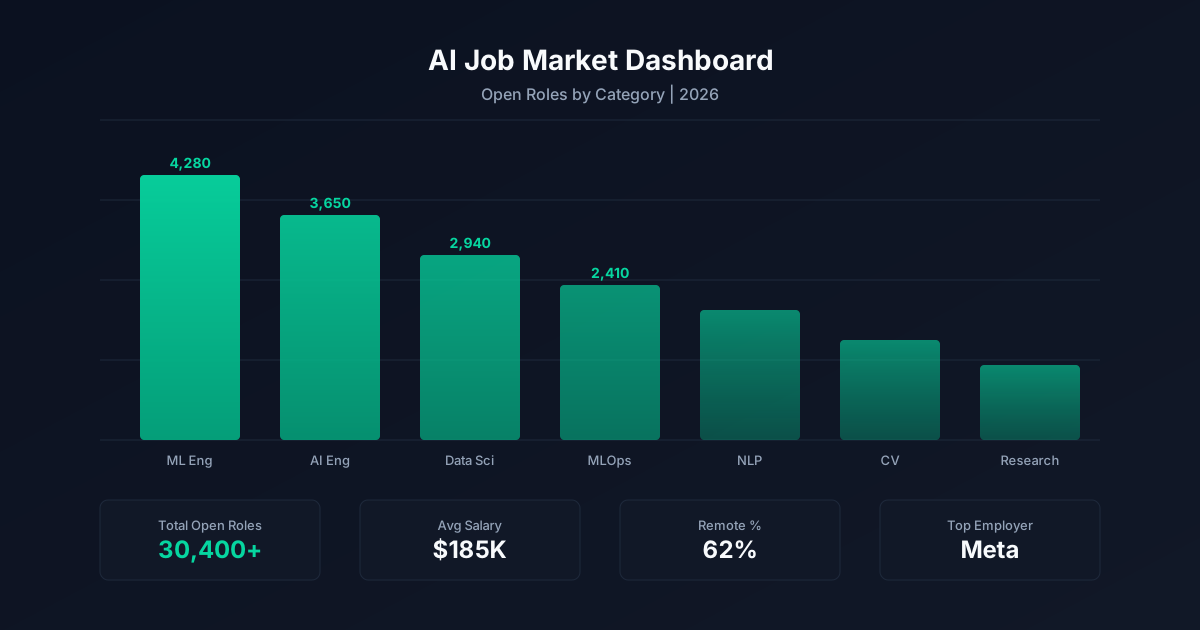
The AI job market spans 3,708 open positions across 16 role categories. The largest categories by volume: AI/ML Engineer (2,605), Data Scientist (310), AI Software Engineer (259). These three account for the majority of open positions, though smaller categories often have higher per-role compensation because of specialized skill requirements.
The seniority mix tells a story about where AI teams are in their maturity. Entry-level roles (102) are outnumbered by mid-level (1,705) and senior (1,469) positions, reflecting that most companies are past the 'build a team from scratch' phase and need experienced engineers who can ship production systems. Leadership roles (Director, VP, C-Level) total 432 positions, representing the bottleneck between technical execution and organizational strategy.
Remote work availability sits at 14% of all AI roles (508 positions), with 3,180 requiring on-site or hybrid attendance. The remote share has stabilized after the post-pandemic correction. Senior and specialized roles (Research Scientist, ML Architect) are more likely to be remote-eligible than entry-level positions, partly because experienced hires have more negotiating power and partly because these roles require less hands-on mentorship.
AI compensation is structured in clear tiers. The market median sits at $217,500. Top-quartile roles start at $272,100, and the 90th percentile reaches $325,000. These figures include base salary with disclosed compensation. Total compensation (including equity, bonuses, and sign-on) runs 20-40% higher at companies that offer those components.
Category matters for compensation. AI Safety roles lead at $300,000 median, while Prompt Engineer roles sit at $140,000. The spread between highest and lowest-paying categories reflects the premium on specialized technical skills versus broader analytical roles.
The most in-demand skills across all AI postings: Python (1,890 postings), Aws (1,103 postings), Azure (877 postings), Rag (855 postings), Gcp (631 postings), Prompt Engineering (560 postings), Pytorch (545 postings), Claude (498 postings). Python dominates, appearing in the vast majority of role descriptions regardless of category. Cloud platform experience (AWS, GCP, Azure) is the second most common requirement. The newer entrants to the top skills list (RAG, vector databases, LLM APIs) reflect the shift from traditional ML toward generative AI applications.
Frequently Asked Questions
Get Weekly AI Career Intelligence
Salary data, skills demand, and market signals from 16,000+ AI job postings. Every Monday.