
Interested in this AI/ML Engineer role at Okta?
Apply Now →Skills & Technologies
About This Role
Secure Every Identity, from AI to Human
Identity is the key to unlocking the potential of AI. Okta secures AI by building the trusted, neutral infrastructure that enables organizations to safely embrace this new era. This work requires a relentless drive to solve complex challenges with real\-world stakes. We are looking for builders and owners who operate with speed and urgency and execute with excellence.
This is an opportunity to do career\-defining work. We're all in on this mission. If you are too, let's talk.
As the Senior, Internal Audit AI Enablement \& Automation, you will own the day\-to\-day build, adoption, and measurement of Okta Internal Audit's AI automation program — turning auditor problem statements into working tools, tracking every measurable metric to a verified strategic outcome, and representing Internal Audit across Finance and company\-wide AI networks.
Okta Internal Audit has moved past the proof\-of\-concept stage. The AI enablement program is live, tools are in production, and meaningful audit capacity has already been recovered and redeployed into higher\-value work — without external development spend.
This role exists to scale that engine. The role is the hands\-on builder, program coordinator, and adoption driver at the center of that effort. This is not a strategy or advisory role — it is a delivery role. The person in this seat ships tools, closes the loop on problem statements, translates recovered audit capacity into documented strategic value, and represents Internal Audit's automation program in the Finance AI Champions and Company\-wide AI Champions networks.
What You Will Own
- Automation Delivery \- *This is the core of the role. Everything else supports it.*
Build and maintain AI automations across all Internal Audit functions using the department's existing AI Hub and SOX testing engine as the foundation. Manage the problem statement intake pipeline, acknowledging every submission with a clear disposition (built, deferred, or declined with rationale) and prioritizing the backlog using impact, frequency, and build complexity. Keep the intake process simple, and maintain visibility into open problem statements so the team knows submissions go somewhere.
- Measurement \& Reporting \- *This role owns the data that makes recovered hours real and attributable.*
Maintain the AI Impact Dashboard with accurate, function\-level attribution. Protect the integrity of the measurement methodology, tracking protocols, time categories, and verification standards. Surface delivery risk early, contribute to periodic AI Value Reports, and support executive and Audit Committee\-ready materials that translate hours saved into dollar value and strategic audit impact.
- Working Group Coordination \- *The Working Groups are the primary vehicle for team\-wide adoption. This role keeps them moving.*
Maintain regular check\-ins with each Working Group, coordinate the Bi\-Weekly Showcase cadence, and track each group against its phased plan. Flag delivery risk early and assist Working Group leads in sequencing deliverables against the overall automation backlog.
- Individual Contributor Activation \- *Broad participation is essential. This role removes the friction that prevents it.*
Track individual participation against department expectations. Reach out directly one\-on\-one, not via group reminder, to any team member with no recorded participation. Lead every team communication with what auditors gain from participating, not what is required of them.
- Culture, Knowledge Management \& External Collaboration \- *This role sustains momentum through recognition, a maintained knowledge base, and active participation in company\-wide AI initiatives.*
Maintain the AI Hub knowledge repository and AI Learning Catalog, keeping resources current, connected to real audit tasks, and tracked at the individual level. Follow up individually with anyone below learning pace.
Represent Internal Audit in cross\-functional and company\-wide AI initiatives — contributing IA's automation learnings to broader enterprise conversations and returning external intelligence back into the IA tool\-building program. Success is measured by bidirectional value: what IA contributes to the enterprise, and what the enterprise contributes back.
What You Bring
- CPA, CIA, CISA, or other relevant certification (active or in progress); CISA preferred given the IT audit and automation crossover this role demands
- 3–6 years of internal audit experience across at least two disciplines (internal audit, IT audit, SOX business process, SOX ITAC/ITGC, or data analytics)
- Sufficient audit technical depth to build automations that meet Internal Audit quality standards — including evidence documentation, workpaper integrity, and SOX testing requirements across financial and IT controls
- Demonstrated ability to build or operate AI tools, automations, or structured prompt workflows applied to real audit work — not just coursework or certifications
- Demonstrated ability to represent a team or function in cross\-functional settings — can prepare, present, and defend a point of view to audiences outside Internal Audit, including Finance leadership and enterprise program stakeholders
- Comfortable managing multiple concurrent workstreams with defined deliverables and deadlines
- Strong written communication skills — able to translate technical output into plain\-language narratives for non\-technical audiences
- Hands\-on experience with AI productivity tools (Claude, Gemini, ChatGPT, or equivalent)
What Sets You Apart
- Big 4 public accounting or IT audit advisory experience
- Experience with audit management platforms (AuditBoard, Workiva, or equivalent)
- Experience coordinating working groups, project timelines, or cross\-functional initiatives
- Experience representing a function or team in cross\-functional working groups, communities of practice, or enterprise\-level program networks
- Background in learning content curation or enablement program support
- Familiarity with basic scripting, API concepts, or no\-code/low\-code workflow tools
- Experience auditing within cloud\-based or SaaS environments
- Awareness of AI governance, ethics, and emerging risks (model bias, data privacy, hallucination risks)
What Success Looks Like
- Builder Mentality: Ships working tools on a predictable cadence — does not wait for perfect requirements, engineering support, or top\-down direction. Closes problem statements with a disposition, not a placeholder
- Precision Over Volume: Tracks what matters and defends the measurement methodology when pressured to inflate numbers. Knows the difference between hours recovered and hours verified — and never conflates them
- Say/Do Ratio: Intake SLAs are met. Working Group milestones are hit. What is committed to leadership is what is delivered — on time, at the quality level stated. Escalates delivery risk early with data, not after the deadline passes
- Offer\-First Communication: Leads every team message with what auditors gain from participating, not what is required of them. Understands that adoption is earned, not mandated
- Intellectual Curiosity: Proactively tracks the AI tool landscape — brings new capabilities, prompt patterns, and automation approaches to the team before they are asked for. Curiosity is directed, not scattered: every new tool evaluated connects to a specific audit task
- Problem\-Solving Transparency: Can walk any team member through how a tool was built or a prioritization decision was made — not just what the output is. Teaches the method, not just the result
- Intellectual Honesty: Comfortable saying "this automation didn't work" or "I don't know how to build that yet" — and documents both outcomes with the same rigor as successes. Failure data improves the backlog
- Stakeholder Navigation: Maintains credibility with Working Group leads, IA leadership, and cross\-functional partners when timelines shift or tools underdeliver. Resolves friction without escalating unnecessarily
- Ownership: Takes end\-to\-end accountability for the automation program — from intake through impact reporting — without requiring follow\-up from the supervising manager to close open items
- Adaptability: Adjusts build priorities as audit cycle demands shift without losing sight of annual targets. Comfortable with ambiguity in a program that is still being built while it runs
- Deadline Accountability: Treats intake SLAs and Working Group milestone commitments as non\-negotiable floors, not targets. Surfaces risk to the supervising manager with supporting data — before the deadline, not after
- Calm Under Pressure: Maintains even temperament when adoption is slow, tools break, or leadership asks hard questions about impact. The team wants to bring problems to this person, not hide them
- Enterprise AI Representation: Shows up to Finance and Company AI Champions programs as a prepared, credible voice for Internal Audit — not just an attendee. Returns external intelligence (new tools, peer use cases, company AI direction) into the IA program within the same quarter it is learned
How We Work
This role operates in Okta's hybrid work environment. You are expected to go to the San Francisco office two days per week.
\#LI\-hybrid
The annual base salary range for this position for candidates located in the San Francisco Bay area is between: $117,000—$160,600 USD
Below is the annual base salary range for candidates located in California (excluding San Francisco Bay Area), Colorado, Illinois, New York and Washington. Your actual base salary will depend on factors such as your skills, qualifications, experience, and work location. In addition, Okta offers equity (where applicable), bonus, and benefits, including health, dental and vision insurance, 401(k), flexible spending account, and paid leave (including PTO and parental leave) in accordance with our applicable plans and policies. To learn more about our Total Rewards program please visit: https://rewards.okta.com/us.
The annual base salary range for this position for candidates located in California (excluding San Francisco Bay Area), Colorado, Illinois, New York, and Washington is between:$104,000—$143,000 USDThe Okta Experience
- Supporting Your Well\-Being
- Driving Social Impact
- Developing Talent and Fostering Connection \+ Community
We are intentional about connection. Our global community, spanning over 20 offices worldwide, is united by a drive to innovate. Your journey begins with an immersive, in\-person onboarding experience designed to accelerate your impact and connect you to our mission and team from day one.
Okta is an Equal Opportunity Employer. All qualified applicants will receive consideration for employment without regard to race, color, religion, sex, sexual orientation, gender identity, national origin, ancestry, marital status, age, physical or mental disability, or status as a protected veteran. We also consider for employment qualified applicants with arrest and convictions records, consistent with applicable laws.
If reasonable accommodation is needed to complete any part of the job application, interview process, or onboarding please use this Form to request an accommodation.
Notice for New York City Applicants \& Employees: Okta may use Automated Employment Decision Tools (AEDT), as defined by New York City Local Law 144, that use artificial intelligence, machine learning, or other automated processes to assist in our recruitment and hiring process. In accordance with NYC Local Law 144, if you are an applicant or employee residing in New York City, please
Okta
The foundation for secure connections between people and technology
Okta is the leading independent provider of identity for the enterprise. The Okta Identity Cloud enables organizations to securely connect the right people to the right technologies at the right time. With over 7,000 pre\-built integrations to applications and infrastructure providers, Okta customers can easily and securely use the best technologies for their business. More than 19,300 organizations, including JetBlue, Nordstrom, Slack, T\-Mobile, Takeda, Teach for America, and Twilio, trust Okta to help protect the identities of their workforces and customers.
Salary Context
This $104K-$160K range is in the lower quartile for AI/ML Engineer roles in our dataset (median: $180K across 1841 roles with salary data).
View full AI/ML Engineer salary data →Role Details
About This Role
AI/ML Engineers build and deploy machine learning models in production. They work across the full ML lifecycle: data pipelines, model training, evaluation, and serving infrastructure. The role has evolved significantly over the past two years. Where ML Engineers once spent most of their time on model architecture, the job now tilts heavily toward inference optimization, cost management, and integrating LLM capabilities into existing systems. Companies want engineers who can ship production systems, and the experimenter-only role is fading fast.
Day-to-day, you're writing training pipelines, debugging data quality issues, setting up evaluation frameworks, and figuring out why your model performs differently in staging than it did on your dev set. The best ML engineers are obsessive about reproducibility and measurement. They instrument everything. They know that a model is only as good as the data feeding it and the infrastructure serving it.
Across the 3,708 AI roles we're tracking, AI/ML Engineer positions make up 70% of the market. At Okta, this role fits into their broader AI and engineering organization.
Demand for AI/ML Engineers has been strong and consistent. Unlike some AI roles that spike with hype cycles, ML engineering is a foundational need. Every company deploying AI models needs people who can keep them running, and the gap between research prototypes and production systems keeps growing.
What the Work Looks Like
A typical week might include: debugging a data pipeline that's silently dropping 3% of training examples, running A/B tests on a new model version, writing documentation for a feature flag system that lets you roll back model deployments, and reviewing a junior engineer's PR for a new evaluation metric. Meetings tend to be cross-functional since ML touches product, engineering, and data teams.
Demand for AI/ML Engineers has been strong and consistent. Unlike some AI roles that spike with hype cycles, ML engineering is a foundational need. Every company deploying AI models needs people who can keep them running, and the gap between research prototypes and production systems keeps growing.
Skills Required
Python and PyTorch dominate the requirements. Most roles expect experience with cloud platforms (AWS, GCP, or Azure) and familiarity with ML frameworks like TensorFlow or JAX. RAG (Retrieval-Augmented Generation) has become a top-3 skill requirement as companies integrate LLMs into their products. Docker and Kubernetes show up in about a third of postings, reflecting the production focus of the role.
Beyond the core stack, employers increasingly want experience with experiment tracking tools (MLflow, Weights & Biases), feature stores, and vector databases. Fine-tuning experience is valuable but less common than you'd think from reading Twitter. Most production LLM work is RAG and prompt engineering, not fine-tuning. If you have both, you're in a strong position.
Companies that are serious about AI/ML hiring tend to post specific infrastructure details in the job description: the frameworks they use, their model serving stack, their data pipeline tools. Vague postings that just say 'ML experience required' without specifics are often companies that haven't figured out what they need yet.
Compensation Benchmarks
AI/ML Engineer roles pay a median of $218,750 based on 3,817 positions with disclosed compensation. Senior-level AI roles across all categories have a median of $230,000. This role's midpoint ($132K) sits 40% below the category median. Disclosed range: $104K to $160K.
Across all AI roles, the market median is $217,500. Top-quartile compensation starts at $272,100. The 90th percentile reaches $325,000. For comparison, the highest-paying categories include AI Safety ($300,000) and Research Engineer ($280,000). By seniority level: Entry: $120,000; Mid: $200,000; Senior: $230,000; Director: $272,150; VP: $250,000.
Okta AI Hiring
Okta has 2 open AI roles right now. They're hiring across AI/ML Engineer, AI Software Engineer. Positions span San Francisco, CA, US, Remote, US. Compensation range: $160K - $247K.
Location Context
AI roles in San Francisco pay a median of $277,088 across 810 tracked positions. That's 27% above the national median.
Career Path
Common paths into AI/ML Engineer roles include Data Scientist, Software Engineer, Research Engineer.
From here, career progression typically leads toward ML Architect, AI Engineering Manager, Principal ML Engineer.
The fastest path into ML engineering is through software engineering with a self-directed ML education. A CS degree helps, but production engineering skills matter more than academic credentials. Build something that works, deploy it, and measure it. That portfolio project is worth more than a Coursera certificate. For career growth, the fork comes around the senior level: go deep on technical complexity (staff/principal track) or move into managing ML teams.
What to Expect in Interviews
Expect system design questions around ML pipelines: how you'd build a training pipeline for a specific use case, handle data drift, or design A/B testing infrastructure for model deployments. Coding rounds typically involve Python, with emphasis on data manipulation (pandas, numpy) and algorithm implementation. Take-home assignments often ask you to build an end-to-end ML pipeline from raw data to deployed model.
When evaluating opportunities: Companies that are serious about AI/ML hiring tend to post specific infrastructure details in the job description: the frameworks they use, their model serving stack, their data pipeline tools. Vague postings that just say 'ML experience required' without specifics are often companies that haven't figured out what they need yet.
AI Hiring Overview
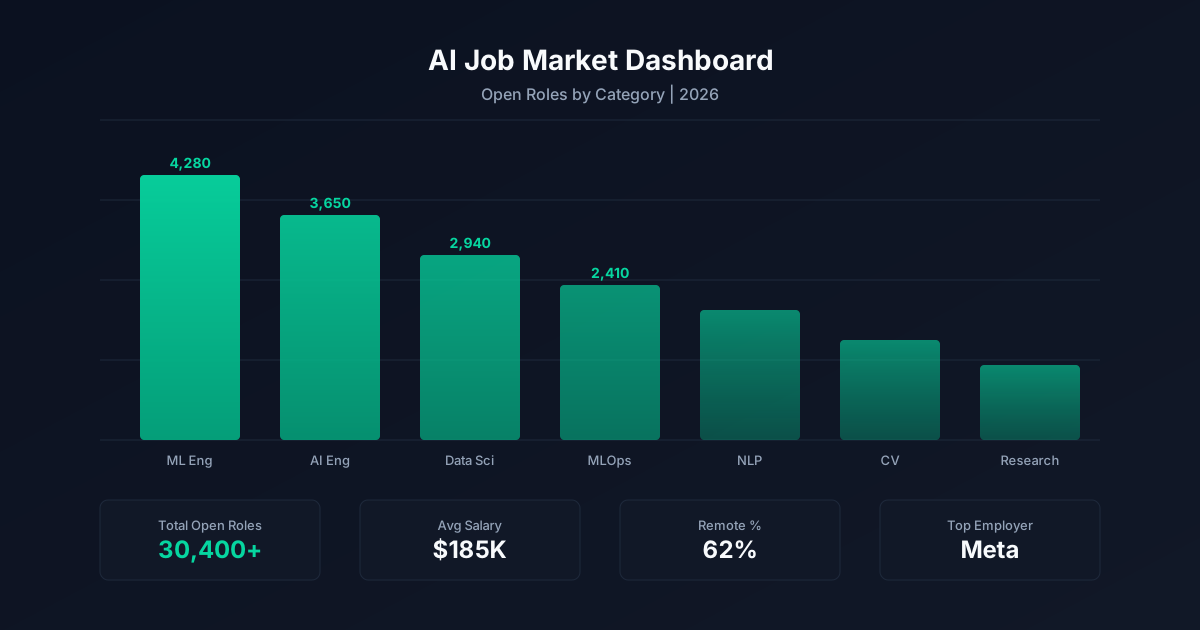
The AI job market has 3,708 open positions tracked in our dataset. By seniority: 102 entry-level, 1,705 mid-level, 1,469 senior, and 432 leadership roles (Director, VP, C-Level). Remote roles make up 14% of the market (508 positions). The remaining 3,180 roles require on-site or hybrid attendance.
The market median for AI roles is $217,500. Top-quartile compensation starts at $272,100. The 90th percentile reaches $325,000. Highest-paying categories: AI Safety ($300,000 median, 21 roles); Research Engineer ($280,000 median, 147 roles); AI Architect ($254,798 median, 67 roles).
Demand for AI/ML Engineers has been strong and consistent. Unlike some AI roles that spike with hype cycles, ML engineering is a foundational need. Every company deploying AI models needs people who can keep them running, and the gap between research prototypes and production systems keeps growing.
The AI Job Market Today
The AI job market spans 3,708 open positions across 16 role categories. The largest categories by volume: AI/ML Engineer (2,605), Data Scientist (310), AI Software Engineer (259). These three account for the majority of open positions, though smaller categories often have higher per-role compensation because of specialized skill requirements.
The seniority mix tells a story about where AI teams are in their maturity. Entry-level roles (102) are outnumbered by mid-level (1,705) and senior (1,469) positions, reflecting that most companies are past the 'build a team from scratch' phase and need experienced engineers who can ship production systems. Leadership roles (Director, VP, C-Level) total 432 positions, representing the bottleneck between technical execution and organizational strategy.
Remote work availability sits at 14% of all AI roles (508 positions), with 3,180 requiring on-site or hybrid attendance. The remote share has stabilized after the post-pandemic correction. Senior and specialized roles (Research Scientist, ML Architect) are more likely to be remote-eligible than entry-level positions, partly because experienced hires have more negotiating power and partly because these roles require less hands-on mentorship.
AI compensation is structured in clear tiers. The market median sits at $217,500. Top-quartile roles start at $272,100, and the 90th percentile reaches $325,000. These figures include base salary with disclosed compensation. Total compensation (including equity, bonuses, and sign-on) runs 20-40% higher at companies that offer those components.
Category matters for compensation. AI Safety roles lead at $300,000 median, while Prompt Engineer roles sit at $140,000. The spread between highest and lowest-paying categories reflects the premium on specialized technical skills versus broader analytical roles.
The most in-demand skills across all AI postings: Python (1,890 postings), Aws (1,103 postings), Azure (877 postings), Rag (855 postings), Gcp (631 postings), Prompt Engineering (560 postings), Pytorch (545 postings), Claude (498 postings). Python dominates, appearing in the vast majority of role descriptions regardless of category. Cloud platform experience (AWS, GCP, Azure) is the second most common requirement. The newer entrants to the top skills list (RAG, vector databases, LLM APIs) reflect the shift from traditional ML toward generative AI applications.
Frequently Asked Questions
Get Weekly AI Career Intelligence
Salary data, skills demand, and market signals from 16,000+ AI job postings. Every Monday.