
Interested in this AI/ML Engineer role at Per Scholas?
Apply Now →Skills & Technologies
About This Role
ABOUT PER SCHOLAS:
For 30 years, Per Scholas has been on a mission to drive mobility and opportunity in the ever\-advancing technology landscape by unlocking the untapped potential of individuals, uplifting communities, and meeting the needs of employers through rigorous tech training. By teaming up with dynamic employer partners, ranging from Fortune 500 companies to innovative startups, we're forging inclusive tech talent pipelines, fulfilling an ever\-increasing need for skilled talent. With national remote training and campuses in 20\+ cities and counting, Per Scholas offers no\-cost training programs in the most sought\-after tech skills, spanning Cloud, Cybersecurity, Data Engineering, IT Support, Software Engineering, and more. To date, 30,000\+ individuals have been trained through Per Scholas, propelling their professional trajectories into high\-growth tech careers with salaries three times higher than their pre\-training earnings. Learn more by visiting PerScholas.org and follow us on LinkedIn, X, Facebook, Instagram, and YouTube.
Per Scholas preferred hires reside within the following states: AZ, CA, CO, FL, GA, IL, IN, KS, MD, MA, MI, MO, NC, NJ, NY, OH, PA, TX, WA
DEPARTMENT: Curriculum Solutions
POSITION TITLE: Technical Curriculum Developer (Agentic AI for IT Support and Data Analytics)
LOCATION: Remote, EST (5–10% travel for video production)
REPORTS TO: VP, Product Development \& Operations
EMPLOYMENT TYPE: Temporary 3 months
WHO WE'RE LOOKING FOR
We are seeking a technically strong and instructionally minded Content Developer to design, develop, and deliver a high\-impact on\-camera workshop series on Agentic AI for IT Support and Data Analytics.
This role is for a technical practitioner and educator \- someone who understands real\-world IT support and Data Analytics workflows and can translate them into structured, hands\-on learning experiences using AI tools such as ChatGPT.
You are not just a content writer; you are a builder and demonstrator who can apply AI tools to real IT and Data Analysis tasks, design practical learning experiences, and confidently deliver high\-quality recorded instructional content.
WHAT YOU'LL DO
- Content Design \& Development (30%)
- Module Creation: Design and develop a multi\-module learning series that applies AI across both IT Support tasks (documentation, customer interaction, troubleshooting, automation, and scripting) and Data Analytics tasks (data cleaning, exploratory analysis, querying, visualization, and reporting), sequenced so learners advance from GenAI prompting to lightweight agentic workflows.
- Technical Documentation: Develop lesson plans, scripts, facilitation guides, and learner materials for both domains.
- Scenario\-Based Learning: Create real\-world scenarios: IT support tickets, logs, and user issues, alongside Data Analytics cases such as messy datasets, business questions, and dashboard/reporting requests.
- Curriculum Architecture: Translate IT Support and Data Analytics job tasks into structured, progressive learning modules aligned to entry\-level roles.
- On\-Camera Instructional Delivery (30%)
- Video Production: Script and record concise 5\-8 minute instructional videos demonstrating real\-time use of GenAI and, in later modules, agentic AI tools across both IT Support and Data Analytics.
- Demonstration\-Based Teaching: Show prompting techniques, iterative workflows, and validation methods, building toward agent/tool orchestration and multi\-step automation.
- Engagement \& Clarity: Deliver clear, structured, and engaging content for asynchronous learners.
- Hands\-on Workshop Design (40%)
- Workshop Development: Create 30\-45\-minute hands\-on workshops aligned with each module across both tracks.
- Task\-Based Learning: Design activities using AI: troubleshooting, documentation, automation, and scripting (IT Support), and data cleaning, querying, analysis, and visualization (Data Analytics).
- Assessment Design: Build performance\-based exercises that validate learner competency in both domains.
WHAT YOU'LL BRING TO US
- Hands\-on experience across IT Support and Data Analytics workflows.
- Demonstrated ability to apply AI tools (e.g., ChatGPT) to real technical tasks.
- Strong communication skills and comfortable demonstrating on camera.
*Required Skill Sets*
Technical Expertise
- 2\-5 years of combined experience across IT Support (Help Desk, Desktop Support, or Service Desk) and Data Analytics (analyst, reporting, or BI work).
- Strong understanding of OS troubleshooting, networking basics, and ticketing workflows.
- Data Analytics fundamentals: data cleaning, querying (SQL), spreadsheet analysis, and data visualization (e.g., Excel/Google Sheets, and a BI tool such as Tableau or Power BI).
- Experience applying AI tools like ChatGPT to documentation, troubleshooting, scripting, and data analysis tasks.
- Familiarity with basic scripting (PowerShell, Bash, or Python); Python for data analysis (e.g., pandas) is a plus.
- Exposure to agentic AI concepts such as tool use, automation, and multi\-step agent workflows (e.g., custom GPTs, Copilot, or similar), or a clear willingness to build this into the curriculum.
Instructional Design \& Professional Skills
- 1\-3 years of experience in instructional design or technical content creation.
- Strong ability to simplify technical workflows into structured learning.
- Proficiency in Google Workspace.
- Strong written and verbal communication skills.
- Experience with training video series production.
*Preferred Skill Sets*
- Familiarity with LMS platforms (e.g., Canvas).
- Experience in workforce training or bootcamp environments.
- Hands\-on experience building agentic AI workflows or automations (e.g., custom GPTs, Copilot Studio, n8n, Zapier, or similar).
- Exposure to cloud platforms or DevOps concepts.
- Access to video production equipment and software technologies.
*Personal Characteristics*
- You thrive in a creative, inventive, fast\-paced startup environment with people who are passionate about their work and mission.
- You are data\-driven, result\-oriented, and a forward\-looking catalyst for social change.
- You have a collaborative and flexible work style. You're excited to work cross\-functionally with other departments and independently.
- You are a lifelong learner.
- You are an effective communicator with strong oral and written skills.
- You are tech\-savvy and learn new tools quickly.
- You are detail\-oriented and have exceptional organizational skills.
- You are adept at managing your time and balancing multiple projects and tasks.
- You stand behind our mission, believing that individuals from any community should have access to well\-paying career positions and that talent should be recognized and recruited from diverse sources.
*Compensation*
For this role specifically, we are targeting a salary range of $45 \- $50 where the difference in salary is typically determined by several factors, including geography in which the selected candidate resides, and alignment with qualifications and experience.
Benefits \& Perks
Per Scholas offers a comprehensive benefits package designed to support your health, financial well\-being, and overall quality of life!
Holidays \& PTO: Full\-TimePer Scholas team members enjoy over 40 days of paid time off each year through a mix of holidays, vacation, and sick/personal time! All employees are eligible for Holiday pay upon hire (a total of 22 holidays annually, including a week off for Independence day and a week before the New Year). Full\-Time Benefits Eligible employees also receive 80 Wellness Hours to use for Sick, Safe, or Personal reasons and accrue Vacation at a rate of 8 hours at the beginning of every month, supporting rest, recharge, and work\-life balance. Vacation accruals increase with tenure. Part\-time employees are afforded time off on a prorated basis and in accordance with local requirements.
Comprehensive Medical Coverage: Benefit eligible employees can choose from multiple medical plans through Cigna or Kaiser Permanente (where available), with options to fit your needs. Eligible employees also have access to a Health Reimbursement Account (HRA) that reimburses eligible out\-of\-pocket expenses, up to $4,000 for individuals and $8,000 for families.
Dental and Vision Insurance: Eligible employees can select from two dental plan options and a vision plan. Employees who waive medical coverage receive employer paid dental and vision premiums.
Retirement Savings: 401(k) plan with a current 100% employer match on contributions up to 6%, eligible employees are offered entry and full vesting after 90 days with the company.
Employee Assistance Program (EAP): Free, confidential, 24/7 access to counseling, legal support, and financial resources for employees and their household members
Parental Leave: Eligible employees are offered up to 6 weeks of 100% paid parental leave to support employees as they welcome a new child and bond with their family.
Additional Benefits \& Perks: Eligible employees have access to employer\-paid life and AD\&D Insurance, as well as employer\-paid short\-term disability coverage, with the option to elect additional life coverage and long\-term disability insurance. Flexible Spending accounts are available for healthcare, dependent care, and commuting expenses. Per Scholas also offers a range of voluntary benefits, including: Accident, Critical Illness, Hospital Indemnity, Legal Services, and Pet Insurance. Additional resources include healthcare concierge support, financial wellness tools, and employee discount programs.
QUESTIONS?
If you have any questions about this role, please feel free to email our Talent team at [email protected]. We look forward to viewing your application!
Equal Employment Opportunity
We're proud to be an equal opportunity employer. All qualified applicants will receive consideration for employment without regard to age, race, color, religion, sex, sexual orientation, gender identity or national origin.
PII Policies
Non\-Discrimination Policy
Salary Context
This $93K-$104K range is in the lower quartile for AI/ML Engineer roles in our dataset (median: $180K across 1841 roles with salary data).
View full AI/ML Engineer salary data →Role Details
About This Role
AI/ML Engineers build and deploy machine learning models in production. They work across the full ML lifecycle: data pipelines, model training, evaluation, and serving infrastructure. The role has evolved significantly over the past two years. Where ML Engineers once spent most of their time on model architecture, the job now tilts heavily toward inference optimization, cost management, and integrating LLM capabilities into existing systems. Companies want engineers who can ship production systems, and the experimenter-only role is fading fast.
Day-to-day, you're writing training pipelines, debugging data quality issues, setting up evaluation frameworks, and figuring out why your model performs differently in staging than it did on your dev set. The best ML engineers are obsessive about reproducibility and measurement. They instrument everything. They know that a model is only as good as the data feeding it and the infrastructure serving it.
Across the 3,708 AI roles we're tracking, AI/ML Engineer positions make up 70% of the market. At Per Scholas, this role fits into their broader AI and engineering organization.
Demand for AI/ML Engineers has been strong and consistent. Unlike some AI roles that spike with hype cycles, ML engineering is a foundational need. Every company deploying AI models needs people who can keep them running, and the gap between research prototypes and production systems keeps growing.
What the Work Looks Like
A typical week might include: debugging a data pipeline that's silently dropping 3% of training examples, running A/B tests on a new model version, writing documentation for a feature flag system that lets you roll back model deployments, and reviewing a junior engineer's PR for a new evaluation metric. Meetings tend to be cross-functional since ML touches product, engineering, and data teams.
Demand for AI/ML Engineers has been strong and consistent. Unlike some AI roles that spike with hype cycles, ML engineering is a foundational need. Every company deploying AI models needs people who can keep them running, and the gap between research prototypes and production systems keeps growing.
Skills Required
Python and PyTorch dominate the requirements. Most roles expect experience with cloud platforms (AWS, GCP, or Azure) and familiarity with ML frameworks like TensorFlow or JAX. RAG (Retrieval-Augmented Generation) has become a top-3 skill requirement as companies integrate LLMs into their products. Docker and Kubernetes show up in about a third of postings, reflecting the production focus of the role.
Beyond the core stack, employers increasingly want experience with experiment tracking tools (MLflow, Weights & Biases), feature stores, and vector databases. Fine-tuning experience is valuable but less common than you'd think from reading Twitter. Most production LLM work is RAG and prompt engineering, not fine-tuning. If you have both, you're in a strong position.
Companies that are serious about AI/ML hiring tend to post specific infrastructure details in the job description: the frameworks they use, their model serving stack, their data pipeline tools. Vague postings that just say 'ML experience required' without specifics are often companies that haven't figured out what they need yet.
Compensation Benchmarks
AI/ML Engineer roles pay a median of $218,750 based on 3,817 positions with disclosed compensation. Mid-level AI roles across all categories have a median of $200,000. This role's midpoint ($98K) sits 55% below the category median. Disclosed range: $93K to $104K.
Across all AI roles, the market median is $217,500. Top-quartile compensation starts at $272,100. The 90th percentile reaches $325,000. For comparison, the highest-paying categories include AI Safety ($300,000) and Research Engineer ($280,000). By seniority level: Entry: $120,000; Mid: $200,000; Senior: $230,000; Director: $272,150; VP: $250,000.
Per Scholas AI Hiring
Per Scholas has 1 open AI role right now. They're hiring across AI/ML Engineer. Based in New York, NY, US. Compensation range: $104K - $104K.
Location Context
AI roles in New York pay a median of $220,000 across 1,045 tracked positions.
Career Path
Common paths into AI/ML Engineer roles include Data Scientist, Software Engineer, Research Engineer.
From here, career progression typically leads toward ML Architect, AI Engineering Manager, Principal ML Engineer.
The fastest path into ML engineering is through software engineering with a self-directed ML education. A CS degree helps, but production engineering skills matter more than academic credentials. Build something that works, deploy it, and measure it. That portfolio project is worth more than a Coursera certificate. For career growth, the fork comes around the senior level: go deep on technical complexity (staff/principal track) or move into managing ML teams.
What to Expect in Interviews
Expect system design questions around ML pipelines: how you'd build a training pipeline for a specific use case, handle data drift, or design A/B testing infrastructure for model deployments. Coding rounds typically involve Python, with emphasis on data manipulation (pandas, numpy) and algorithm implementation. Take-home assignments often ask you to build an end-to-end ML pipeline from raw data to deployed model.
When evaluating opportunities: Companies that are serious about AI/ML hiring tend to post specific infrastructure details in the job description: the frameworks they use, their model serving stack, their data pipeline tools. Vague postings that just say 'ML experience required' without specifics are often companies that haven't figured out what they need yet.
AI Hiring Overview
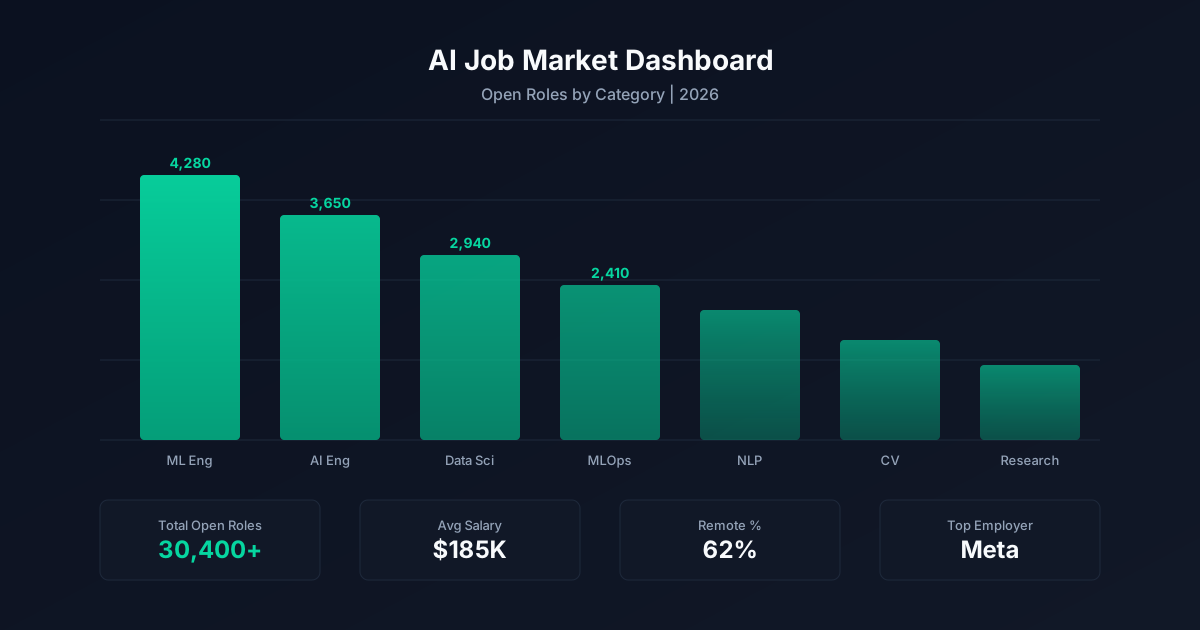
The AI job market has 3,708 open positions tracked in our dataset. By seniority: 102 entry-level, 1,705 mid-level, 1,469 senior, and 432 leadership roles (Director, VP, C-Level). Remote roles make up 14% of the market (508 positions). The remaining 3,180 roles require on-site or hybrid attendance.
The market median for AI roles is $217,500. Top-quartile compensation starts at $272,100. The 90th percentile reaches $325,000. Highest-paying categories: AI Safety ($300,000 median, 21 roles); Research Engineer ($280,000 median, 147 roles); AI Architect ($254,798 median, 67 roles).
Demand for AI/ML Engineers has been strong and consistent. Unlike some AI roles that spike with hype cycles, ML engineering is a foundational need. Every company deploying AI models needs people who can keep them running, and the gap between research prototypes and production systems keeps growing.
The AI Job Market Today
The AI job market spans 3,708 open positions across 16 role categories. The largest categories by volume: AI/ML Engineer (2,605), Data Scientist (310), AI Software Engineer (259). These three account for the majority of open positions, though smaller categories often have higher per-role compensation because of specialized skill requirements.
The seniority mix tells a story about where AI teams are in their maturity. Entry-level roles (102) are outnumbered by mid-level (1,705) and senior (1,469) positions, reflecting that most companies are past the 'build a team from scratch' phase and need experienced engineers who can ship production systems. Leadership roles (Director, VP, C-Level) total 432 positions, representing the bottleneck between technical execution and organizational strategy.
Remote work availability sits at 14% of all AI roles (508 positions), with 3,180 requiring on-site or hybrid attendance. The remote share has stabilized after the post-pandemic correction. Senior and specialized roles (Research Scientist, ML Architect) are more likely to be remote-eligible than entry-level positions, partly because experienced hires have more negotiating power and partly because these roles require less hands-on mentorship.
AI compensation is structured in clear tiers. The market median sits at $217,500. Top-quartile roles start at $272,100, and the 90th percentile reaches $325,000. These figures include base salary with disclosed compensation. Total compensation (including equity, bonuses, and sign-on) runs 20-40% higher at companies that offer those components.
Category matters for compensation. AI Safety roles lead at $300,000 median, while Prompt Engineer roles sit at $140,000. The spread between highest and lowest-paying categories reflects the premium on specialized technical skills versus broader analytical roles.
The most in-demand skills across all AI postings: Python (1,890 postings), Aws (1,103 postings), Azure (877 postings), Rag (855 postings), Gcp (631 postings), Prompt Engineering (560 postings), Pytorch (545 postings), Claude (498 postings). Python dominates, appearing in the vast majority of role descriptions regardless of category. Cloud platform experience (AWS, GCP, Azure) is the second most common requirement. The newer entrants to the top skills list (RAG, vector databases, LLM APIs) reflect the shift from traditional ML toward generative AI applications.
Frequently Asked Questions
Get Weekly AI Career Intelligence
Salary data, skills demand, and market signals from 16,000+ AI job postings. Every Monday.