
Interested in this Data Scientist role at Retool?
Apply Now →About This Role
ABOUT RETOOL
Nearly every company in the world runs on custom software for critical operations like tracking performance metrics, handling customer support workflows, building admin dashboards, and countless other processes you might not have even thought of. But most companies don't have adequate resources to properly invest in these tools, leading to a lot of old and clunky internal software or, even worse, users still stuck in manual and spreadsheet flows.
At Retool, we’re building the first enterprise AppGen platform: software that transforms natural language into production\-ready code, integrates directly with business data, and meets the highest standards of security and governance. AI is redefining what it means to build software—and who gets to build it. The definition of “developer” now includes analysts, operators, and domain experts creating solutions directly. As the pool of builders widens, so does the complexity of what they need to build. The opportunity is enormous, but so is the challenge of enabling this larger community to build production\-grade software safely. That means AI that understands real business data, enforces enterprise policies automatically, and empowers teams to create once and reuse everywhere with shared, trusted components.
Over 100 million hours of work has been automated by developers and domain experts using our platform, freeing them to focus on creative problem\-solving and strategic initiatives that drive real business value. The people closest to knowing what needs to be built can now safely create custom solutions within enterprise guardrails. And that's a mission worth striving for.
Let's build the future together!
WHY WE'RE LOOKING FOR YOU
Retool is rapidly growing, and we’re tackling increasingly complex questions about our customers, product, and business. We’re looking for a Data Scientist to join our Data Science \& Analytics team to help Retool make better, faster decisions at scale.
This is a generalist role for someone who’s excited by ambiguity, motivated by impact, and comfortable partnering across teams to shape strategy—not just report on outcomes. You’ll focus on understanding *why* things are happening, what signals matter most, and what Retool should do next, with success measured by real business and customer impact. Your work will inform company‑wide decisions across Product, GTM, and Leadership.
WHAT YOU'LL DO
- Analyze customer behavior, product usage, and business performance to surface insights tied to core metrics like ARR, retention, and sales efficiency
- Frame ambiguous business questions into clear analytical approaches and recommendations
- Build models, frameworks, and narratives that influence strategy, prioritization, and tradeoffs
- Identify customer friction and risk early—and help teams act before issues escalate
- Enable teams to self‑serve on foundational analytics so you can stay focused on higher‑impact work
WHO YOU'LL WORK WITH
Data science and analytics is a centralized, company‑level function that partners closely across teams at Retool.
- Product and Engineering to inform product direction, roadmap, and prioritization
- GTM teams, such as Marketing, Sales, Customer Success, and RevOps, to understand acquisition, expansion, and retention dynamics
- Executive leadership—supporting strategic decisions across the company with clear, customer‑grounded insights
THE SKILLSET YOU'LL BRING
We’re looking for someone who’s comfortable operating in fast‑moving, evolving environments, is comfortable making progress with imperfect information, and who enjoys owning problems end‑to‑end.
- 5\+ years of experience working in data science and/or product analytics
- Experience working in startup or high‑growth environments, especially B2B SaaS
- Strong SQL proficiency with an eye for writing performant, robust queries
- Comfort operating in ambiguity and proactively identifying and defining business problems
- Experience helping teams shift from intuition‑driven to data‑informed decision‑making
- Exposure to experimentation, forecasting, or predictive modeling
- Experience designing data models and building pipelines to unblock yourself
- Strong ability to synthesize complex information (data, context, and constraints) into clear, concise narratives for business stakeholders
- Comfort moving quickly by default to produce actionable insights—and slowing down when the cost of a wrong decision is high
- Ease context‑switching across problem areas and teams, from high‑level strategy to low‑level details as needed
For candidates based in the United States, the pay range(s) for this role is listed below and represents base salary range for non\-commissionable roles or on\-target earnings (OTE) for commissionable roles. This salary range may be inclusive of several career levels at Retool and will be narrowed during the interview process based on a number of factors such as (but not limited to), scope and responsibilities, the candidate’s experience and qualifications, and location.
Additional compensation in the form(s) of equity and/or commission are dependent on the position offered. Retool provides a comprehensive benefit plan, including medical, dental, vision, and 401(k). Pay and benefits are subject to change at any time, consistent with the terms of any applicable compensation or benefit plans.
The base pay range for this role is $182,800 – $250,000 per year.
Retool offers generous benefits to all employees and hybrid work location. For more information, please visit the benefits and perks section of our careers page!
Retool is currently set up to employ all roles in the US and specific roles in the UK. To find roles that can be employed in the UK, please refer to our careers page and review the indicated locations.
Salary Context
This $182K-$250K range is above the 75th percentile for Data Scientist roles in our dataset (median: $155K across 226 roles with salary data).
View full Data Scientist salary data →Role Details
About This Role
Data Scientists extract insights and build predictive models from data. In the AI era, many roles now include LLM-powered analytics, automated reporting, and integration with generative AI tools. The role has evolved from 'the person who runs SQL queries' to 'the person who builds AI-powered data products.'
Modern data science roles fall into two camps: analytics-focused (insights, dashboards, experimentation) and ML-focused (building predictive models, recommendation systems, NLP features). The best data scientists can operate in both modes. The AI shift means that even analytics-focused roles now involve building automated insight pipelines using LLMs, going well beyond one-off reports.
Across the 3,708 AI roles we're tracking, Data Scientist positions make up 8% of the market. At Retool, this role fits into their broader AI and engineering organization.
Data Scientist roles remain in high demand, though the definition keeps shifting. Companies increasingly want candidates who can bridge traditional statistics with modern ML and LLM capabilities. The 'pure insights' data scientist role is consolidating into analytics engineering, while the 'build models' data scientist role is merging with ML engineering.
What the Work Looks Like
A typical week includes: analyzing experiment results for a product feature launch, building a predictive model for customer churn, creating an automated reporting pipeline using LLM-powered summarization, presenting insights to stakeholders, and cleaning data (always cleaning data). The ratio of analysis to engineering varies by company, but expect both.
Data Scientist roles remain in high demand, though the definition keeps shifting. Companies increasingly want candidates who can bridge traditional statistics with modern ML and LLM capabilities. The 'pure insights' data scientist role is consolidating into analytics engineering, while the 'build models' data scientist role is merging with ML engineering.
Skills in Demand for This Role
Python, SQL, and statistical modeling are the foundation. Increasingly, roles want experience with LLMs for data analysis, automated insight generation, and building AI-powered data products. Familiarity with cloud data platforms (Snowflake, BigQuery, Databricks) and ML frameworks (scikit-learn, PyTorch) covers most job requirements.
Experimentation design and causal inference are underrated skills that separate strong candidates. Companies care about whether their product changes cause improvements, and can distinguish causation from correlation. A/B testing methodology, Bayesian statistics, and the ability to communicate uncertainty to non-technical stakeholders are high-value skills.
Good postings specify the data stack, the types of problems you'll work on, and the team structure. Look for companies that differentiate between analytics and ML data science. Vague 'data scientist' postings that list every skill under the sun usually mean the company doesn't know what they need.
Compensation Benchmarks
Data Scientist roles pay a median of $192,890 based on 463 positions with disclosed compensation. Mid-level AI roles across all categories have a median of $200,000. This role's midpoint ($216K) sits 12% above the category median. Disclosed range: $182K to $250K.
Across all AI roles, the market median is $217,500. Top-quartile compensation starts at $272,100. The 90th percentile reaches $325,000. For comparison, the highest-paying categories include AI Safety ($300,000) and Research Engineer ($280,000). By seniority level: Entry: $120,000; Mid: $200,000; Senior: $230,000; Director: $272,150; VP: $250,000.
Retool AI Hiring
Retool has 3 open AI roles right now. They're hiring across AI/ML Engineer, Data Scientist, AI Software Engineer. Based in San Francisco, CA, US. Compensation range: $250K - $315K.
Location Context
AI roles in San Francisco pay a median of $277,088 across 810 tracked positions. That's 27% above the national median.
Career Path
Common paths into Data Scientist roles include Data Analyst, Statistician, Quantitative Researcher.
From here, career progression typically leads toward Senior Data Scientist, ML Engineer, AI Product Manager.
Start with statistics and SQL. Build a real analysis project on public data that demonstrates insight generation alongside model building. The market values data scientists who can communicate findings clearly to business stakeholders. If you want to move toward ML engineering, invest in software engineering fundamentals and production deployment skills.
What to Expect in Interviews
Interviews combine statistics, coding, and business acumen. SQL is almost always tested, often with complex joins and window functions. Expect a case study round where you're given a business problem and asked to design an analysis plan. Coding rounds focus on pandas, statistical modeling, and visualization. The strongest differentiator is how well you communicate insights to non-technical stakeholders during presentation rounds.
When evaluating opportunities: Good postings specify the data stack, the types of problems you'll work on, and the team structure. Look for companies that differentiate between analytics and ML data science. Vague 'data scientist' postings that list every skill under the sun usually mean the company doesn't know what they need.
AI Hiring Overview
The AI job market has 3,708 open positions tracked in our dataset. By seniority: 102 entry-level, 1,705 mid-level, 1,469 senior, and 432 leadership roles (Director, VP, C-Level). Remote roles make up 14% of the market (508 positions). The remaining 3,180 roles require on-site or hybrid attendance.
The market median for AI roles is $217,500. Top-quartile compensation starts at $272,100. The 90th percentile reaches $325,000. Highest-paying categories: AI Safety ($300,000 median, 21 roles); Research Engineer ($280,000 median, 147 roles); AI Architect ($254,798 median, 67 roles).
Data Scientist roles remain in high demand, though the definition keeps shifting. Companies increasingly want candidates who can bridge traditional statistics with modern ML and LLM capabilities. The 'pure insights' data scientist role is consolidating into analytics engineering, while the 'build models' data scientist role is merging with ML engineering.
The AI Job Market Today
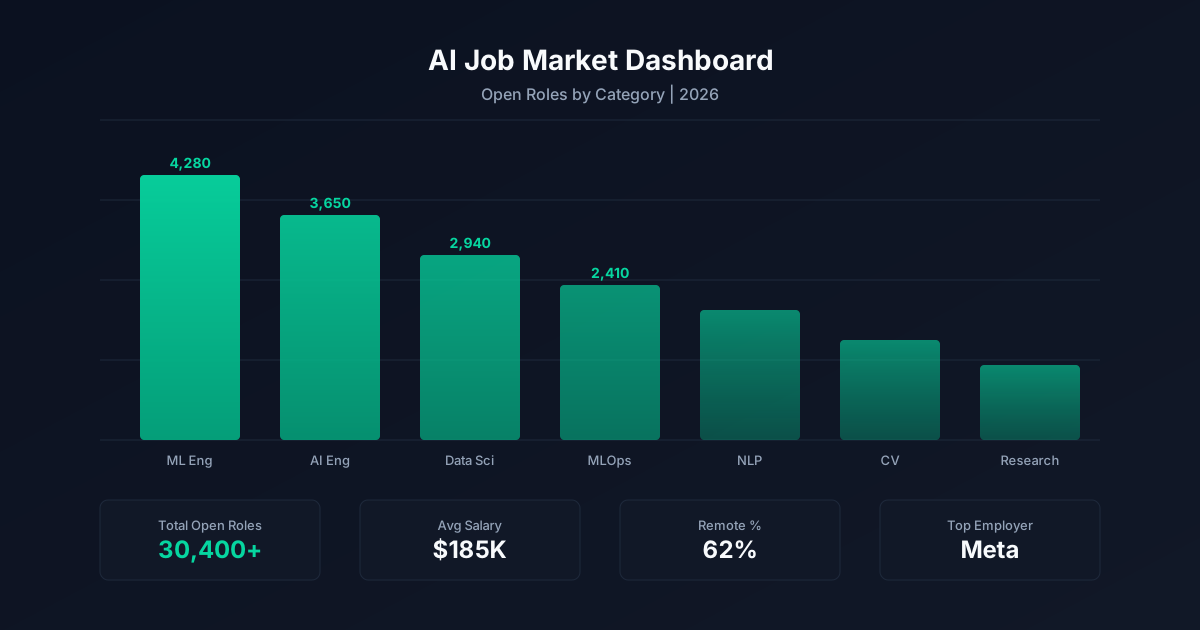
The AI job market spans 3,708 open positions across 16 role categories. The largest categories by volume: AI/ML Engineer (2,605), Data Scientist (310), AI Software Engineer (259). These three account for the majority of open positions, though smaller categories often have higher per-role compensation because of specialized skill requirements.
The seniority mix tells a story about where AI teams are in their maturity. Entry-level roles (102) are outnumbered by mid-level (1,705) and senior (1,469) positions, reflecting that most companies are past the 'build a team from scratch' phase and need experienced engineers who can ship production systems. Leadership roles (Director, VP, C-Level) total 432 positions, representing the bottleneck between technical execution and organizational strategy.
Remote work availability sits at 14% of all AI roles (508 positions), with 3,180 requiring on-site or hybrid attendance. The remote share has stabilized after the post-pandemic correction. Senior and specialized roles (Research Scientist, ML Architect) are more likely to be remote-eligible than entry-level positions, partly because experienced hires have more negotiating power and partly because these roles require less hands-on mentorship.
AI compensation is structured in clear tiers. The market median sits at $217,500. Top-quartile roles start at $272,100, and the 90th percentile reaches $325,000. These figures include base salary with disclosed compensation. Total compensation (including equity, bonuses, and sign-on) runs 20-40% higher at companies that offer those components.
Category matters for compensation. AI Safety roles lead at $300,000 median, while Prompt Engineer roles sit at $140,000. The spread between highest and lowest-paying categories reflects the premium on specialized technical skills versus broader analytical roles.
The most in-demand skills across all AI postings: Python (1,890 postings), Aws (1,103 postings), Azure (877 postings), Rag (855 postings), Gcp (631 postings), Prompt Engineering (560 postings), Pytorch (545 postings), Claude (498 postings). Python dominates, appearing in the vast majority of role descriptions regardless of category. Cloud platform experience (AWS, GCP, Azure) is the second most common requirement. The newer entrants to the top skills list (RAG, vector databases, LLM APIs) reflect the shift from traditional ML toward generative AI applications.
Frequently Asked Questions
Get Weekly AI Career Intelligence
Salary data, skills demand, and market signals from 16,000+ AI job postings. Every Monday.