
Interested in this AI/ML Engineer role at Rippling?
Apply Now →Skills & Technologies
About This Role
Kai is the AI company rebuilding cybersecurity for the machine\-speed era. Founded by second time founders and trusted by Fortune 500 enterprises, Kai is building a future where security has no categories, no silos, and no human speed bottlenecks. The Kai Agentic Platform replaces fragmented, human\-limited workflows with agentic AI systems that continuously contextualize, assess, reason, and execute security work at the speed of thought \- making human defenders, superhuman.
Why Kai?
- Well\-funded: With $125M raised, we have the capital, runway, and resolve to rebuild cybersecurity from first principles.
- Proven: We've earned the trust of Fortune 500 and Global 1000 companies, and we're just getting started. Their confidence in Kai reflects what we've built: an AI\-powered cybersecurity platform that performs at the scale and speed the enterprise demands.
- Experienced founders: Our founding team consists of second\-time entrepreneurs, each with over 20 years of experience in the cybersecurity industry. Their proven expertise and vision drive our ambitious goals.
- World\-class leadership team: Our Heads of AI, Engineering, and Product bring extensive experience from some of the world’s most influential companies, ensuring top\-tier mentorship, direction, and vision.
- Frontier AI Applied Research Team: Our researchers operate at the leading edge of agentic AI systems, translating breakthrough capabilities into real\-world cybersecurity applications.
- Generous compensation: We offer highly competitive salaries, equity options, and a supportive work environment. Your contributions will be valued and rewarded as we grow together.
We're looking for a AI Platform Security Engineer to drive the security of the Azure infrastructure that powers the Kai AI\-native cybersecurity product. This role centers on the security of the cloud foundation, data platform, AI/ML infrastructure, and internal developer platform that the product depends on.
This is a deeply technical, infrastructure\-focused role. You'll work closely with Platform Engineering, DevOps, Data Engineering, and AI/MLOps teams to ensure that the systems, pipelines, and environments underpinning our product are designed, built, and operated securely.
What You'll Do...
Cloud Infrastructure Security
- Own the end\-to\-end security infrastructure architecture of our Azure environment, including landing zone design, management group and subscription structure, network topology, and resource governance.
- Enforce and continuously improve guardrails using Azure Policy, Cloud security posture management (CSPM), and infrastructure\-as\-code (IaC) security scanning (Checkov, tfsec, or equivalent).
- Manage and mature the Azure network security model: hub\-and\-spoke topology, NSG and Azure Firewall rule governance, Private Endpoints, and DDoS protection controls.
- Lead cloud infrastructure security posture reviews, drive down misconfigurations, and own the organization's Secure Score improvement roadmap.
- Maintain and harden Azure landing zones, ensuring new workloads are provisioned into a secure\-by\-default environment.
Identity, Access, and Secrets Management
- Drive the organization's cloud identity and access management strategy, including Entra ID tenant configuration, Privileged Identity Management (PIM), Conditional Access policies, and workload identity (managed identities, federated credentials, service principals).
- Enforce least\-privilege IAM across all Azure subscriptions and resources; conduct regular access reviews and entitlement hygiene campaigns.
- Architect and operate the enterprise secrets management program using Azure Key Vault with HSM\-backed keys, including key rotation automation, certificate lifecycle management, and developer\-facing secrets injection patterns.
- Define and enforce policies for human and non\-human identities across CI/CD systems, internal tooling, and AI/ML workloads.
Kubernetes and Container Platform Security
- Secure the Azure Kubernetes Service (AKS) platform: cluster hardening, node pool configuration, admission control (OPA/Gatekeeper, Kyverno), runtime security, and network policy enforcement.
- Own container security standards: base image governance, image signing and provenance (Notary, Cosign), container registry security (Azure Container Registry), and vulnerability scanning integration in the build pipeline.
- Maintain and improve Pod Security Standards, workload identity binding (Azure Workload Identity), and namespace\-level security isolation.
- Collaborate with Platform Engineering on the internal developer platform (IDP) to ensure that developer self\-service pathways are built with security guardrails as first\-class controls.
AI and Data Platform Security
- Secure the data and AI/ML infrastructure layer.
- Define and enforce data security controls including storage encryption (CMK), data classification enforcement, network isolation for data services, and access boundary policies between training, staging, and production AI environments.
- Establish security controls for AI/ML pipelines: training data provenance and integrity, model artifact signing, inference endpoint hardening, and isolation of multi\-tenant AI workloads.
- Work with Data Engineering and MLOps teams to ensure AI infrastructure changes go through security review and that data access patterns are auditable and compliant.
Detection, Response, and Vulnerability Management
- Own the cloud\-native detection and monitoring stack
- Develop and maintain detection rules and analytic content tuned to cloud infrastructure and AI platform threats (e.g., credential abuse, lateral movement, data exfiltration from AI workloads).
- Lead the infrastructure vulnerability management program: agent\-based and agentless scanning across Azure VMs, AKS nodes, and container images; SLA\-based remediation tracking; and patch compliance reporting.
- Own cloud incident response runbooks for infrastructure\-layer security events and serve as the technical lead for cloud\-scoped security incidents.
Security Automation and Platform Hardening
- Build and maintain policy\-as\-code frameworks that enforce security standards across IaC templates (Terraform, Bicep) before resources are provisioned.
- Develop internal security automation for drift detection, misconfiguration remediation, and continuous compliance validation against CIS Azure Foundations Benchmark and equivalent baselines.
- Partner with DevOps and Platform Engineering to embed security gates into infrastructure CI/CD pipelines, ensuring that insecure infrastructure changes cannot reach production.
- Maintain the platform security baseline documentation and runbooks, enabling the broader engineering organization to build a well\-understood, secure foundation.
What We're Looking For
Required
- An ownership mentality that places the wellbeing of the company, our customers, and teammates at the forefront of everything that the role does.
- Ability to thrive in a high\-paced, high\-growth startup environment.
- 6\+ years of experience in cloud security, infrastructure security, or platform security engineering, with at least 3 years working deeply in Microsoft Azure.
- Expert\-level knowledge of Azure security services: Entra ID, Key Vault, Azure Firewall, Azure Policy, and Private Networking.
- Strong hands\-on experience with Kubernetes security and AKS platform operations, including admission controllers, runtime security, and workload identity.
- Demonstrated experience securing data platforms and AI/ML infrastructure (data lakes, blob storage, model training environments, inference endpoints).
- Proficiency with infrastructure\-as\-code tools (Terraform and/or Bicep) and IaC security scanning.
- Strong scripting and automation skills in Python, Bash, or PowerShell for building security tooling and automation workflows.
- Experience with cloud identity architecture: Entra ID, managed identities, OAuth 2\.0/OIDC, PIM, and Conditional Access.
- Working knowledge of network security concepts: firewalls, NSGs, DNS security, private networking, and Zero Trust network access (ZTNA).
Preferred
- Experience securing AI/ML platforms, LLM inference infrastructure, or vector database environments
- Familiarity with the MITRE ATT\&CK for Cloud and MITRE ATLAS (adversarial ML) frameworks.
- Experience developing detection content in Microsoft Sentinel (KQL authoring) or equivalent SIEM platforms.
- Relevant certifications such as AZ\-500, SC\-100, CKS (Certified Kubernetes Security Specialist), CCSP, or GCIA.
- Prior experience in a cybersecurity product company or securing multi\-tenant SaaS infrastructure.
- Familiarity with compliance frameworks relevant to cloud infrastructure: SOC 2, ISO 27001, CSA STAR, and NIST CSF.
Role Details
About This Role
AI/ML Engineers build and deploy machine learning models in production. They work across the full ML lifecycle: data pipelines, model training, evaluation, and serving infrastructure. The role has evolved significantly over the past two years. Where ML Engineers once spent most of their time on model architecture, the job now tilts heavily toward inference optimization, cost management, and integrating LLM capabilities into existing systems. Companies want engineers who can ship production systems, and the experimenter-only role is fading fast.
Day-to-day, you're writing training pipelines, debugging data quality issues, setting up evaluation frameworks, and figuring out why your model performs differently in staging than it did on your dev set. The best ML engineers are obsessive about reproducibility and measurement. They instrument everything. They know that a model is only as good as the data feeding it and the infrastructure serving it.
Across the 3,708 AI roles we're tracking, AI/ML Engineer positions make up 70% of the market. At Rippling, this role fits into their broader AI and engineering organization.
Demand for AI/ML Engineers has been strong and consistent. Unlike some AI roles that spike with hype cycles, ML engineering is a foundational need. Every company deploying AI models needs people who can keep them running, and the gap between research prototypes and production systems keeps growing.
What the Work Looks Like
A typical week might include: debugging a data pipeline that's silently dropping 3% of training examples, running A/B tests on a new model version, writing documentation for a feature flag system that lets you roll back model deployments, and reviewing a junior engineer's PR for a new evaluation metric. Meetings tend to be cross-functional since ML touches product, engineering, and data teams.
Demand for AI/ML Engineers has been strong and consistent. Unlike some AI roles that spike with hype cycles, ML engineering is a foundational need. Every company deploying AI models needs people who can keep them running, and the gap between research prototypes and production systems keeps growing.
Skills Required
Python and PyTorch dominate the requirements. Most roles expect experience with cloud platforms (AWS, GCP, or Azure) and familiarity with ML frameworks like TensorFlow or JAX. RAG (Retrieval-Augmented Generation) has become a top-3 skill requirement as companies integrate LLMs into their products. Docker and Kubernetes show up in about a third of postings, reflecting the production focus of the role.
Beyond the core stack, employers increasingly want experience with experiment tracking tools (MLflow, Weights & Biases), feature stores, and vector databases. Fine-tuning experience is valuable but less common than you'd think from reading Twitter. Most production LLM work is RAG and prompt engineering, not fine-tuning. If you have both, you're in a strong position.
Companies that are serious about AI/ML hiring tend to post specific infrastructure details in the job description: the frameworks they use, their model serving stack, their data pipeline tools. Vague postings that just say 'ML experience required' without specifics are often companies that haven't figured out what they need yet.
Compensation Benchmarks
AI/ML Engineer roles pay a median of $218,750 based on 3,817 positions with disclosed compensation. Mid-level AI roles across all categories have a median of $200,000.
Across all AI roles, the market median is $217,500. Top-quartile compensation starts at $272,100. The 90th percentile reaches $325,000. For comparison, the highest-paying categories include AI Safety ($300,000) and Research Engineer ($280,000). By seniority level: Entry: $120,000; Mid: $200,000; Senior: $230,000; Director: $272,150; VP: $250,000.
Rippling AI Hiring
Rippling has 19 open AI roles right now. They're hiring across AI Product Manager, AI Software Engineer, AI/ML Engineer, Data Engineer. Positions span Remote, US, New York, NY, US, San Francisco, CA, US. Compensation range: $60K - $330K.
Location Context
Across all AI roles, 14% (508 positions) offer remote work, while 3,180 require on-site attendance. Top AI hiring metros: New York (1,045 roles, $220,000 median); San Francisco (810 roles, $277,088 median); Los Angeles (397 roles, $215,000 median).
Career Path
Common paths into AI/ML Engineer roles include Data Scientist, Software Engineer, Research Engineer.
From here, career progression typically leads toward ML Architect, AI Engineering Manager, Principal ML Engineer.
The fastest path into ML engineering is through software engineering with a self-directed ML education. A CS degree helps, but production engineering skills matter more than academic credentials. Build something that works, deploy it, and measure it. That portfolio project is worth more than a Coursera certificate. For career growth, the fork comes around the senior level: go deep on technical complexity (staff/principal track) or move into managing ML teams.
What to Expect in Interviews
Expect system design questions around ML pipelines: how you'd build a training pipeline for a specific use case, handle data drift, or design A/B testing infrastructure for model deployments. Coding rounds typically involve Python, with emphasis on data manipulation (pandas, numpy) and algorithm implementation. Take-home assignments often ask you to build an end-to-end ML pipeline from raw data to deployed model.
When evaluating opportunities: Companies that are serious about AI/ML hiring tend to post specific infrastructure details in the job description: the frameworks they use, their model serving stack, their data pipeline tools. Vague postings that just say 'ML experience required' without specifics are often companies that haven't figured out what they need yet.
AI Hiring Overview
The AI job market has 3,708 open positions tracked in our dataset. By seniority: 102 entry-level, 1,705 mid-level, 1,469 senior, and 432 leadership roles (Director, VP, C-Level). Remote roles make up 14% of the market (508 positions). The remaining 3,180 roles require on-site or hybrid attendance.
The market median for AI roles is $217,500. Top-quartile compensation starts at $272,100. The 90th percentile reaches $325,000. Highest-paying categories: AI Safety ($300,000 median, 21 roles); Research Engineer ($280,000 median, 147 roles); AI Architect ($254,798 median, 67 roles).
Demand for AI/ML Engineers has been strong and consistent. Unlike some AI roles that spike with hype cycles, ML engineering is a foundational need. Every company deploying AI models needs people who can keep them running, and the gap between research prototypes and production systems keeps growing.
The AI Job Market Today
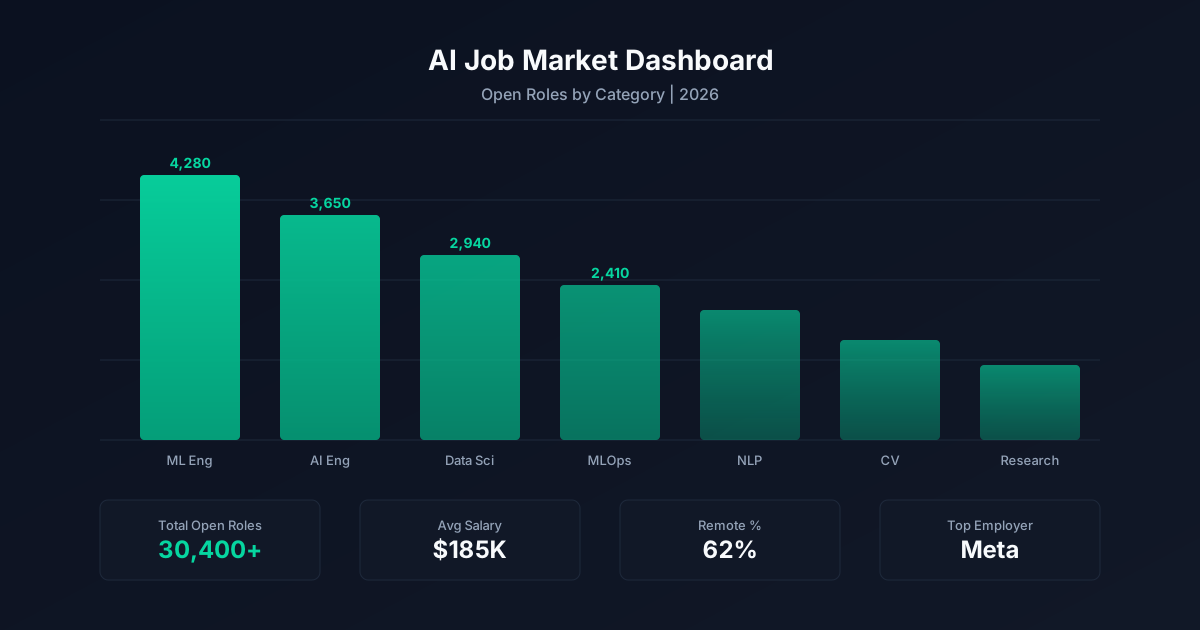
The AI job market spans 3,708 open positions across 16 role categories. The largest categories by volume: AI/ML Engineer (2,605), Data Scientist (310), AI Software Engineer (259). These three account for the majority of open positions, though smaller categories often have higher per-role compensation because of specialized skill requirements.
The seniority mix tells a story about where AI teams are in their maturity. Entry-level roles (102) are outnumbered by mid-level (1,705) and senior (1,469) positions, reflecting that most companies are past the 'build a team from scratch' phase and need experienced engineers who can ship production systems. Leadership roles (Director, VP, C-Level) total 432 positions, representing the bottleneck between technical execution and organizational strategy.
Remote work availability sits at 14% of all AI roles (508 positions), with 3,180 requiring on-site or hybrid attendance. The remote share has stabilized after the post-pandemic correction. Senior and specialized roles (Research Scientist, ML Architect) are more likely to be remote-eligible than entry-level positions, partly because experienced hires have more negotiating power and partly because these roles require less hands-on mentorship.
AI compensation is structured in clear tiers. The market median sits at $217,500. Top-quartile roles start at $272,100, and the 90th percentile reaches $325,000. These figures include base salary with disclosed compensation. Total compensation (including equity, bonuses, and sign-on) runs 20-40% higher at companies that offer those components.
Category matters for compensation. AI Safety roles lead at $300,000 median, while Prompt Engineer roles sit at $140,000. The spread between highest and lowest-paying categories reflects the premium on specialized technical skills versus broader analytical roles.
The most in-demand skills across all AI postings: Python (1,890 postings), Aws (1,103 postings), Azure (877 postings), Rag (855 postings), Gcp (631 postings), Prompt Engineering (560 postings), Pytorch (545 postings), Claude (498 postings). Python dominates, appearing in the vast majority of role descriptions regardless of category. Cloud platform experience (AWS, GCP, Azure) is the second most common requirement. The newer entrants to the top skills list (RAG, vector databases, LLM APIs) reflect the shift from traditional ML toward generative AI applications.
Frequently Asked Questions
Get Weekly AI Career Intelligence
Salary data, skills demand, and market signals from 16,000+ AI job postings. Every Monday.