
Interested in this AI Agent Developer role at Shop My?
Apply Now →About This Role
Join ShopMy – Powering the Future of Digital Marketing
ShopMy is transforming e\-commerce by building the infrastructure for human\-led curation at scale. We help brands run performance\-driven creator programs while enabling top creators to monetize their influence and partner directly with the brands they love—driving discovery through trusted tastemakers and authentic recommendations.
ShopMy recently became a unicorn, raising at a $1\.5B valuation with backing from Bessemer Venture Partners, Avenir Growth Capital, and Bain Capital Ventures.
At ShopMy, you're building the future of human\-led commerce for the world's best brands, tastemakers, and shoppers. You move fast and see immediate impact in your work, alongside accomplished teammates who are driven by helping find the world's best things. If you’re excited to help shape the future of curated commerce at the intersection of technology, culture, and taste, we’d love to meet you.
About the Role
We are looking for a Product Manager for our AI agents. ShopMy is building a growing fleet of agents that do real work for internal teams and external clients, from brands and creators to the people who support them. As these agents move toward improving from their own track record, someone has to own what each agent is for and keep it pointed at useful work. That is you.
In this role you sit between the people an agent serves and the agentic system itself. You deeply understand the client's need, whether that client is an internal team or an external brand or creator, and you translate that need into concrete demands on the agents: how they should behave, how they delegate, what good output looks like, and where their boundaries sit. You work closely with the teams and clients each agent serves, along with product and engineering, turning recurring evidence from real runs into a system that gets measurably better over time.
What We're Looking For
We need someone who embodies three qualities:
You are a systems thinker. You deeply understand the people an agent serves, whether an internal team or an external brand or creator, and you see how their work actually flows: where decisions happen, where context gets lost, where things slow down. You assume the requests and complaints you are handed are incomplete, and you read between them to find the need actually worth solving. You know where an agent genuinely helps and where it does not.
You are hands\-on with agents. You do not just write requirements and hand them off. You are in the prompts, documents, and delegation yourself, you prototype and test against real runs rather than writing long specs, and you partner with engineering to ship the harder capabilities. You earn trust through what works.
You live on the frontier of agents. You have real intuition for LLMs: how they are prompted, how they delegate to one another, and how they are evaluated. You set the bar for what a great agent feels like, accurate, reliable, on\-tone, and trusted, and you keep up with what is newly possible.
What You’ll Do
- Deep dive with customer teams to deeply understand their processes and problems, and decide and prioritize where to plug in agents for the greatest impact
- Own and deeply understand the customer need behind each agent, whether the client is an internal team or an external brand or creator, and convert it into clear requirements and priorities for the agents
- Garden agents against that need: watch for recurring gaps, quality drift, confusing delegation, weak eval coverage, and agents being stretched beyond their shape
- Own prompt and document quality, delegation shape, locked instructions, and agent boundaries for your agents with a high bar for precision
- Help shape the agentic orchestration system itself, not just the individual agents: spot flaws, friction, and missing capabilities in how agents are coordinated, and act as a product driver for where the system should go next
- Triage the improvement queue: act on the agent\-side changes you own, route tool and capability gaps to engineering, and route product ambiguity to product owners
- Partner with the people an agent serves, along with product and engineering, so every agent has the right scope, knowledge, and tools to succeed, without taking over their domains
What We're Looking For
- 3\+ years in product management, or a closely related role where you owned a product, workflow, or service against real customer needs
- A keen understanding of business processes and strong business judgment: you can reason about where the leverage and the ROI are, and focus the agents there
- A track record of deeply understanding customers, internal or external, and turning their needs into clear requirements others can act on
- An evidence\-driven, analytical mindset, with the patience and attention to detail to read run histories, spot recurring patterns, and prioritize by impact
- Enough technical fluency to prototype, evaluate, and go deep with engineers on agent design and reliability; you do not need to be a software engineer, but you cannot be hands\-off
- Real comfort operating independently amid ambiguity, in a role and a system that are both still being built
- Bachelor's degree or equivalent practical experience
Bonus Points
- Experience working in high\-growth startups or fast\-paced product environments
- Hands\-on experience building, prompting, or evaluating LLM agents
- Familiarity with eval frameworks or LLM\-as\-judge systems
- Background in consulting or strategic business operations
- Background in the creator economy, influencer or affiliate marketing, or e\-commerce
- Experience working directly with brands or creators as clients
In compliance with New York Pay Transparency Law, the salary range for this position is as shown. We note that salary information as a general guideline only, actual compensation may vary from posting based on the offer for this role, including the scope and responsibilities of the position, relevant work experience, key skills, education, training and business considerations.
New York Pay Range
$150,000 \- $225,000 USD
*The provided salary range is base salary, exclusive of bonus potential or commission and is a good faith estimate of cash compensation. ShopMy is flexible pending candidate's experience and how our business needs evolve throughout the search. Every employee of ShopMy receives equity on top of cash compensation!*
ShopMy offers a bundle of benefits on top of being a great place to work.
Our teammates are provided benefits such as:
- Medical \& Dental Coverage at 70%
- Equity in ShopMy
- Flexible PTO
- 14 weeks of parental leave
- Wellness \& Social Stipend
- Technology Stipend
- Learning \& Development Stipend
- 401k program (3% automated contribution from ShopMy!)
- Wellhub Membership
- Company retreats
- Opportunity to monetize your influence\- all employees build out a ShopMy page!
- Birthday PTO
- Brand new NYC HQ office
Salary Context
This $150K-$225K range is above the median for AI Agent Developer roles in our dataset (median: $188K across 26 roles with salary data).
View full AI Agent Developer salary data →Role Details
About This Role
AI Agent Developers build autonomous systems that can reason, plan, and take actions. They design multi-step workflows, tool-use frameworks, and orchestration layers that let LLMs interact with external systems. This is the frontier of applied AI engineering.
Agent development is where the most interesting (and hardest) problems in applied AI live right now. Making an LLM answer a question is straightforward. Making it reliably execute a 15-step workflow that involves calling APIs, reading databases, making decisions, and recovering from errors is an unsolved problem. You're building systems that have to work despite the fact that the underlying model is non-deterministic.
Across the 3,708 AI roles we're tracking, AI Agent Developer positions make up 1% of the market. At Shop My, this role fits into their broader AI and engineering organization.
AI Agent Developer is one of the newest and fastest-growing AI role categories. The market is early but accelerating as companies move beyond simple chatbots toward AI systems that can take real actions. Compensation is high because the skill set is rare and the business impact is potentially enormous.
What the Work Looks Like
A typical week includes: designing the action space and tool definitions for a new agent use case, debugging why the agent chose the wrong action sequence on a specific input, building evaluation frameworks that test agent reliability across hundreds of scenarios, optimizing the prompt chain for cost and latency, and implementing safety guardrails to prevent the agent from taking destructive actions. The work is equal parts engineering and empirical science.
AI Agent Developer is one of the newest and fastest-growing AI role categories. The market is early but accelerating as companies move beyond simple chatbots toward AI systems that can take real actions. Compensation is high because the skill set is rare and the business impact is potentially enormous.
Skills in Demand for This Role
Deep experience with LLM APIs and agent frameworks (LangChain, CrewAI, AutoGen). Strong understanding of prompt engineering, function calling, and error handling for non-deterministic systems. Python is standard. Experience with orchestration patterns, state management, and workflow engines adds significant value.
The best agent developers think like systems engineers. They design for failure modes, build observability into every step, and understand that agent reliability is the product. Expertise in evaluation methodology for non-deterministic systems is the differentiator. Can you measure whether your agent works 'well enough'? Can you find the edge cases where it breaks?
Look for roles that describe specific agent use cases, mention evaluation methodology, and talk about production deployment. Early-stage companies exploring agents can be exciting, but be prepared for ambiguity. The most valuable roles are at companies that have already shipped a v1 and need to make it reliable.
Compensation Benchmarks
AI Agent Developer roles pay a median of $238,500 based on 58 positions with disclosed compensation. Senior-level AI roles across all categories have a median of $230,000. This role's midpoint ($187K) sits 21% below the category median. Disclosed range: $150K to $225K.
Across all AI roles, the market median is $217,500. Top-quartile compensation starts at $272,100. The 90th percentile reaches $325,000. For comparison, the highest-paying categories include AI Safety ($300,000) and Research Engineer ($280,000). By seniority level: Entry: $120,000; Mid: $200,000; Senior: $230,000; Director: $272,150; VP: $250,000.
Shop My AI Hiring
Shop My has 1 open AI role right now. They're hiring across AI Agent Developer. Based in Remote, US. Compensation range: $225K - $225K.
Remote Work Context
Remote AI roles pay a median of $185,334 across 717 positions. About 14% of all AI roles offer remote work.
Career Path
Common paths into AI Agent Developer roles include Software Engineer, LLM Engineer, Prompt Engineer.
From here, career progression typically leads toward AI Architect, Principal Engineer, Head of AI Engineering.
Build agents. That's the portfolio. Take an open-source agent framework, build something that completes a non-trivial multi-step task, evaluate it rigorously, and document what you learned about reliability, cost, and failure modes. The field is new enough that practical experience counts for more than credentials.
What to Expect in Interviews
Interviews focus on systems thinking and reliability engineering. Expect questions about agent architecture: how you'd design a multi-step workflow with error recovery, how you'd evaluate agent performance, and how you'd prevent agents from taking destructive actions. Coding exercises often involve building a simple agent with tool use and evaluating its behavior across different scenarios. Discussion of safety and guardrails is increasingly common.
When evaluating opportunities: Look for roles that describe specific agent use cases, mention evaluation methodology, and talk about production deployment. Early-stage companies exploring agents can be exciting, but be prepared for ambiguity. The most valuable roles are at companies that have already shipped a v1 and need to make it reliable.
AI Hiring Overview
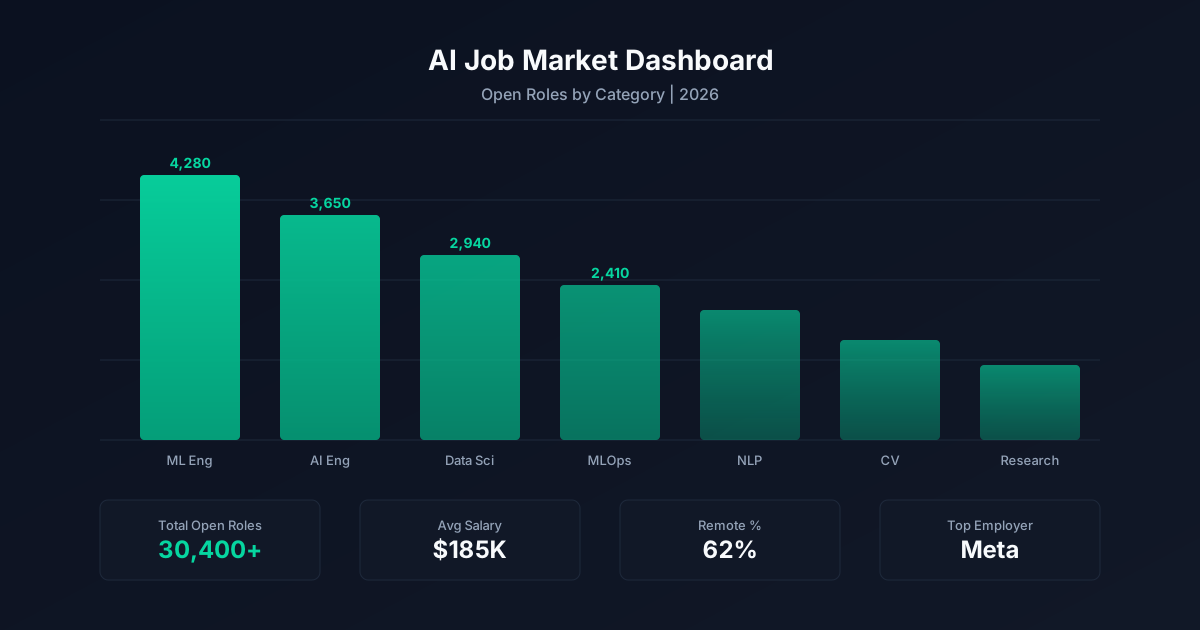
The AI job market has 3,708 open positions tracked in our dataset. By seniority: 102 entry-level, 1,705 mid-level, 1,469 senior, and 432 leadership roles (Director, VP, C-Level). Remote roles make up 14% of the market (508 positions). The remaining 3,180 roles require on-site or hybrid attendance.
The market median for AI roles is $217,500. Top-quartile compensation starts at $272,100. The 90th percentile reaches $325,000. Highest-paying categories: AI Safety ($300,000 median, 21 roles); Research Engineer ($280,000 median, 147 roles); AI Architect ($254,798 median, 67 roles).
AI Agent Developer is one of the newest and fastest-growing AI role categories. The market is early but accelerating as companies move beyond simple chatbots toward AI systems that can take real actions. Compensation is high because the skill set is rare and the business impact is potentially enormous.
The AI Job Market Today
The AI job market spans 3,708 open positions across 16 role categories. The largest categories by volume: AI/ML Engineer (2,605), Data Scientist (310), AI Software Engineer (259). These three account for the majority of open positions, though smaller categories often have higher per-role compensation because of specialized skill requirements.
The seniority mix tells a story about where AI teams are in their maturity. Entry-level roles (102) are outnumbered by mid-level (1,705) and senior (1,469) positions, reflecting that most companies are past the 'build a team from scratch' phase and need experienced engineers who can ship production systems. Leadership roles (Director, VP, C-Level) total 432 positions, representing the bottleneck between technical execution and organizational strategy.
Remote work availability sits at 14% of all AI roles (508 positions), with 3,180 requiring on-site or hybrid attendance. The remote share has stabilized after the post-pandemic correction. Senior and specialized roles (Research Scientist, ML Architect) are more likely to be remote-eligible than entry-level positions, partly because experienced hires have more negotiating power and partly because these roles require less hands-on mentorship.
AI compensation is structured in clear tiers. The market median sits at $217,500. Top-quartile roles start at $272,100, and the 90th percentile reaches $325,000. These figures include base salary with disclosed compensation. Total compensation (including equity, bonuses, and sign-on) runs 20-40% higher at companies that offer those components.
Category matters for compensation. AI Safety roles lead at $300,000 median, while Prompt Engineer roles sit at $140,000. The spread between highest and lowest-paying categories reflects the premium on specialized technical skills versus broader analytical roles.
The most in-demand skills across all AI postings: Python (1,890 postings), Aws (1,103 postings), Azure (877 postings), Rag (855 postings), Gcp (631 postings), Prompt Engineering (560 postings), Pytorch (545 postings), Claude (498 postings). Python dominates, appearing in the vast majority of role descriptions regardless of category. Cloud platform experience (AWS, GCP, Azure) is the second most common requirement. The newer entrants to the top skills list (RAG, vector databases, LLM APIs) reflect the shift from traditional ML toward generative AI applications.
Frequently Asked Questions
Get Weekly AI Career Intelligence
Salary data, skills demand, and market signals from 16,000+ AI job postings. Every Monday.