
Interested in this AI/ML Engineer role at T-Mobile?
Apply Now →Skills & Technologies
About This Role
T\-Mobile is in pursuit of exceptional talent to join our executive team. We’re committed to excellence and innovation, and we are on the lookout for a leader who can steer our company towards new heights of success. In this pivotal role, you will be responsible for driving strategic initiatives and leading a talented team of professionals. The ideal candidate will possess a proven track record of success, demonstrating a keen ability to navigate complex challenges and capitalize on emerging opportunities. As a key member of our executive team, you will play a crucial role in shaping and executing our organizational strategy and contributing to our continued growth and market leadership. Join us in our commitment to driving innovation, inspiring collaboration, fostering a positive company culture, and achieving unparalleled success.
The Sr. Director, Agentic AI Automation \& FDE is T\-Mobile’s internal evangelist for Agentic AI and the leader responsible for pushing AI into every department of the company and has a primary focus on back\-office functions including supply chain, finance, legal, HR, and all corporate functions. This role builds and leads the Forward Deployment Engineering practice, embedding specialized AI engineers directly inside business units to make AI real in every part of the enterprise, not just in centralized platform teams. The role holds direct accountability for business unit outcome metrics, owns the FDE operating model and performance framework, and serves as T\-Mobile’s primary relationship holder with key AI technology partners Google, Anthropic, and OpenAI. It reports directly to the SVP, Enterprise Transformation \& AI, and leads a cohort of Forward Deployment Engineers across US and India with a mandate to scale.* Build and lead the Forward Deployment Engineering practice: design the FDE operating model, engagement methodology, domain rotation structure, and performance measurement framework. Own FDE hiring, onboarding, and cohort development for the initial 20\-person US and India cohort and subsequent hiring waves. Establish the practice standards, diagnostic frameworks, and iteration protocols that govern how FDEs operate across all T\-Mobile business domains.
- Own the Agentic AI Automation delivery function: oversee the design, deployment, and production optimization of agentic AI systems across T\-Mobile's commercial domains care, retail, B2B, supply chain, finance, legal, and HR. Ensure deployed solutions are built on the CoE shared platform rather than bespoke per\-BU stacks and hold accountability for whether business unit outcome metrics actually move.
- Manage the BU partnership model and AI vendor relationships: establish and maintain Sr. Director level relationships with back\-office and consumer business unit leaders across all FDE\-embedded domains. Own the domain prioritization framework with primary focus on back\-office functions. Manage T\-Mobile’s strategic partnerships with Google, Anthropic, and OpenAI including joint roadmap input, early access to emerging agentic capabilities, and translating partner technology advances into T\-Mobile deployments. Translate BU operational friction into structured feedback for CoE engineering and governance teams.
- Drive the reusable pattern library and CoE knowledge loop: ensure proven domain solutions are codified into templates, building blocks, and playbooks that land on the CoE shared platform. Oversee structured bi\-weekly feedback cycles from FDEs to CoE engineering teams and participate in CoE sprint reviews to translate field observations into platform improvements.
- Report program performance and EBITDA impact: own the roll\-up reporting of FDE domain outcomes to SVP and ELT audiences. Build and maintain the measurement framework for tracking AI\-driven business impact across domains, including AHT reduction, containment rates, conversion lift, procurement cycle compression, and other BU\-specific metrics.
- Also responsible for other Duties/Projects as assigned by business management as needed.
The Experience You’ll Bring
- Bachelor's Computer Science, Engineering, or a related field (Required).
- 10\+ years of experience in technology leadership with progressive experience in AI engineering applied ML, or enterprise digital transformation.
- 7\-10\+ years of experience in people leadership managing technical teams including senior engineers and team leads.
- 2\-4 years hands\-on experience with Agentic AI systems, LLM deployment, RAG architecture, or multi\-agent orchestration in production environments.
Enough about what you’ve done. Let’s talk about who you are.
- Deep understanding of Agentic AI system design, prompt orchestration, LLM integration patterns, and production AI reliability.
- Familiarity with operations in at least two of the target domains: care, retail, B2B, supply chain, finance, HR.
- Ability to define, instrument, and report on business outcome metrics tied to AI deployment not activity or deployment milestones.
- Demonstrated ability to lead technical delivery in ambiguous, operational environments without formal authority.
- Ability to translate AI field performance and domain outcome data for SVP and ELT audiences.
- Track record of building and scaling a new technical practice, center of excellence, or field engineering function.
- At least 18 years of age
- Legally authorized to work in the United States
*T\-Mobile* *requires U.S. citizenship for certain roles within the organization. This role requires U.S. citizenship. Individuals hired into this role will be required to submit documentation proving U.S. citizenship within the first 7 days of hire \- failure to do so will result in termination.*
Base Pay Range: $259,300 \- $350,800
Corporate Bonus Target: 35%
The pay range above is the general base pay range for a successful candidate in the role. The successful candidate’s actual pay will be based on various factors, such as qualifications and experience, so the actual starting pay will vary within this range. Most Corporate employees are eligible for a year\-end bonus based on company and/or individual performance and which is set at a percentage of the employee’s eligible earnings in the prior year.
At T\-Mobile, our benefits exemplify the spirit of One Team, Together! A big part of how we care for one another is working to ensure our benefits evolve to meet the needs of our team members. Full and part\-time employees have access to the same benefits when eligible. We cover all of the bases, offering medical, dental and vision insurance, a flexible spending account, 401(k), employee stock grants, employee stock purchase plan, paid time off and up to 12 paid holidays \- which total about 4 weeks for new full\-time employees and about 2\.5 weeks for new part\-time employees annually \- paid parental and family leave, family building benefits, back\-up care, enhanced family support, childcare subsidy, tuition assistance, college coaching, short\- and long\-term disability, voluntary AD\&D coverage, voluntary accident coverage, voluntary life insurance, voluntary disability insurance, and voluntary long\-term care insurance. We don't stop there \- eligible employees can also receive mobile service \& home internet discounts, pet insurance, and access to commuter and transit programs! To learn about T\-Mobile’s amazing benefits, check out *www.t\-mobilebenefits.com**.*
Never stop growing!###
As part of the T\-Mobile team, you know the Un\-carrier doesn’t have a corporate ladder–it’s more like a jungle gym of possibilities! We love helping our employees grow in their careers, because it’s that shared drive to aim high that drives our business and our culture forward. By applying for this career opportunity, you’re living our values while investing in your career growth–and we applaud it. You’re unstoppable!###
T\-Mobile USA, Inc. is an Equal Opportunity Employer. All decisions concerning the employment relationship will be made without regard to age, race, ethnicity, color, religion, creed, sex, sexual orientation, gender identity or expression, genetic information, national origin, religious affiliation, marital status, citizenship status, veteran status, the presence of any physical or mental disability, or any other status or characteristic protected by federal, state, or local law. Discrimination, retaliation or harassment based upon any of these factors is wholly inconsistent with how we do business and will not be tolerated.###
Talent comes in all forms at the Un\-carrier. If you are an individual with a disability and need reasonable accommodation at any point in the application or interview process, please let us know by emailing ApplicantAccommodation@t\-mobile.com or calling 1\-844\-873\-9500\. Please note, this contact channel is not a means to apply for or inquire about a position and we are unable to respond to non\-accommodation related requests.
Salary Context
This $259K-$350K range is above the 75th percentile for AI/ML Engineer roles in our dataset (median: $180K across 1841 roles with salary data).
View full AI/ML Engineer salary data →Role Details
About This Role
AI/ML Engineers build and deploy machine learning models in production. They work across the full ML lifecycle: data pipelines, model training, evaluation, and serving infrastructure. The role has evolved significantly over the past two years. Where ML Engineers once spent most of their time on model architecture, the job now tilts heavily toward inference optimization, cost management, and integrating LLM capabilities into existing systems. Companies want engineers who can ship production systems, and the experimenter-only role is fading fast.
Day-to-day, you're writing training pipelines, debugging data quality issues, setting up evaluation frameworks, and figuring out why your model performs differently in staging than it did on your dev set. The best ML engineers are obsessive about reproducibility and measurement. They instrument everything. They know that a model is only as good as the data feeding it and the infrastructure serving it.
Across the 3,708 AI roles we're tracking, AI/ML Engineer positions make up 70% of the market. At T-Mobile, this role fits into their broader AI and engineering organization.
Demand for AI/ML Engineers has been strong and consistent. Unlike some AI roles that spike with hype cycles, ML engineering is a foundational need. Every company deploying AI models needs people who can keep them running, and the gap between research prototypes and production systems keeps growing.
What the Work Looks Like
A typical week might include: debugging a data pipeline that's silently dropping 3% of training examples, running A/B tests on a new model version, writing documentation for a feature flag system that lets you roll back model deployments, and reviewing a junior engineer's PR for a new evaluation metric. Meetings tend to be cross-functional since ML touches product, engineering, and data teams.
Demand for AI/ML Engineers has been strong and consistent. Unlike some AI roles that spike with hype cycles, ML engineering is a foundational need. Every company deploying AI models needs people who can keep them running, and the gap between research prototypes and production systems keeps growing.
Skills Required
Python and PyTorch dominate the requirements. Most roles expect experience with cloud platforms (AWS, GCP, or Azure) and familiarity with ML frameworks like TensorFlow or JAX. RAG (Retrieval-Augmented Generation) has become a top-3 skill requirement as companies integrate LLMs into their products. Docker and Kubernetes show up in about a third of postings, reflecting the production focus of the role.
Beyond the core stack, employers increasingly want experience with experiment tracking tools (MLflow, Weights & Biases), feature stores, and vector databases. Fine-tuning experience is valuable but less common than you'd think from reading Twitter. Most production LLM work is RAG and prompt engineering, not fine-tuning. If you have both, you're in a strong position.
Companies that are serious about AI/ML hiring tend to post specific infrastructure details in the job description: the frameworks they use, their model serving stack, their data pipeline tools. Vague postings that just say 'ML experience required' without specifics are often companies that haven't figured out what they need yet.
Compensation Benchmarks
AI/ML Engineer roles pay a median of $218,750 based on 3,817 positions with disclosed compensation. Director-level AI roles across all categories have a median of $272,150. This role's midpoint ($305K) sits 39% above the category median. Disclosed range: $259K to $350K.
Across all AI roles, the market median is $217,500. Top-quartile compensation starts at $272,100. The 90th percentile reaches $325,000. For comparison, the highest-paying categories include AI Safety ($300,000) and Research Engineer ($280,000). By seniority level: Entry: $120,000; Mid: $200,000; Senior: $230,000; Director: $272,150; VP: $250,000.
T-Mobile AI Hiring
T-Mobile has 6 open AI roles right now. They're hiring across AI/ML Engineer, AI Product Manager, Research Scientist. Positions span Atlanta, GA, US, Bellevue, WA, US, New York, NY, US. Compensation range: $120K - $350K.
Location Context
Across all AI roles, 14% (508 positions) offer remote work, while 3,180 require on-site attendance. Top AI hiring metros: New York (1,045 roles, $220,000 median); San Francisco (810 roles, $277,088 median); Los Angeles (397 roles, $215,000 median).
Career Path
Common paths into AI/ML Engineer roles include Data Scientist, Software Engineer, Research Engineer.
From here, career progression typically leads toward ML Architect, AI Engineering Manager, Principal ML Engineer.
The fastest path into ML engineering is through software engineering with a self-directed ML education. A CS degree helps, but production engineering skills matter more than academic credentials. Build something that works, deploy it, and measure it. That portfolio project is worth more than a Coursera certificate. For career growth, the fork comes around the senior level: go deep on technical complexity (staff/principal track) or move into managing ML teams.
What to Expect in Interviews
Expect system design questions around ML pipelines: how you'd build a training pipeline for a specific use case, handle data drift, or design A/B testing infrastructure for model deployments. Coding rounds typically involve Python, with emphasis on data manipulation (pandas, numpy) and algorithm implementation. Take-home assignments often ask you to build an end-to-end ML pipeline from raw data to deployed model.
When evaluating opportunities: Companies that are serious about AI/ML hiring tend to post specific infrastructure details in the job description: the frameworks they use, their model serving stack, their data pipeline tools. Vague postings that just say 'ML experience required' without specifics are often companies that haven't figured out what they need yet.
AI Hiring Overview
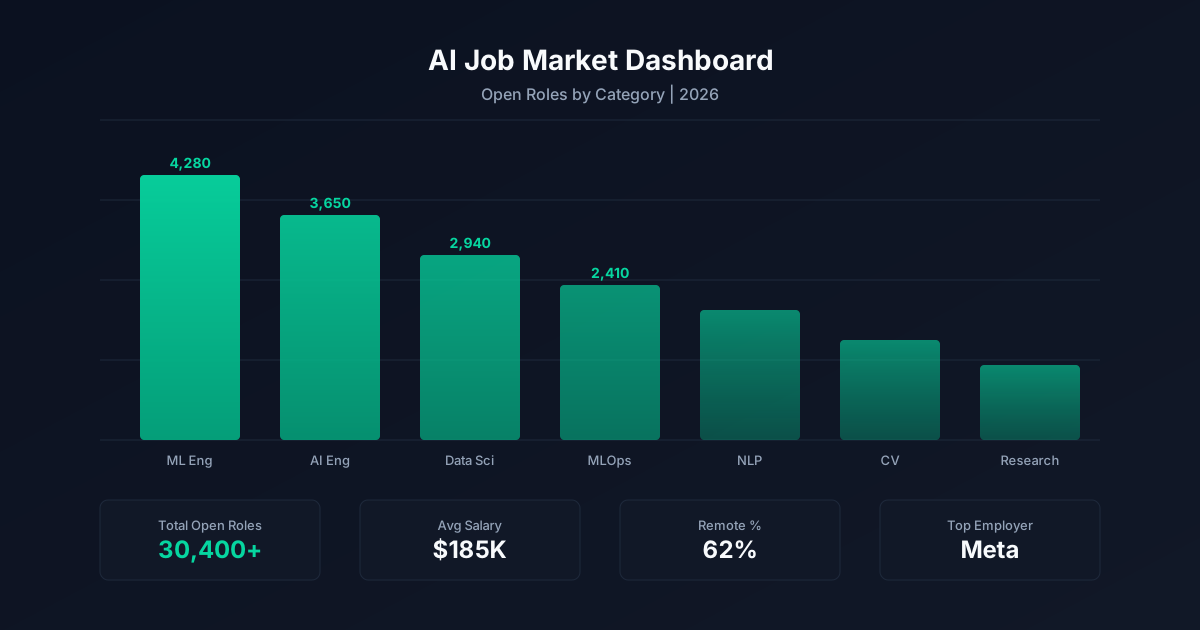
The AI job market has 3,708 open positions tracked in our dataset. By seniority: 102 entry-level, 1,705 mid-level, 1,469 senior, and 432 leadership roles (Director, VP, C-Level). Remote roles make up 14% of the market (508 positions). The remaining 3,180 roles require on-site or hybrid attendance.
The market median for AI roles is $217,500. Top-quartile compensation starts at $272,100. The 90th percentile reaches $325,000. Highest-paying categories: AI Safety ($300,000 median, 21 roles); Research Engineer ($280,000 median, 147 roles); AI Architect ($254,798 median, 67 roles).
Demand for AI/ML Engineers has been strong and consistent. Unlike some AI roles that spike with hype cycles, ML engineering is a foundational need. Every company deploying AI models needs people who can keep them running, and the gap between research prototypes and production systems keeps growing.
The AI Job Market Today
The AI job market spans 3,708 open positions across 16 role categories. The largest categories by volume: AI/ML Engineer (2,605), Data Scientist (310), AI Software Engineer (259). These three account for the majority of open positions, though smaller categories often have higher per-role compensation because of specialized skill requirements.
The seniority mix tells a story about where AI teams are in their maturity. Entry-level roles (102) are outnumbered by mid-level (1,705) and senior (1,469) positions, reflecting that most companies are past the 'build a team from scratch' phase and need experienced engineers who can ship production systems. Leadership roles (Director, VP, C-Level) total 432 positions, representing the bottleneck between technical execution and organizational strategy.
Remote work availability sits at 14% of all AI roles (508 positions), with 3,180 requiring on-site or hybrid attendance. The remote share has stabilized after the post-pandemic correction. Senior and specialized roles (Research Scientist, ML Architect) are more likely to be remote-eligible than entry-level positions, partly because experienced hires have more negotiating power and partly because these roles require less hands-on mentorship.
AI compensation is structured in clear tiers. The market median sits at $217,500. Top-quartile roles start at $272,100, and the 90th percentile reaches $325,000. These figures include base salary with disclosed compensation. Total compensation (including equity, bonuses, and sign-on) runs 20-40% higher at companies that offer those components.
Category matters for compensation. AI Safety roles lead at $300,000 median, while Prompt Engineer roles sit at $140,000. The spread between highest and lowest-paying categories reflects the premium on specialized technical skills versus broader analytical roles.
The most in-demand skills across all AI postings: Python (1,890 postings), Aws (1,103 postings), Azure (877 postings), Rag (855 postings), Gcp (631 postings), Prompt Engineering (560 postings), Pytorch (545 postings), Claude (498 postings). Python dominates, appearing in the vast majority of role descriptions regardless of category. Cloud platform experience (AWS, GCP, Azure) is the second most common requirement. The newer entrants to the top skills list (RAG, vector databases, LLM APIs) reflect the shift from traditional ML toward generative AI applications.
Frequently Asked Questions
Get Weekly AI Career Intelligence
Salary data, skills demand, and market signals from 16,000+ AI job postings. Every Monday.