
Interested in this Data Scientist role at Toyota North America?
Apply Now →Skills & Technologies
About This Role
Overview
Who we are
Collaborative. Respectful. A place to dream and do. These are just a few words that describe what life is like at Toyota. As one of the world’s most admired brands, Toyota is growing and leading the future of mobility through innovative, high\-quality solutions designed to enhance lives and delight those we serve. We’re looking for talented team members who want to Dream. Do. Grow. with us.
*Toyota does not offer support or sponsorship of job applicants for employment\-based visas or any other work authorization for this role now or in the future. You must have the right to work in the United States and not require Toyota support or sponsorship for immigration\-related employment (e.g., H\-1B, O\-1, E\-3, H\-1B1, TN, F\-1 OPT, F\-1 STEM OPT, F\-1 CPT, TN, (job flexibility benefits) (also known as I\-140 or Adjustment of Status portability), etc.) now or in the future. You should not apply for this role if you will require Toyota to assist with immigration support or sponsorship now or in the future.*
*This position is based out of Toyota North American Headquarters in Plano, TX*
Who we’re looking for
Toyota's Digital Innovations organization is seeking a Data Scientist \- Optimization to lead the design, development, and industrialization of advanced optimization solutions supporting integrated vehicle and parts supply chain transformation. This role applies mathematical optimization, operations research, data science, and cloud\-based engineering practices to help deliver the North American Vehicle Supply Chain vision of providing the right vehicle to the right place at the right time.
The successful candidate will serve as a hands\-on technical leader for optimization use cases across demand planning, supply allocation, production and logistics planning, ETA improvement, inventory positioning, scheduling, routing, network design, and decision automation. The role will use commercial optimization platforms such as Gurobi, along with Python\-based data science ecosystems and cloud services, to translate complex business constraints into scalable decision models and production\-ready products.
Reporting to the General Manager of Supply Chain Transformation, this person will partner closely with business process owners, product owners, application architects, data engineers, platform teams, and executive stakeholders. The role requires strong technical depth, Toyota Way leadership, cross\-functional influence, clear communication, and the ability to move advanced analytics solutions from concept to reliable operations.
What you’ll be doing
- Lead the development and deployment of mathematical optimization models for integrated supply chain planning, including mixed\-integer programming, linear programming, network flow, constraint programming, heuristics, simulation\-informed optimization, and scenario\-based decision support.
- Use optimization platforms such as Gurobi to formulate, solve, tune, and operationalize complex business problems involving capacity, allocation, sequencing, routing, inventory, production, distribution, transportation, and service\-level tradeoffs.
- Translate business objectives, policies, operational constraints, and Toyota\-specific process rules into data\-driven optimization model structures, objective functions, constraints, decision variables, and performance measures.
- Partner with vehicle and parts business leaders to identify high\-value optimization opportunities, define problem statements, quantify value, prioritize use cases, and establish measurable outcomes tied to supply chain efficiency, revenue enablement, cost reduction, service improvement, and customer/dealer experience.
- Manage and coach a team of data scientists, optimization engineers, analysts, and technical contributors; provide direction on solution design, modeling standards, code quality, experimentation discipline, and operational readiness.
- Collaborate with product owners, architects, data engineers, application developers, and cloud/platform teams to embed optimization services into digital products, APIs, workflows, and decision\-support tools.
- Develop scalable data pipelines and model inputs using trusted enterprise data sources, including operational vehicle, parts, logistics, demand, production, and dealer/customer data, with appropriate focus on data quality, lineage, and traceability.
- Define model validation approaches, sensitivity analysis, back\-testing methods, benchmarking, explainability, and guardrails to ensure optimization recommendations are accurate, interpretable, stable, and usable by business teams.
- Oversee the transition of optimization solutions from proof\-of\-concept into production, including MLOps/ModelOps practices, monitoring, retraining or re\-optimization strategies, exception handling, release management, and hypercare support.
- Establish standards for scenario planning, what\-if analysis, tradeoff visualization, KPI reporting, and executive storytelling to support faster and better business decisions.
- Support Agile delivery practices by defining epics, features, user stories, acceptance criteria, model requirements, test cases, and traceability from business use cases through technical implementation.
- Communicate complex optimization concepts to executive, business, and technical audiences in clear business language; influence alignment, drive buy\-in, and support adoption of new decision processes.
- Continuously evaluate delivered solutions against company standards, budget expectations, operational stability, compliance requirements, model performance, and business value realization.
- Promote Toyota Way behaviors by encouraging genchi genbutsu, respect for people, continuous improvement, fact\-based decision\-making, and collaboration across business and technology teams.
- Practice genchi genbutsu — go to the source to learn the operation, processes, and real\-world constraints firsthand, and validate problem framing with domain SMEs before formulating and committing to optimization solutions.
- Design and embed optimization within end\-to\-end decision workflows, partnering on workflow and process orchestration (e.g., BPMN / Camunda) so model outputs drive automated, auditable business actions.
Leadership Expectations* Serve as a technical thought leader who can set direction, and hold the team accountable for high\-quality delivery.
- Operate with executive presence and communicate risks, decisions, tradeoffs, and value realization clearly to senior leadership.
- Build trust across Digital Innovations, business departments, enterprise architecture, data/platform teams, vendors, and external partners.
- Create a culture of experimentation, disciplined engineering, continuous improvement, and measurable business impact.
- Lead with curiosity and humility — prioritize deeply understanding the business operation before optimizing it, and model collaborative, question\-driven behavior for the team.
- Connect the team’s optimization roadmap to enterprise direction through Hoshin and OKR planning, prioritizing and sequencing use cases against the 2–3 year supply chain transformation strategy.
What you bring
- Bachelor's degree or higher in Operations Research, Industrial Engineering, Applied Mathematics, Statistics, Computer Science, Data Science, Engineering, Supply Chain Management, or a related field, or equivalent professional experience.
- Demonstrated experience building and deploying optimization models using Gurobi or comparable commercial/open\-source solvers.
- Strong proficiency in Python and common data science/optimization libraries such as pandas, NumPy, SciPy, Pyomo, OR\-Tools, scikit\-learn, or equivalent tools.
- Experience formulating optimization problems with real\-world constraints, imperfect data, competing objectives, and operational tradeoffs.
- Experience with cloud\-based data and analytics platforms and with moving advanced analytics or optimization solutions into production environments.
- Experience leading or managing multi\-disciplinary teams that include data scientists, engineers, architects, product owners, application developers, and business process owners.
- Demonstrated ability to manage multiple initiatives simultaneously while balancing scope, value, risk, timeline, budget, and resource constraints.
- Excellent verbal and written communication skills, with the ability to simplify technical content for senior leaders and business stakeholders.
- Strong Agile/Scrum delivery experience, including backlog refinement, sprint planning, acceptance criteria definition, demos, and release readiness.
- Demonstrated success working in a fusion or cross\-functional product team alongside product owners, domain SMEs, and engineers from diverse backgrounds — listening first, asking probing questions to understand the operation before solving, and building shared understanding and trust across disciplines.
Added bonus if you have
- Master's degree or Ph.D. in Operations Research, Industrial Engineering, Applied Mathematics, Computer Science, Data Science, or a related quantitative discipline.
- Automotive industry experience, especially in vehicle supply chain, demand and supply planning, production planning, allocation, logistics, distribution, or dealer\-facing operations.
- Strong understanding of supply chain planning, logistics, manufacturing, inventory, allocation, scheduling, or transportation management processes
- Experience with integrated business planning, sales and operations planning, network optimization, ETA improvement, vehicle ordering, production confirmation, or logistics orchestration.
- Hands\-on experience with cloud services such as AWS, Azure, or GCP and with production patterns for APIs, batch optimization, event\-driven optimization, and model monitoring.
- Experience designing decision\-support products with user\-centric workflows, scenario comparison, explainability, and adoption\-focused change management.
- Experience with enterprise data governance, data quality management, and modern data platform integration.
- Supervisory or people leadership experience in a data science, analytics, optimization, or digital product organization.
- Experience with semantic data modeling or knowledge\-graph engineering to represent supply chain entities, relationships, and business constraints for optimization and decision automation.
- Experience applying agentic AI and multi\-agent system frameworks to decision automation (familiarity with Digital Innovations’ agentic platform, DIAL, a plus).
- Experience deploying industrial\-grade optimization or machine learning solutions that support mission\-critical operational decisions.
- Experience combining optimization with machine learning, simulation, forecasting, reinforcement learning, or agentic AI to improve decision automation.
- Experience creating reusable optimization frameworks, solver tuning playbooks, model libraries, and technical standards for enterprise teams.
- A strong eye for user\-centric design and storytelling that enables business users to trust, understand, and act on model recommendations.
What we’ll bring
During your interview process, our team can fill you in on all the details of our industry\-leading benefits and career development opportunities. A few highlights include:
- A work environment built on teamwork, flexibility, and respect
- Professional growth and development programs to help advance your career, as well as tuition reimbursement
- Team Member Vehicle Purchase Discount.
- Toyota Team Member Lease Vehicle Program (if applicable).
- Comprehensive health care and wellness plans for your entire family
- Toyota 401(k) Savings Plan featuring a company match, as well as an annual retirement contribution from Toyota regardless of whether you contribute
- Paid holidays and paid time off
- Referral services related to prenatal services, adoption, childcare, schools, and more
- Tax Advantaged Accounts (Health Savings Account, Health Care FSA, Dependent Care FSA
- Relocation assistance (if applicable)
Belonging at Toyota
Our success begins and ends with our people. We embrace all perspectives and value unique human experiences. Respect for all is our North Star. Toyota is proud to have 10\+ different Business Partnering Groups across 100 different North American chapter locations that support team members’ efforts to dream, do and grow without questioning that they belong.
Applicants for our positions are considered without regard to race, ethnicity, national origin, sex, sexual orientation, gender identity or expression, age, disability, religion, military or veteran status, or any other characteristics protected by law.
Have a question, need assistance with your application or do you require any special accommodations? Please send an email to [email protected].
Role Details
About This Role
Data Scientists extract insights and build predictive models from data. In the AI era, many roles now include LLM-powered analytics, automated reporting, and integration with generative AI tools. The role has evolved from 'the person who runs SQL queries' to 'the person who builds AI-powered data products.'
Modern data science roles fall into two camps: analytics-focused (insights, dashboards, experimentation) and ML-focused (building predictive models, recommendation systems, NLP features). The best data scientists can operate in both modes. The AI shift means that even analytics-focused roles now involve building automated insight pipelines using LLMs, going well beyond one-off reports.
Across the 3,708 AI roles we're tracking, Data Scientist positions make up 8% of the market. At Toyota North America, this role fits into their broader AI and engineering organization.
Data Scientist roles remain in high demand, though the definition keeps shifting. Companies increasingly want candidates who can bridge traditional statistics with modern ML and LLM capabilities. The 'pure insights' data scientist role is consolidating into analytics engineering, while the 'build models' data scientist role is merging with ML engineering.
What the Work Looks Like
A typical week includes: analyzing experiment results for a product feature launch, building a predictive model for customer churn, creating an automated reporting pipeline using LLM-powered summarization, presenting insights to stakeholders, and cleaning data (always cleaning data). The ratio of analysis to engineering varies by company, but expect both.
Data Scientist roles remain in high demand, though the definition keeps shifting. Companies increasingly want candidates who can bridge traditional statistics with modern ML and LLM capabilities. The 'pure insights' data scientist role is consolidating into analytics engineering, while the 'build models' data scientist role is merging with ML engineering.
Skills Required
Python, SQL, and statistical modeling are the foundation. Increasingly, roles want experience with LLMs for data analysis, automated insight generation, and building AI-powered data products. Familiarity with cloud data platforms (Snowflake, BigQuery, Databricks) and ML frameworks (scikit-learn, PyTorch) covers most job requirements.
Experimentation design and causal inference are underrated skills that separate strong candidates. Companies care about whether their product changes cause improvements, and can distinguish causation from correlation. A/B testing methodology, Bayesian statistics, and the ability to communicate uncertainty to non-technical stakeholders are high-value skills.
Good postings specify the data stack, the types of problems you'll work on, and the team structure. Look for companies that differentiate between analytics and ML data science. Vague 'data scientist' postings that list every skill under the sun usually mean the company doesn't know what they need.
Compensation Benchmarks
Data Scientist roles pay a median of $192,890 based on 463 positions with disclosed compensation. Mid-level AI roles across all categories have a median of $200,000.
Across all AI roles, the market median is $217,500. Top-quartile compensation starts at $272,100. The 90th percentile reaches $325,000. For comparison, the highest-paying categories include AI Safety ($300,000) and Research Engineer ($280,000). By seniority level: Entry: $120,000; Mid: $200,000; Senior: $230,000; Director: $272,150; VP: $250,000.
Toyota North America AI Hiring
Toyota North America has 2 open AI roles right now. They're hiring across MLOps Engineer, Data Scientist. Based in Plano, TX, US.
Location Context
Across all AI roles, 14% (508 positions) offer remote work, while 3,180 require on-site attendance. Top AI hiring metros: New York (1,045 roles, $220,000 median); San Francisco (810 roles, $277,088 median); Los Angeles (397 roles, $215,000 median).
Career Path
Common paths into Data Scientist roles include Data Analyst, Statistician, Quantitative Researcher.
From here, career progression typically leads toward Senior Data Scientist, ML Engineer, AI Product Manager.
Start with statistics and SQL. Build a real analysis project on public data that demonstrates insight generation alongside model building. The market values data scientists who can communicate findings clearly to business stakeholders. If you want to move toward ML engineering, invest in software engineering fundamentals and production deployment skills.
What to Expect in Interviews
Interviews combine statistics, coding, and business acumen. SQL is almost always tested, often with complex joins and window functions. Expect a case study round where you're given a business problem and asked to design an analysis plan. Coding rounds focus on pandas, statistical modeling, and visualization. The strongest differentiator is how well you communicate insights to non-technical stakeholders during presentation rounds.
When evaluating opportunities: Good postings specify the data stack, the types of problems you'll work on, and the team structure. Look for companies that differentiate between analytics and ML data science. Vague 'data scientist' postings that list every skill under the sun usually mean the company doesn't know what they need.
AI Hiring Overview
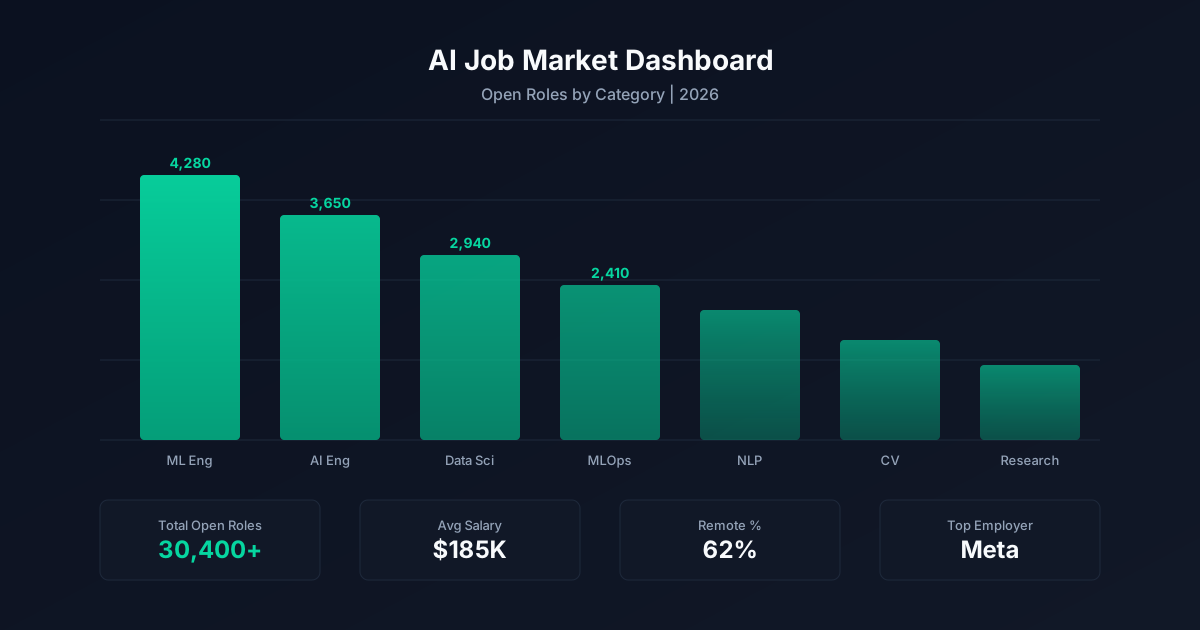
The AI job market has 3,708 open positions tracked in our dataset. By seniority: 102 entry-level, 1,705 mid-level, 1,469 senior, and 432 leadership roles (Director, VP, C-Level). Remote roles make up 14% of the market (508 positions). The remaining 3,180 roles require on-site or hybrid attendance.
The market median for AI roles is $217,500. Top-quartile compensation starts at $272,100. The 90th percentile reaches $325,000. Highest-paying categories: AI Safety ($300,000 median, 21 roles); Research Engineer ($280,000 median, 147 roles); AI Architect ($254,798 median, 67 roles).
Data Scientist roles remain in high demand, though the definition keeps shifting. Companies increasingly want candidates who can bridge traditional statistics with modern ML and LLM capabilities. The 'pure insights' data scientist role is consolidating into analytics engineering, while the 'build models' data scientist role is merging with ML engineering.
The AI Job Market Today
The AI job market spans 3,708 open positions across 16 role categories. The largest categories by volume: AI/ML Engineer (2,605), Data Scientist (310), AI Software Engineer (259). These three account for the majority of open positions, though smaller categories often have higher per-role compensation because of specialized skill requirements.
The seniority mix tells a story about where AI teams are in their maturity. Entry-level roles (102) are outnumbered by mid-level (1,705) and senior (1,469) positions, reflecting that most companies are past the 'build a team from scratch' phase and need experienced engineers who can ship production systems. Leadership roles (Director, VP, C-Level) total 432 positions, representing the bottleneck between technical execution and organizational strategy.
Remote work availability sits at 14% of all AI roles (508 positions), with 3,180 requiring on-site or hybrid attendance. The remote share has stabilized after the post-pandemic correction. Senior and specialized roles (Research Scientist, ML Architect) are more likely to be remote-eligible than entry-level positions, partly because experienced hires have more negotiating power and partly because these roles require less hands-on mentorship.
AI compensation is structured in clear tiers. The market median sits at $217,500. Top-quartile roles start at $272,100, and the 90th percentile reaches $325,000. These figures include base salary with disclosed compensation. Total compensation (including equity, bonuses, and sign-on) runs 20-40% higher at companies that offer those components.
Category matters for compensation. AI Safety roles lead at $300,000 median, while Prompt Engineer roles sit at $140,000. The spread between highest and lowest-paying categories reflects the premium on specialized technical skills versus broader analytical roles.
The most in-demand skills across all AI postings: Python (1,890 postings), Aws (1,103 postings), Azure (877 postings), Rag (855 postings), Gcp (631 postings), Prompt Engineering (560 postings), Pytorch (545 postings), Claude (498 postings). Python dominates, appearing in the vast majority of role descriptions regardless of category. Cloud platform experience (AWS, GCP, Azure) is the second most common requirement. The newer entrants to the top skills list (RAG, vector databases, LLM APIs) reflect the shift from traditional ML toward generative AI applications.
Frequently Asked Questions
Get Weekly AI Career Intelligence
Salary data, skills demand, and market signals from 16,000+ AI job postings. Every Monday.