
Interested in this AI/ML Engineer role at University of Utah?
Apply Now →Skills & Technologies
About This Role
Details
Open Date 07/22/2026
Requisition Number PRN45702B
Job Title IT Software Engineers
Working Title AI Platform Engineer III
Career Progression Track P00
Track Level P3 \- Career
FLSA Code Computer Employee
Patient Sensitive Job Code? No
Standard Hours per Week 40
Full Time or Part Time? Full Time
Shift Day
Work Schedule Summary
M\-F 8\-5
VP Area President
Department 00428 \- UIT \- Network \& Comm. Srvs
Location Campus
City Salt Lake City, UT
Type of Recruitment External Posting
Pay Rate Range $100,000\-125,000
Close Date 08/15/2026
Priority Review Date (Note \- Posting may close at any time)
Job Summary
AI Platform Engineer III
The AI Platform Engineer III is responsible for designing, developing, implementing, governing, and supporting enterprise artificial intelligence solutions across the University. This position serves as a technical leader for generative AI platforms, AI\-powered applications, custom agents, workflow automation, and enterprise AI adoption.
The successful candidate will possess demonstrated experience administering enterprise AI platforms, developing custom AI agents and GPTs, implementing agentic workflows, applying advanced prompt engineering techniques, and building AI\-powered business solutions that improve productivity, automate business processes, support financial reporting and analysis, and enhance decision\-making.
This position works closely with university leadership, researchers, business units, developers, security teams, and technology partners to identify, develop, and operationalize high\-value AI use cases. Responsibilities include AI platform administration, AI solution architecture, agent development, AI governance, enterprise integrations, and business process automation.
This is not an entry\-level AI position. Candidates must demonstrate prior hands\-on experience working with enterprise AI platforms, large language models, agentic frameworks, custom AI agents, and AI solution development. The selected candidate will be expected to contribute immediately as an experienced AI practitioner.
About UIT : University Information Technology ( UIT ) , the central IT service provider for the University of Utah, reports to the U’s Chief Information Officer and is responsible for many of the U’s shared IT services including the wired and wireless network; Campus Information Services ( CIS ) portal; UMail, telephone, and online collaboration; digital learning technologies; information security; software licensing; and a host of other IT systems and services.
About the University of Utah : Located in Salt Lake City, the U is the flagship institution of the State of Utah’s system of higher education, home to arts and museum venues and a member of the BIG \-12 Conference . Skiing and snowboarding opportunities are a short distance from campus, and opportunities to pursue activities from biking to hiking to fishing abound . Salt Lake City is home to the Utah Symphony and Opera , Ballet West , professional sports teams , and a wide range of other cultural and recreational activities.
Responsibilities
AI Platform Engineer III
- Design, develop, deploy, and support enterprise AI solutions that improve productivity, automate business processes, and deliver measurable business value.
- Build and maintain custom AI agents, GPTs, copilots, and agentic workflows that support academic, administrative, operational, research, and financial use cases.
- Administer and optimize enterprise AI platforms including OpenAI ChatGPT Enterprise, Anthropic Claude Enterprise, Microsoft Copilot, Google Gemini, NotebookLM, AWS Bedrock, Azure AI Foundry, Microsoft Fabric, and future University\-approved AI services
- .Develop AI\-powered solutions for financial reporting, business intelligence, executive reporting, operational analytics, forecasting, workflow automation, and decision support.
- Design and implement advanced AI architectures utilizing Model Context Protocol ( MCP ), retrieval augmented generation ( RAG ), tool integrations, orchestration frameworks, enterprise knowledge systems, and API \-based solutions.
- Create, test, evaluate, and optimize prompts, workflows, instructions, and AI evaluation frameworks to improve solution quality, reliability, accuracy, and user adoption.
- Develop integrations between AI platforms and enterprise systems using APIs, automation platforms, cloud services, databases, and business applications.
- Administer AI governance, security, compliance, identity management, access controls, licensing, usage monitoring, and operational standards while ensuring responsible and secure use of AI technologies.
- Collaborate with University leadership, business units, and technical teams to identify, evaluate, prototype, and operationalize high\-value AI use cases and emerging technologies.
- Provide technical leadership, consulting, documentation, training, troubleshooting, and production support for enterprise AI platforms, AI\-powered solutions, and AI engineering best practices.
Job Code: P38263
Grade: P21
Minimum Qualifications
EQUIVALENCY STATEMENT : 1 year of higher education can be substituted for 1 year of directly related work experience (Example: bachelor’s degree \= 4 years of directly related work experience).
Department may hire employee at one of the following job levels:
IT Software Engineer, III : Requires a bachelor’s (or equivalency) \+ 6 years or a master’s (or equivalency) \+ 4 years of directly related work experience.
Preferences
MINIMUM QUALIFICATIONS :
- Minimum one (1\) year of hands\-on professional experience working with generative AI platforms and large language models in a production or enterprise environment. This requirement is mandatory and cannot be substituted.
- Experience designing, developing, and deploying production AI agents, custom GPTs, copilots, intelligent assistants, and agentic workflows.
- Demonstrated expertise in prompt engineering, prompt optimization, AI evaluation methodologies, and improving AI solution accuracy and performance.
- Experience building AI\-powered solutions for financial reporting, business intelligence, operational analytics, executive reporting, forecasting, process automation, and decision support.
- Knowledge of AI governance, security, privacy, compliance, and responsible AI practices.
PREFERRED QUALIFICATIONS :
- Two or more years of hands\-on experience working with enterprise generative AI technologies and large language models.
- Experience administering and supporting enterprise AI platforms such as OpenAI ChatGPT Enterprise, Anthropic Claude Enterprise, Microsoft Copilot, Google Gemini Enterprise, AWS Bedrock, Azure AI Foundry, Microsoft Fabric, or similar technologies.
- Experience implementing and supporting agentic AI architectures, including Model Context Protocol ( MCP ), retrieval augmented generation ( RAG ), tool integrations, and AI orchestration frameworks.
- Experience with cloud AI platforms and services including AWS SageMaker, AWS Bedrock, Azure AI Foundry, Microsoft Fabric, Google Vertex AI, or comparable environments.
- Experience integrating AI platforms with enterprise applications, APIs, databases, cloud services, and business workflows.
- Experience with Microsoft 365, Microsoft Entra ID, Google Workspace, Grouper, or comparable identity and collaboration platforms.
- Proficiency with Python, PowerShell, REST APIs, JSON , automation frameworks, or related technical skills.
- Experience working in higher education, research computing, academic technology, or other complex institutional environments.
- Experience supporting faculty, researchers, students, and university administrative functions is strongly preferred.
- Experience with vector databases, embeddings, semantic search, enterprise search, knowledge management systems, and retrieval augmented generation ( RAG ) solutions.
- Experience leading AI proof\-of\-concepts, pilot projects, enterprise AI adoption initiatives, and cross\-functional AI solution development efforts.
Type Benefited Staff
Special Instructions Summary
Additional Information
The University is a participating employer with Utah Retirement Systems (“URS”). Eligible new hires with prior URS service, may elect to enroll in URS if they make the election before they become eligible for retirement (usually the first day of work). Contact Human Resources at (801\) 581\-7447 for information. Individuals who previously retired and are receiving monthly retirement benefits from URS are subject to URS’ post\-retirement rules and restrictions. Please contact Utah Retirement Systems at (801\) 366\-7770 or (800\) 695\-4877 or University Human Resource Management at (801\) 581\-7447 if you have questions regarding the post\-retirement rules.
This position may require the successful completion of a criminal background check and/or drug screen.
The University of Utah values candidates who have experience working in settings with students and possess a strong commitment to improving access to higher education.
Veterans’ preference is extended to qualified applicants, upon request and consistent with University policy and Utah state law. Upon request, reasonable accommodations in the application process will be provided to individuals with disabilities.
Consistent with state and federal law, the University of Utah does not discriminate based upon race, ethnicity, color, religion, national origin, age, disability, sex, sexual orientation, gender, gender identity, gender expression, pregnancy, pregnancy\-related conditions, genetic information, or protected veteran’s status. The University does not discriminate on the basis of sex in the education program or activity that it operates, as required by Title IX and 34 CFR part 106\. The requirement not to discriminate in education programs or activities extends to admission and employment. Inquiries about the application of Title IX and its regulations may be referred to the Title IX Coordinator, to the Department of Education, Office for Civil Rights, or both.
To request a reasonable accommodation for a disability or if you or someone you know has experienced discrimination or sexual misconduct including sexual harassment, you may contact the Director/Title IX Coordinator in the Office of Equal Opportunity and Title IX ( OEO ). More information, including the Director/Title IX Coordinator’s office address, electronic mail address, and telephone number can be located at the: University of Utah Non‑Discrimination page .
Online reports may be submitted at https://oeo.utah.edu
\*\*https://publicsafety.utah.edu/safetyreport/\*\*This report includes statistics about criminal offenses, hate crimes, arrests and referrals for disciplinary action, and Violence Against Women Act offenses. They also provide information about safety and security\-related services offered by the University of Utah. A paper copy can be obtained by request at the Department of Public Safety located at 1658 East 500 South.
As per University of Utah policy 5\-108: Transfer of Benefits Eligible Staff Members , a new hire to the University of Utah who is still serving a 12 month probationary period will not be hired into another University of Utah job (a transfer) until the successful completion of the probationary period.
Salary Context
This $100K-$125K range is in the lower quartile for AI/ML Engineer roles in our dataset (median: $180K across 1841 roles with salary data).
View full AI/ML Engineer salary data →Role Details
About This Role
AI/ML Engineers build and deploy machine learning models in production. They work across the full ML lifecycle: data pipelines, model training, evaluation, and serving infrastructure. The role has evolved significantly over the past two years. Where ML Engineers once spent most of their time on model architecture, the job now tilts heavily toward inference optimization, cost management, and integrating LLM capabilities into existing systems. Companies want engineers who can ship production systems, and the experimenter-only role is fading fast.
Day-to-day, you're writing training pipelines, debugging data quality issues, setting up evaluation frameworks, and figuring out why your model performs differently in staging than it did on your dev set. The best ML engineers are obsessive about reproducibility and measurement. They instrument everything. They know that a model is only as good as the data feeding it and the infrastructure serving it.
Across the 3,708 AI roles we're tracking, AI/ML Engineer positions make up 70% of the market. At University of Utah, this role fits into their broader AI and engineering organization.
Demand for AI/ML Engineers has been strong and consistent. Unlike some AI roles that spike with hype cycles, ML engineering is a foundational need. Every company deploying AI models needs people who can keep them running, and the gap between research prototypes and production systems keeps growing.
What the Work Looks Like
A typical week might include: debugging a data pipeline that's silently dropping 3% of training examples, running A/B tests on a new model version, writing documentation for a feature flag system that lets you roll back model deployments, and reviewing a junior engineer's PR for a new evaluation metric. Meetings tend to be cross-functional since ML touches product, engineering, and data teams.
Demand for AI/ML Engineers has been strong and consistent. Unlike some AI roles that spike with hype cycles, ML engineering is a foundational need. Every company deploying AI models needs people who can keep them running, and the gap between research prototypes and production systems keeps growing.
Skills Required
Python and PyTorch dominate the requirements. Most roles expect experience with cloud platforms (AWS, GCP, or Azure) and familiarity with ML frameworks like TensorFlow or JAX. RAG (Retrieval-Augmented Generation) has become a top-3 skill requirement as companies integrate LLMs into their products. Docker and Kubernetes show up in about a third of postings, reflecting the production focus of the role.
Beyond the core stack, employers increasingly want experience with experiment tracking tools (MLflow, Weights & Biases), feature stores, and vector databases. Fine-tuning experience is valuable but less common than you'd think from reading Twitter. Most production LLM work is RAG and prompt engineering, not fine-tuning. If you have both, you're in a strong position.
Companies that are serious about AI/ML hiring tend to post specific infrastructure details in the job description: the frameworks they use, their model serving stack, their data pipeline tools. Vague postings that just say 'ML experience required' without specifics are often companies that haven't figured out what they need yet.
Compensation Benchmarks
AI/ML Engineer roles pay a median of $218,750 based on 3,817 positions with disclosed compensation. Mid-level AI roles across all categories have a median of $200,000. This role's midpoint ($112K) sits 49% below the category median. Disclosed range: $100K to $125K.
Across all AI roles, the market median is $217,500. Top-quartile compensation starts at $272,100. The 90th percentile reaches $325,000. For comparison, the highest-paying categories include AI Safety ($300,000) and Research Engineer ($280,000). By seniority level: Entry: $120,000; Mid: $200,000; Senior: $230,000; Director: $272,150; VP: $250,000.
University of Utah AI Hiring
University of Utah has 4 open AI roles right now. They're hiring across AI/ML Engineer, Research Engineer, Research Scientist. Based in Salt Lake City, UT, US. Compensation range: $41K - $125K.
Location Context
Across all AI roles, 14% (508 positions) offer remote work, while 3,180 require on-site attendance. Top AI hiring metros: New York (1,045 roles, $220,000 median); San Francisco (810 roles, $277,088 median); Los Angeles (397 roles, $215,000 median).
Career Path
Common paths into AI/ML Engineer roles include Data Scientist, Software Engineer, Research Engineer.
From here, career progression typically leads toward ML Architect, AI Engineering Manager, Principal ML Engineer.
The fastest path into ML engineering is through software engineering with a self-directed ML education. A CS degree helps, but production engineering skills matter more than academic credentials. Build something that works, deploy it, and measure it. That portfolio project is worth more than a Coursera certificate. For career growth, the fork comes around the senior level: go deep on technical complexity (staff/principal track) or move into managing ML teams.
What to Expect in Interviews
Expect system design questions around ML pipelines: how you'd build a training pipeline for a specific use case, handle data drift, or design A/B testing infrastructure for model deployments. Coding rounds typically involve Python, with emphasis on data manipulation (pandas, numpy) and algorithm implementation. Take-home assignments often ask you to build an end-to-end ML pipeline from raw data to deployed model.
When evaluating opportunities: Companies that are serious about AI/ML hiring tend to post specific infrastructure details in the job description: the frameworks they use, their model serving stack, their data pipeline tools. Vague postings that just say 'ML experience required' without specifics are often companies that haven't figured out what they need yet.
AI Hiring Overview
The AI job market has 3,708 open positions tracked in our dataset. By seniority: 102 entry-level, 1,705 mid-level, 1,469 senior, and 432 leadership roles (Director, VP, C-Level). Remote roles make up 14% of the market (508 positions). The remaining 3,180 roles require on-site or hybrid attendance.
The market median for AI roles is $217,500. Top-quartile compensation starts at $272,100. The 90th percentile reaches $325,000. Highest-paying categories: AI Safety ($300,000 median, 21 roles); Research Engineer ($280,000 median, 147 roles); AI Architect ($254,798 median, 67 roles).
Demand for AI/ML Engineers has been strong and consistent. Unlike some AI roles that spike with hype cycles, ML engineering is a foundational need. Every company deploying AI models needs people who can keep them running, and the gap between research prototypes and production systems keeps growing.
The AI Job Market Today
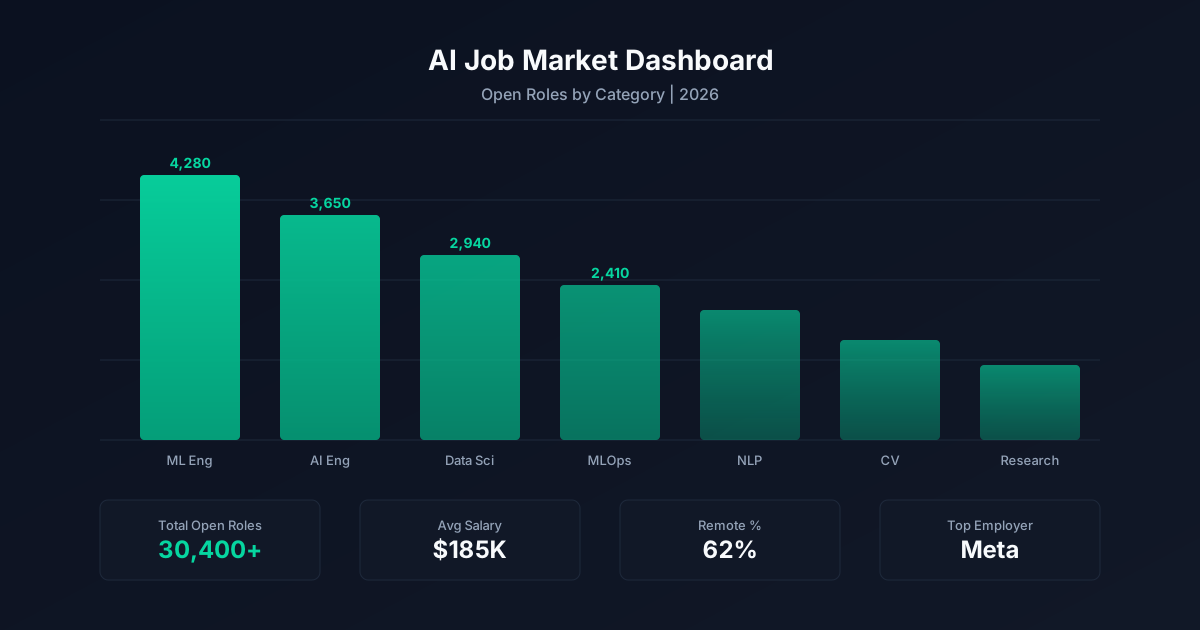
The AI job market spans 3,708 open positions across 16 role categories. The largest categories by volume: AI/ML Engineer (2,605), Data Scientist (310), AI Software Engineer (259). These three account for the majority of open positions, though smaller categories often have higher per-role compensation because of specialized skill requirements.
The seniority mix tells a story about where AI teams are in their maturity. Entry-level roles (102) are outnumbered by mid-level (1,705) and senior (1,469) positions, reflecting that most companies are past the 'build a team from scratch' phase and need experienced engineers who can ship production systems. Leadership roles (Director, VP, C-Level) total 432 positions, representing the bottleneck between technical execution and organizational strategy.
Remote work availability sits at 14% of all AI roles (508 positions), with 3,180 requiring on-site or hybrid attendance. The remote share has stabilized after the post-pandemic correction. Senior and specialized roles (Research Scientist, ML Architect) are more likely to be remote-eligible than entry-level positions, partly because experienced hires have more negotiating power and partly because these roles require less hands-on mentorship.
AI compensation is structured in clear tiers. The market median sits at $217,500. Top-quartile roles start at $272,100, and the 90th percentile reaches $325,000. These figures include base salary with disclosed compensation. Total compensation (including equity, bonuses, and sign-on) runs 20-40% higher at companies that offer those components.
Category matters for compensation. AI Safety roles lead at $300,000 median, while Prompt Engineer roles sit at $140,000. The spread between highest and lowest-paying categories reflects the premium on specialized technical skills versus broader analytical roles.
The most in-demand skills across all AI postings: Python (1,890 postings), Aws (1,103 postings), Azure (877 postings), Rag (855 postings), Gcp (631 postings), Prompt Engineering (560 postings), Pytorch (545 postings), Claude (498 postings). Python dominates, appearing in the vast majority of role descriptions regardless of category. Cloud platform experience (AWS, GCP, Azure) is the second most common requirement. The newer entrants to the top skills list (RAG, vector databases, LLM APIs) reflect the shift from traditional ML toward generative AI applications.
Frequently Asked Questions
Get Weekly AI Career Intelligence
Salary data, skills demand, and market signals from 16,000+ AI job postings. Every Monday.