
Interested in this AI Software Engineer role at West Monroe?
Apply Now →Skills & Technologies
About This Role
Are you ready to make an impact?
West Monroe is seeking a Software Engineer to join the AI Assets Foundry Team, working with the internal Labs product team to develop proprietary software assets and AI capabilities that help our consultants sell and deliver more effectively and efficiently. This is an internal product engineering role focused on building reusable, scalable, secure AI\-enabled applications and platform components in partnership with product owners, designers, architects, senior engineers, governance, and engineering teammates.
Responsibilities:
- Develop, test, deploy, and support full\-stack software features and reusable asset components for the Tech Ex AI Assets portfolio.
- Implement Generative AI\-enabled capabilities within software products, including API integrations, prompt workflows, retrieval\-augmented generation patterns, and data\-driven features under the guidance of senior engineers and architects.
- Translate product requirements, user stories, and acceptance criteria into clean, maintainable, and secure code in collaboration with product owners, product design, and engineering teammates.
- Participate in Agile ceremonies and contribute to iterative delivery, estimation, backlog refinement, sprint planning, demos, and retrospectives.
- Follow established architecture patterns, coding standards, security practices, and responsible AI guidance while contributing practical engineering input during design discussions.
- Contribute to engineering quality through unit testing, integration testing, code reviews, documentation, CI/CD practices, and defect resolution.
- Troubleshoot application issues across front\-end, back\-end, data, cloud, and AI service layers with support from senior team members when needed.
- Collaborate with distributed engineering, product, governance, and product success partners to improve internal software assets and drive adoption by West Monroe consultants.
- Continue building depth across modern software engineering, cloud development, data integration, and AI\-enabled application development practices.
Core Technologies:
- Back\-end: Node.js, Python, .NET
- Front\-end: React, TypeScript, JavaScript, HTML5, CSS3
- Database / Data: PostgreSQL, MongoDB, SQL Server, data integration patterns, and exposure to vector search or embedding stores where applicable
- Cloud: Microsoft Azure, Amazon Web Services (AWS)
- Generative AI: Azure OpenAI, Databricks Machine Learning, LLM integration, prompt engineering, embeddings, retrieval\-augmented generation, and AI evaluation concepts
Patterns \& Tools:
- Patterns: REST APIs, MVC, MVVM, service\-oriented architecture, event\-driven patterns, and microservice concepts
- Source Control / Delivery: Git, Azure DevOps, pull requests, branching strategies, and CI/CD pipelines
- DevOps Tooling: Terraform, Docker, infrastructure as code, environment configuration, and deployment automation
- Package Management: npm, NuGet
- Testing / Quality: Jest, unit testing, integration testing, code review, static analysis, and defect triage
Qualifications:
- Bachelor's degree in a relevant field preferred, or equivalent experience required.
- 2\+ years of experience in full\-stack software development or comparable hands\-on application development experience.
- Working knowledge of object\-oriented concepts, software design principles, algorithms, data structures, and common design patterns.
- Hands\-on experience with modern application development using APIs, databases, front\-end frameworks, back\-end services, and source control practices.
- Exposure to cloud services, CI/CD delivery practices, automated testing, and modern DevOps ways of working.
- Interest in and practical exposure to AI, machine learning, Generative AI, or data\-driven software capabilities; experience with Azure OpenAI, Databricks, LLM APIs, RAG, embeddings, or model evaluation is preferred but not required.
- Comfortable working within a fast\-paced, collaborative Agile/Scrum product environment with product owners, designers, architects, senior engineers, governance, and product success partners.
- Able to follow architecture direction, ask thoughtful technical questions, and make steady contributions to hands\-on asset development without owning architecture decisions.
- Strong problem\-solving, debugging, communication, documentation, and learning skills.
- Strong English communication skills and ability to work effectively with distributed teams across geographies and time zones.
- Smart, versatile, and passionate about delivering high\-quality code while continuing to grow across technologies and languages
Based on pay transparency guidelines, the salary range for this role can vary based on your proximity to one of our West Monroe offices (see table below).
Employees (and their families) are covered by medical, dental, vision, and basic life insurance. Employees are able to enroll in our company’s 401k plan, purchase shares from our employee stock ownership program and be eligible to receive annual bonuses. Employees will also receive unlimited flexible time off and ten paid holidays throughout the calendar year. Eligibility for ten weeks of paid parental leave will also be available upon hire date.
Seattle or Washington, D.C.
$96,600 \- $113,600 USD
Los Angeles
$101,200 \- $119,000 USD
New York City or San Francisco
$105,800 \- $124,400 USD
A location not listed above
$9,200 \- $108,200 USD
### Other consultancies talk at you.
At West Monroe, we work with you.
We’re a global business and technology consulting firm passionate about creating measurable value for our clients, delivering real\-world solutions.
The combination of business and technology is not new, but how we bring them together is unique. We’re fluent in both. We know that technology alone is not the answer, but how we apply it is. We rely on data to constantly adapt and solve new challenges. Actions that work today with outcomes that generate value for years to come.
At West Monroe, we zero in on the heart of the opportunity, getting to results faster and preparing people for what’s next.
You’ll feel the difference in how we work. We show up personally. We’re right there in the room with you, co\-creating through the challenges. With West Monroe, collaboration isn’t a lofty promise, but a daily action. We work together with you to turn vision into clear action with lasting impact.
West Monroeis an Equal Employment Opportunity Employer
We believe in treating each employee and applicant for employment fairly and with dignity. We base our employment decisions on merit, experience, and potential, without regard to race, color, national origin, sex, sexual orientation, gender identity, marital status, age, religion, disability, veteran status, or any other characteristic prohibited by federal, state or local law. To learn more about diversity, equity and inclusion at West Monroe, visit www.westmonroe.com/inclusion. If you require a reasonable accommodation to participate in our recruiting process, please inquire by sending an email to [email protected].
Please review our current policy regarding use of generative artificial intelligence during the application process.
If you are based in California, we encourage you to read West Monroe’s Notice at Collection for California residents, provided pursuant to the California Consumer Privacy Act (CCPA) and linked here.
Salary Context
This $9K-$124K range is in the lower quartile for AI Software Engineer roles in our dataset (median: $183K across 194 roles with salary data).
Role Details
About This Role
AI Software Engineers build the applications and systems that AI models run inside. They own the API layers, data pipelines, frontend integrations, and infrastructure that turn a model into a product users interact with. Every AI company needs engineers who can build the software around the AI.
The challenge is building reliable systems around inherently unreliable components. Models are probabilistic. They'll give different answers to the same question. They hallucinate. They're slow. They're expensive. Your job is to build an application layer that handles all of this gracefully while delivering a product that users trust and enjoy.
Across the 3,708 AI roles we're tracking, AI Software Engineer positions make up 7% of the market. At West Monroe, this role fits into their broader AI and engineering organization.
AI Software Engineer roles are among the most numerous in the AI job market. Every company deploying AI needs software engineers who understand AI integration patterns. The demand is broad, spanning startups to enterprises, across every industry adopting AI capabilities.
What the Work Looks Like
A typical week includes: building API endpoints that serve model inference with caching and fallback logic, designing the data pipeline that feeds context to a RAG system, implementing streaming responses in the frontend, debugging a race condition in the async inference pipeline, and optimizing database queries for the vector search layer. It's full-stack engineering with AI at the center.
AI Software Engineer roles are among the most numerous in the AI job market. Every company deploying AI needs software engineers who understand AI integration patterns. The demand is broad, spanning startups to enterprises, across every industry adopting AI capabilities.
Skills Required
Full-stack engineering skills with AI integration experience. Python and TypeScript are the most common requirements. You'll need to understand API design, database architecture, and how to build reliable systems around probabilistic outputs. Experience with streaming, async processing, and caching patterns is increasingly important as real-time AI applications proliferate.
Knowledge of vector databases, embedding APIs, and LLM integration patterns (function calling, structured outputs, retry logic) differentiates AI software engineers from general software engineers. Understanding cost optimization (caching strategies, model routing, batched inference) is valuable since inference costs can dominate application economics.
Strong postings describe the product you'll be building, the AI integration patterns you'll work with, and the scale requirements. Look for companies that have existing AI features and need engineers to improve and expand them, not companies that are 'planning to add AI' someday.
Compensation Benchmarks
AI Software Engineer roles pay a median of $219,250 based on 424 positions with disclosed compensation. Mid-level AI roles across all categories have a median of $200,000. This role's midpoint ($66K) sits 70% below the category median. Disclosed range: $9K to $124K.
Across all AI roles, the market median is $217,500. Top-quartile compensation starts at $272,100. The 90th percentile reaches $325,000. For comparison, the highest-paying categories include AI Safety ($300,000) and Research Engineer ($280,000). By seniority level: Entry: $120,000; Mid: $200,000; Senior: $230,000; Director: $272,150; VP: $250,000.
West Monroe AI Hiring
West Monroe has 4 open AI roles right now. They're hiring across AI Software Engineer, AI/ML Engineer, AI Product Manager. Based in Chicago, IL, US. Compensation range: $124K - $250K.
Location Context
AI roles in Chicago pay a median of $205,100 across 97 tracked positions. That's 6% below the national median.
Career Path
Common paths into AI Software Engineer roles include Software Engineer, Full-Stack Developer, Backend Engineer.
From here, career progression typically leads toward Staff Engineer, AI Architect, Engineering Manager.
If you're a software engineer, you're already 80% there. Learn the AI integration patterns: RAG, streaming inference, function calling, structured outputs. Build a project that demonstrates you can wrap an AI model in a production-quality application with proper error handling, caching, and user experience. That's the portfolio piece that gets you hired.
What to Expect in Interviews
Technical screens look like standard software engineering interviews with an AI twist. Expect system design questions about building reliable applications around probabilistic models: handling streaming responses, implementing retry logic for API failures, and designing caching strategies for LLM outputs. Coding rounds test standard algorithms plus practical integration patterns like async processing and rate limiting.
When evaluating opportunities: Strong postings describe the product you'll be building, the AI integration patterns you'll work with, and the scale requirements. Look for companies that have existing AI features and need engineers to improve and expand them, not companies that are 'planning to add AI' someday.
AI Hiring Overview
The AI job market has 3,708 open positions tracked in our dataset. By seniority: 102 entry-level, 1,705 mid-level, 1,469 senior, and 432 leadership roles (Director, VP, C-Level). Remote roles make up 14% of the market (508 positions). The remaining 3,180 roles require on-site or hybrid attendance.
The market median for AI roles is $217,500. Top-quartile compensation starts at $272,100. The 90th percentile reaches $325,000. Highest-paying categories: AI Safety ($300,000 median, 21 roles); Research Engineer ($280,000 median, 147 roles); AI Architect ($254,798 median, 67 roles).
AI Software Engineer roles are among the most numerous in the AI job market. Every company deploying AI needs software engineers who understand AI integration patterns. The demand is broad, spanning startups to enterprises, across every industry adopting AI capabilities.
The AI Job Market Today
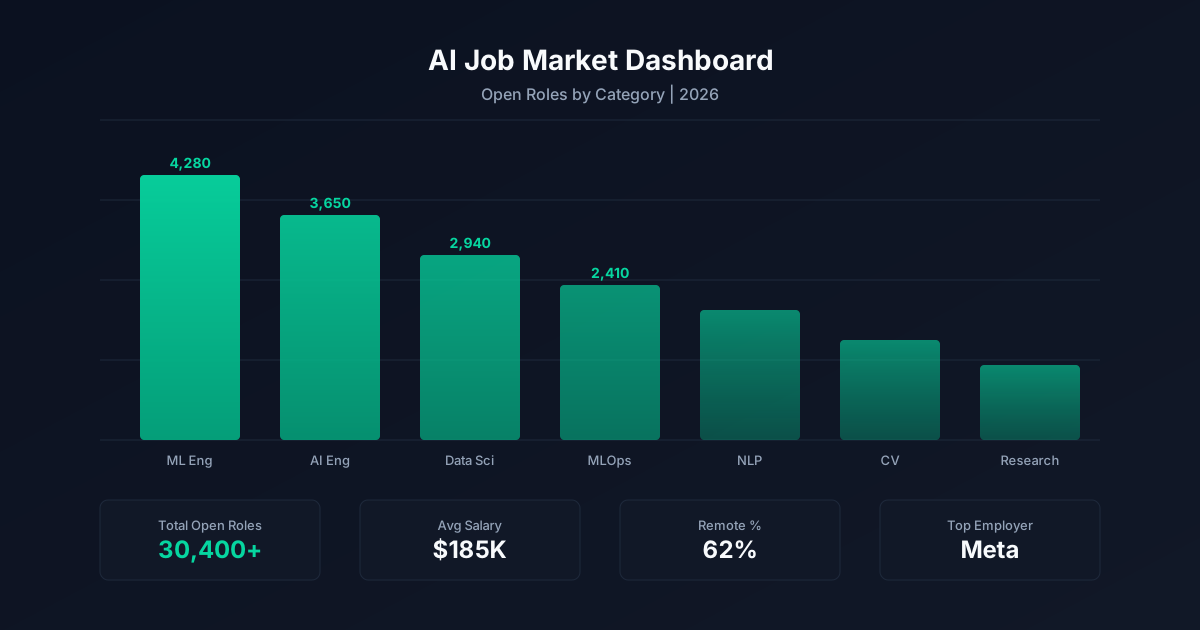
The AI job market spans 3,708 open positions across 16 role categories. The largest categories by volume: AI/ML Engineer (2,605), Data Scientist (310), AI Software Engineer (259). These three account for the majority of open positions, though smaller categories often have higher per-role compensation because of specialized skill requirements.
The seniority mix tells a story about where AI teams are in their maturity. Entry-level roles (102) are outnumbered by mid-level (1,705) and senior (1,469) positions, reflecting that most companies are past the 'build a team from scratch' phase and need experienced engineers who can ship production systems. Leadership roles (Director, VP, C-Level) total 432 positions, representing the bottleneck between technical execution and organizational strategy.
Remote work availability sits at 14% of all AI roles (508 positions), with 3,180 requiring on-site or hybrid attendance. The remote share has stabilized after the post-pandemic correction. Senior and specialized roles (Research Scientist, ML Architect) are more likely to be remote-eligible than entry-level positions, partly because experienced hires have more negotiating power and partly because these roles require less hands-on mentorship.
AI compensation is structured in clear tiers. The market median sits at $217,500. Top-quartile roles start at $272,100, and the 90th percentile reaches $325,000. These figures include base salary with disclosed compensation. Total compensation (including equity, bonuses, and sign-on) runs 20-40% higher at companies that offer those components.
Category matters for compensation. AI Safety roles lead at $300,000 median, while Prompt Engineer roles sit at $140,000. The spread between highest and lowest-paying categories reflects the premium on specialized technical skills versus broader analytical roles.
The most in-demand skills across all AI postings: Python (1,890 postings), Aws (1,103 postings), Azure (877 postings), Rag (855 postings), Gcp (631 postings), Prompt Engineering (560 postings), Pytorch (545 postings), Claude (498 postings). Python dominates, appearing in the vast majority of role descriptions regardless of category. Cloud platform experience (AWS, GCP, Azure) is the second most common requirement. The newer entrants to the top skills list (RAG, vector databases, LLM APIs) reflect the shift from traditional ML toward generative AI applications.
Frequently Asked Questions
Get Weekly AI Career Intelligence
Salary data, skills demand, and market signals from 16,000+ AI job postings. Every Monday.