
Interested in this AI Software Engineer role at Whatnot?
Apply Now →Skills & Technologies
About This Role
Join the Future of Commerce with Whatnot!
---------------------------------------------
Whatnot is the largest live shopping platform in North America and Europe to buy, sell, and discover the things you love. Whether it's trading cards, fashion, electronics, or live plants, our sellers are building real businesses across hundreds of categories. We're building live commerce at a scale that's never been done in the West, and there's no playbook to copy. The people here are shaping how an entirely new industry develops.
As a remote co\-located team, we're inspired by our values and anchored in hubs across the US, UK, Ireland, Poland, Germany, and Australia. We move fast, stay close to our users, and focus on the work that drives the most impact.
We're one of the fastest growing marketplaces and were recently named the \#1 Best Startup Employer in America by Forbes. Check out the latest Whatnot updates on our news and engineering blogs and join us as we enable anyone to turn their passion into a business and bring people together through commerce.
Role
--------
We’re looking for a Senior Software Engineer to join our Developer Tools team and be a primary contributor of our AI Tooling work end\-to\-end. In this role, you will build and own the AI tooling that shapes how Whatnot’s engineering organization—and increasingly, non\-engineering teams—write code, ship software, and operate systems faster and more effectively.
This is not a machine learning or data science role. You won’t be training models—you’ll be building the tooling, infrastructure, and workflows that allow AI coding agents and assistants to operate effectively within Whatnot’s codebase and processes. You should be deeply familiar with the current generation of AI development tools, especially tools provided by the big 3 LLM companies (Anthropic, OpenAI, Google) and have broad knowledge of other AI and LLM products and services.
Critically, you must be a strong software engineer first. You’ll serve as the primary interface between the Developer Tools team and Whatnot’s AI Tooling Working Group—a cross\-functional community group that tracks the bleeding\-edge frontier of AI tooling. You’ll gather feedback, identify high\-impact opportunities, and feed that context into the team’s roadmap and build priorities.
### You will work on all aspects of AI tooling, including:
- Building and shipping AI tooling across the full spectrum—from near\-term developer productivity wins to long\-term autonomous agent capabilities—while helping shape what we prioritize next based on what you see working (and not working) on the ground
- Designing and building sandboxed, containerized environments where AI agents can operate autonomously—running code, executing tests, and iterating on solutions with appropriate guardrails
- Building multi\-agent orchestration systems and workflows, including CI\-fixing agents, SRE context agents, and other autonomous AI capabilities that reduce toil and accelerate delivery
- Enabling non\-engineers (PMs, designers, operations) to leverage AI tools effectively through purpose\-built workflows, onboarding experiences, and low\-code/no\-code interfaces
- Building and optimizing AI\-aware developer infrastructure: CLAUDE.md configurations, MCP servers, prompt engineering frameworks, and context management systems that make AI assistants more effective in our codebase
- Deploying, monitoring, and maintaining the infrastructure supporting AI tools and workflows to ensure high availability, performance, and reliability for the organization.
- Evaluating and integrating emerging AI tools and platforms as the landscape evolves—staying ahead of the curve and bringing the best of the ecosystem into Whatnot
This is a high\-visibility, high\-autonomy role. You'll have significant ownership over a space that is evolving rapidly, is a top strategic priority for Whatnot's engineering leadership, and directly shapes how our engineers work every day.
We offer flexibility to work from home or our office hub, and we value in\-person time for planning, problem\-solving, and connection. Team members in this role must live within commuting distance of our Los Angeles or New York hubs.
You
-------
People who do well at Whatnot tend to be comfortable figuring things out as they go, biased toward action, and genuinely curious about what they're building. They care more about outcomes than credit and stay close to the product and the people using it.
- 5\+ years of software engineering experience, with a strong track record of building and shipping production systems. You're a software engineer first—backend\-leaning is fine, but you're comfortable getting around a frontend codebase too, and ideally have enough breadth across different stacks to understand what good tooling looks like beyond your home turf.
- A genuine developer tooling enthusiast who's built or improved internal tools, obsessed over local dev ergonomics, or contributed to platform infrastructure—and ideally owned some of it in production. You see AI not just as autocomplete, but as a catalyst for reimagining how developers interact with their environments, codebases, and workflows.
- Deeply familiar with the current generation of AI coding tools—Claude Code (strongly preferred), Cursor, Codex, or similar—and use them to get real work done. You have strong opinions about where this space is heading and don't need to chase every new release to stay effective.
- Strong product thinking—you can translate ambiguous problem spaces into concrete plans and prioritize across competing initiatives. You’re comfortable writing a technical design doc and can clearly communicate what you’re building and why to people outside your team.
- Clear communicator who adapts naturally to your audience—whether that’s pairing with a staff engineer on an integration, onboarding a PM onto an AI workflow, or fielding questions from our VP of Engineering or CPO. The people you work with will span the full spectrum of technical ability.
- Bonus: experience with agent sandboxing, containerized execution environments, multi\-agent orchestration, LLM APIs and observability, prompt engineering at scale, or enabling non\-technical users to leverage AI\-powered workflows.
Benefits
------------
- Generous Holiday and Time off Policy
- Health Insurance options including Medical, Dental, Vision
- Work From Home Support
+ Home office setup allowance
+ Monthly allowance for cell phone and internet
- Care benefits
+ Monthly allowance for wellness
+ Annual allowance towards Childcare
+ Lifetime benefit for family planning, such as adoption or fertility expenses
- Retirement; 401k offering for Traditional and Roth accounts in the US (employer match up to 4% of base salary) and Pension plans internationally
- Monthly allowance to dogfood the app
+ All Whatnauts are expected to develop a deep understanding of our product. We're passionate about building the best user experience, and all employees are expected to use Whatnot as both a buyer and a seller as part of their job (our dogfooding budget makes this fun and easy!).
- Parental Leave
+ 16 weeks of paid parental leave \+ one month gradual return to work \*company leave allownces run concurrently with country leave requirements which take precedence
EOE
-------
Whatnot is proud to be an Equal Opportunity Employer. We value diversity, and we do not discriminate on the basis of race, religion, color, national origin, gender, sexual orientation, age, marital status, veteran status, parental status, disability status, or any other status protected by local law. We believe that our work is better and our company culture is improved when we encourage, support, and respect the different skills and experiences represented within our workforce.
Compensation Range: $195K \- $290K
Salary Context
This $195K-$290K range is above the 75th percentile for AI Software Engineer roles in our dataset (median: $183K across 194 roles with salary data).
Role Details
About This Role
AI Software Engineers build the applications and systems that AI models run inside. They own the API layers, data pipelines, frontend integrations, and infrastructure that turn a model into a product users interact with. Every AI company needs engineers who can build the software around the AI.
The challenge is building reliable systems around inherently unreliable components. Models are probabilistic. They'll give different answers to the same question. They hallucinate. They're slow. They're expensive. Your job is to build an application layer that handles all of this gracefully while delivering a product that users trust and enjoy.
Across the 3,708 AI roles we're tracking, AI Software Engineer positions make up 7% of the market. At Whatnot, this role fits into their broader AI and engineering organization.
AI Software Engineer roles are among the most numerous in the AI job market. Every company deploying AI needs software engineers who understand AI integration patterns. The demand is broad, spanning startups to enterprises, across every industry adopting AI capabilities.
What the Work Looks Like
A typical week includes: building API endpoints that serve model inference with caching and fallback logic, designing the data pipeline that feeds context to a RAG system, implementing streaming responses in the frontend, debugging a race condition in the async inference pipeline, and optimizing database queries for the vector search layer. It's full-stack engineering with AI at the center.
AI Software Engineer roles are among the most numerous in the AI job market. Every company deploying AI needs software engineers who understand AI integration patterns. The demand is broad, spanning startups to enterprises, across every industry adopting AI capabilities.
Skills Required
Full-stack engineering skills with AI integration experience. Python and TypeScript are the most common requirements. You'll need to understand API design, database architecture, and how to build reliable systems around probabilistic outputs. Experience with streaming, async processing, and caching patterns is increasingly important as real-time AI applications proliferate.
Knowledge of vector databases, embedding APIs, and LLM integration patterns (function calling, structured outputs, retry logic) differentiates AI software engineers from general software engineers. Understanding cost optimization (caching strategies, model routing, batched inference) is valuable since inference costs can dominate application economics.
Strong postings describe the product you'll be building, the AI integration patterns you'll work with, and the scale requirements. Look for companies that have existing AI features and need engineers to improve and expand them, not companies that are 'planning to add AI' someday.
Compensation Benchmarks
AI Software Engineer roles pay a median of $219,250 based on 424 positions with disclosed compensation. Mid-level AI roles across all categories have a median of $200,000. This role's midpoint ($242K) sits 11% above the category median. Disclosed range: $195K to $290K.
Across all AI roles, the market median is $217,500. Top-quartile compensation starts at $272,100. The 90th percentile reaches $325,000. For comparison, the highest-paying categories include AI Safety ($300,000) and Research Engineer ($280,000). By seniority level: Entry: $120,000; Mid: $200,000; Senior: $230,000; Director: $272,150; VP: $250,000.
Whatnot AI Hiring
Whatnot has 5 open AI roles right now. They're hiring across AI/ML Engineer, AI Software Engineer. Based in New York, NY, US. Compensation range: $280K - $345K.
Location Context
AI roles in New York pay a median of $220,000 across 1,045 tracked positions.
Career Path
Common paths into AI Software Engineer roles include Software Engineer, Full-Stack Developer, Backend Engineer.
From here, career progression typically leads toward Staff Engineer, AI Architect, Engineering Manager.
If you're a software engineer, you're already 80% there. Learn the AI integration patterns: RAG, streaming inference, function calling, structured outputs. Build a project that demonstrates you can wrap an AI model in a production-quality application with proper error handling, caching, and user experience. That's the portfolio piece that gets you hired.
What to Expect in Interviews
Technical screens look like standard software engineering interviews with an AI twist. Expect system design questions about building reliable applications around probabilistic models: handling streaming responses, implementing retry logic for API failures, and designing caching strategies for LLM outputs. Coding rounds test standard algorithms plus practical integration patterns like async processing and rate limiting.
When evaluating opportunities: Strong postings describe the product you'll be building, the AI integration patterns you'll work with, and the scale requirements. Look for companies that have existing AI features and need engineers to improve and expand them, not companies that are 'planning to add AI' someday.
AI Hiring Overview
The AI job market has 3,708 open positions tracked in our dataset. By seniority: 102 entry-level, 1,705 mid-level, 1,469 senior, and 432 leadership roles (Director, VP, C-Level). Remote roles make up 14% of the market (508 positions). The remaining 3,180 roles require on-site or hybrid attendance.
The market median for AI roles is $217,500. Top-quartile compensation starts at $272,100. The 90th percentile reaches $325,000. Highest-paying categories: AI Safety ($300,000 median, 21 roles); Research Engineer ($280,000 median, 147 roles); AI Architect ($254,798 median, 67 roles).
AI Software Engineer roles are among the most numerous in the AI job market. Every company deploying AI needs software engineers who understand AI integration patterns. The demand is broad, spanning startups to enterprises, across every industry adopting AI capabilities.
The AI Job Market Today
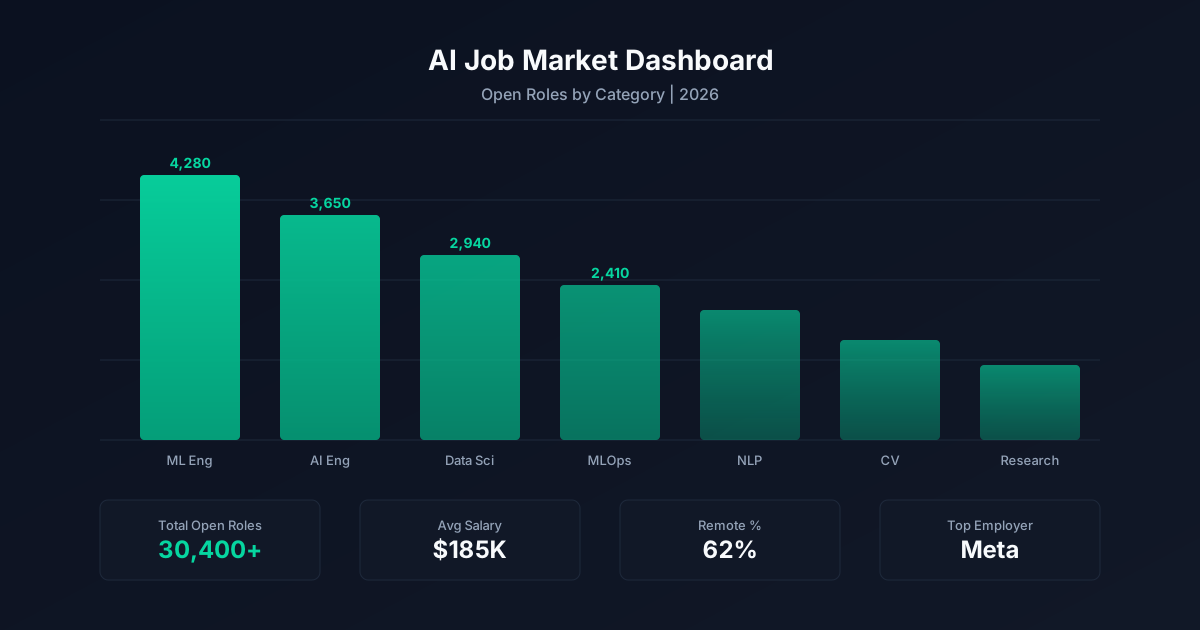
The AI job market spans 3,708 open positions across 16 role categories. The largest categories by volume: AI/ML Engineer (2,605), Data Scientist (310), AI Software Engineer (259). These three account for the majority of open positions, though smaller categories often have higher per-role compensation because of specialized skill requirements.
The seniority mix tells a story about where AI teams are in their maturity. Entry-level roles (102) are outnumbered by mid-level (1,705) and senior (1,469) positions, reflecting that most companies are past the 'build a team from scratch' phase and need experienced engineers who can ship production systems. Leadership roles (Director, VP, C-Level) total 432 positions, representing the bottleneck between technical execution and organizational strategy.
Remote work availability sits at 14% of all AI roles (508 positions), with 3,180 requiring on-site or hybrid attendance. The remote share has stabilized after the post-pandemic correction. Senior and specialized roles (Research Scientist, ML Architect) are more likely to be remote-eligible than entry-level positions, partly because experienced hires have more negotiating power and partly because these roles require less hands-on mentorship.
AI compensation is structured in clear tiers. The market median sits at $217,500. Top-quartile roles start at $272,100, and the 90th percentile reaches $325,000. These figures include base salary with disclosed compensation. Total compensation (including equity, bonuses, and sign-on) runs 20-40% higher at companies that offer those components.
Category matters for compensation. AI Safety roles lead at $300,000 median, while Prompt Engineer roles sit at $140,000. The spread between highest and lowest-paying categories reflects the premium on specialized technical skills versus broader analytical roles.
The most in-demand skills across all AI postings: Python (1,890 postings), Aws (1,103 postings), Azure (877 postings), Rag (855 postings), Gcp (631 postings), Prompt Engineering (560 postings), Pytorch (545 postings), Claude (498 postings). Python dominates, appearing in the vast majority of role descriptions regardless of category. Cloud platform experience (AWS, GCP, Azure) is the second most common requirement. The newer entrants to the top skills list (RAG, vector databases, LLM APIs) reflect the shift from traditional ML toward generative AI applications.
Frequently Asked Questions
Get Weekly AI Career Intelligence
Salary data, skills demand, and market signals from 16,000+ AI job postings. Every Monday.