
Interested in this Research Engineer role at WindBorne Systems?
Apply Now →Skills & Technologies
About This Role
WindBorne Systems is supercharging weather forecasts with a proprietary data source: a global constellation of next\-generation smart weather balloons targeting critical atmospheric data. We design, manufacture, and operate our own balloons, using their observations to generate otherwise unattainable weather intelligence.
Our mission is to eliminate weather uncertainty and help humanity adapt to climate change—whether by predicting hurricanes or speeding the adoption of renewables. The founding team of Stanford engineers was named Forbes 2019 30 Under 30 and is backed by top\-tier investors, including Khosla Ventures and Footwork VC.
WindBorne builds AI weather models that run 24/7, producing global forecasts every 20 minutes. Weather forecasting presents unusually rich machine learning problems: enormous, messy datasets; imperfect ground truth; complex physical structure; and models that must work reliably in the real world.
We are looking for a broadly capable ML researcher and engineer who is passionate about machine learning and excited to push our models forward. We care more about your ability to identify important problems and make progress on them than whether your previous work fits a particular specialty.
Responsibilities
--------------------
### What you’d own:
- AI\-based data assimilation — Develop methods for incorporating real\-time observations from balloons, satellites, weather stations, and other sources into our forecasts.
- A foundation model for weather — Work toward a single model capable of predicting many weather\-related datasets, including variables and data products not covered by traditional global forecasts.
- Messy, large weather datasets — Find, understand, clean, and combine large datasets with inconsistent formats, resolutions, coverage, and quality. Determine which data is actually useful and build systems that make it easier to use again.
- Rapid experiments — Test ideas quickly, learn from failures, and follow promising results into the weeds and chase down another 1% of model improvement.
- Infrastructure and systems — Turn successful experiments into reusable systems that accelerate future research.
- Research direction — Form hypotheses, design convincing experiments, keep up with relevant ML research, and help decide which ideas are worth pursuing.
- Whatever the problem needs — Venture into operations, infrastructure, evaluation, data engineering, or other technical side quests when needed to get the research working in practice.
Skills and Qualifications
-----------------------------
### Requirements
- Strong research taste: you can identify important questions, design experiments that answer them, and recognize when a result is real.
- Deep enthusiasm for machine learning and a desire to understand models in detail rather than treating them as black boxes.
- Strong Python and PyTorch skills, with experience developing and debugging nontrivial ML systems.
- Experience working with large, messy datasets and building dependable pipelines or abstractions around them.
- Able to iterate quickly while thinking systematically about which work should become durable infrastructure.
- Comfortable crossing boundaries between research and engineering and learning unfamiliar tools or domains as needed.
- Experience with weather, climate, geospatial data, scientific machine learning, computer vision, or time\-series forecasting is helpful, but not required.
Benefits
------------
- 401(k)
- Dental, health, and vision insurance
- Unlimited PTO
- Stock Option Plan
- Office food and beverages
Salary
----------
- $140k–$240k. We consider a range of backgrounds and experience levels and adjust offers to be competitive with market rates.
Location
------------
1600 Bridge Pkwy, Redwood City, CA. Hybrid or in\-person.
Salary Context
This $140K-$240K range is above the median for Research Engineer roles in our dataset (median: $188K across 44 roles with salary data).
View full Research Engineer salary data →Role Details
About This Role
Research Engineers bridge the gap between research and production. They implement papers, build experiment infrastructure, optimize training pipelines, and make research prototypes production-ready. They're the engineers who make research work at scale.
The role sits at a unique intersection. You need to understand the math well enough to implement novel architectures correctly, and you need the engineering chops to make them run efficiently on distributed systems. When a research scientist has a breakthrough idea, you're the person who turns it from a notebook prototype into a training pipeline that runs on 256 GPUs.
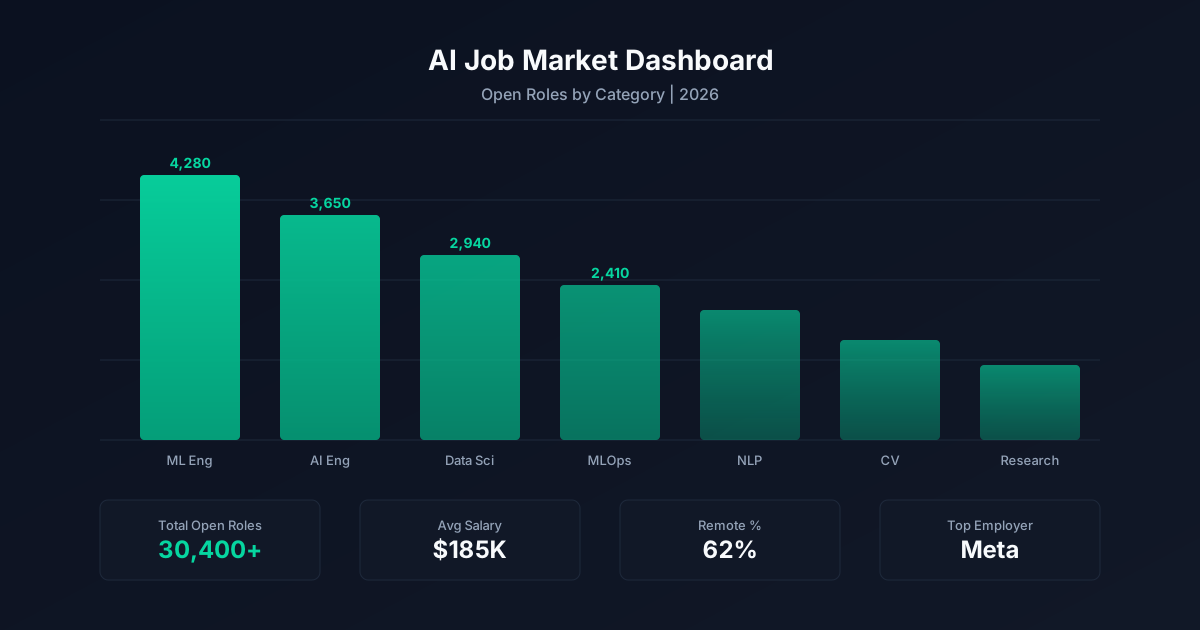
Across the 3,708 AI roles we're tracking, Research Engineer positions make up 2% of the market. At WindBorne Systems, this role fits into their broader AI and engineering organization.
Research Engineer roles are growing as AI labs recognize that research velocity depends on engineering quality. The role is less competitive than Research Scientist (no PhD required), but the bar for engineering skill is very high. These roles are concentrated at major labs and well-funded startups.
What the Work Looks Like
A typical week involves: implementing a new attention mechanism from a recent paper, profiling and optimizing a training pipeline that's bottlenecked on data loading, building evaluation infrastructure for a new benchmark, debugging distributed training issues across a GPU cluster, and pair-programming with a research scientist on their latest experiment. The work is deeply technical.
Research Engineer roles are growing as AI labs recognize that research velocity depends on engineering quality. The role is less competitive than Research Scientist (no PhD required), but the bar for engineering skill is very high. These roles are concentrated at major labs and well-funded startups.
Skills Required
Strong software engineering fundamentals plus ML knowledge. Python, C++, and CUDA experience are common requirements. You'll need to read papers and turn ideas into working code. Distributed systems experience (especially distributed training) is highly valued. Performance optimization skills separate great candidates from good ones.
Experience with large-scale training infrastructure (FSDP, DeepSpeed, Megatron), GPU programming (CUDA, Triton), and the internals of ML frameworks (PyTorch internals, custom autograd functions) is what makes candidates stand out. The best research engineers can debug issues that span the full stack from GPU memory management to numerical precision to algorithmic correctness.
Strong postings mention the team's recent research, the infrastructure scale, and the specific technical challenges. They often list the research areas you'd support. Look for roles that emphasize both implementation quality and research understanding.
Compensation Benchmarks
Research Engineer roles pay a median of $280,000 based on 147 positions with disclosed compensation. Mid-level AI roles across all categories have a median of $200,000. This role's midpoint ($190K) sits 32% below the category median. Disclosed range: $140K to $240K.
Across all AI roles, the market median is $217,500. Top-quartile compensation starts at $272,100. The 90th percentile reaches $325,000. For comparison, the highest-paying categories include AI Safety ($300,000) and AI Architect ($254,798). By seniority level: Entry: $120,000; Mid: $200,000; Senior: $230,000; Director: $272,150; VP: $250,000.
WindBorne Systems AI Hiring
WindBorne Systems has 4 open AI roles right now. They're hiring across AI/ML Engineer, Research Engineer. Based in Palo Alto, CA, US. Compensation range: $240K - $240K.
Location Context
Across all AI roles, 14% (508 positions) offer remote work, while 3,180 require on-site attendance. Top AI hiring metros: New York (1,045 roles, $220,000 median); San Francisco (810 roles, $277,088 median); Los Angeles (397 roles, $215,000 median).
Career Path
Common paths into Research Engineer roles include Software Engineer, ML Engineer, Research Intern.
From here, career progression typically leads toward Senior Research Engineer, Research Scientist, ML Architect.
This is one of the best entry points into AI research without a PhD. Build a strong engineering portfolio with ML projects, contribute to open-source ML frameworks, and demonstrate that you can implement complex ideas correctly and efficiently. The transition to Research Scientist is possible with published first-author work, which some research engineer roles support.
What to Expect in Interviews
Technical screens test both engineering skill and research understanding. Expect coding rounds with performance-critical implementations (GPU optimization, efficient data loading). Be prepared to discuss papers relevant to the team's research area and explain how you'd implement key ideas. System design questions focus on training infrastructure: distributed training, experiment tracking, and compute resource management.
When evaluating opportunities: Strong postings mention the team's recent research, the infrastructure scale, and the specific technical challenges. They often list the research areas you'd support. Look for roles that emphasize both implementation quality and research understanding.
AI Hiring Overview
The AI job market has 3,708 open positions tracked in our dataset. By seniority: 102 entry-level, 1,705 mid-level, 1,469 senior, and 432 leadership roles (Director, VP, C-Level). Remote roles make up 14% of the market (508 positions). The remaining 3,180 roles require on-site or hybrid attendance.
The market median for AI roles is $217,500. Top-quartile compensation starts at $272,100. The 90th percentile reaches $325,000. Highest-paying categories: AI Safety ($300,000 median, 21 roles); Research Engineer ($280,000 median, 147 roles); AI Architect ($254,798 median, 67 roles).
Research Engineer roles are growing as AI labs recognize that research velocity depends on engineering quality. The role is less competitive than Research Scientist (no PhD required), but the bar for engineering skill is very high. These roles are concentrated at major labs and well-funded startups.
The AI Job Market Today
The AI job market spans 3,708 open positions across 16 role categories. The largest categories by volume: AI/ML Engineer (2,605), Data Scientist (310), AI Software Engineer (259). These three account for the majority of open positions, though smaller categories often have higher per-role compensation because of specialized skill requirements.
The seniority mix tells a story about where AI teams are in their maturity. Entry-level roles (102) are outnumbered by mid-level (1,705) and senior (1,469) positions, reflecting that most companies are past the 'build a team from scratch' phase and need experienced engineers who can ship production systems. Leadership roles (Director, VP, C-Level) total 432 positions, representing the bottleneck between technical execution and organizational strategy.
Remote work availability sits at 14% of all AI roles (508 positions), with 3,180 requiring on-site or hybrid attendance. The remote share has stabilized after the post-pandemic correction. Senior and specialized roles (Research Scientist, ML Architect) are more likely to be remote-eligible than entry-level positions, partly because experienced hires have more negotiating power and partly because these roles require less hands-on mentorship.
AI compensation is structured in clear tiers. The market median sits at $217,500. Top-quartile roles start at $272,100, and the 90th percentile reaches $325,000. These figures include base salary with disclosed compensation. Total compensation (including equity, bonuses, and sign-on) runs 20-40% higher at companies that offer those components.
Category matters for compensation. AI Safety roles lead at $300,000 median, while Prompt Engineer roles sit at $140,000. The spread between highest and lowest-paying categories reflects the premium on specialized technical skills versus broader analytical roles.
The most in-demand skills across all AI postings: Python (1,890 postings), Aws (1,103 postings), Azure (877 postings), Rag (855 postings), Gcp (631 postings), Prompt Engineering (560 postings), Pytorch (545 postings), Claude (498 postings). Python dominates, appearing in the vast majority of role descriptions regardless of category. Cloud platform experience (AWS, GCP, Azure) is the second most common requirement. The newer entrants to the top skills list (RAG, vector databases, LLM APIs) reflect the shift from traditional ML toward generative AI applications.
Frequently Asked Questions
Get Weekly AI Career Intelligence
Salary data, skills demand, and market signals from 16,000+ AI job postings. Every Monday.