
Interested in this AI Product Manager role at Amazon.com?
Apply Now →Skills & Technologies
About This Role
DESCRIPTION
---------------
AI is transforming every corner of Amazon — and with that transformation comes the responsibility to get it right. The Amazon Responsible AI (RAI) team is building the systems and programs that ensure Amazon's AI is fair, safe, transparent, and compliant with emerging global regulations. We are looking for a Sr. Product Manager \- Technical who wants to define the product vision for AI governance at Amazon scale — building the tools and experiences that help thousands of builder teams develop AI responsibly without slowing down.
No one has solved AI governance at this scale before. Today, tracking thousands of AI systems against evolving regulatory frameworks, internal expectations, and voluntary commitments is a problem that's impossible to manage manually. You'll define the product that makes it possible — automating what would take an army of auditors, and giving builders the tools to do the right thing without slowing down. This is a greenfield opportunity on a small, senior team building from scratch alongside Amazon Scholars, Principal Applied Scientists, and policy experts. You'll own the product vision and shape the platform direction.
As a PMT on the Responsible AI team, you will define and drive the product strategy for our AI governance platform, working at the intersection of technology, policy, and science. You'll partner deeply with engineering teams building the platform, Applied Scientists developing AI\-powered classification and assessment models, and policy experts interpreting regulatory requirements — turning ambiguity into a clear, prioritized roadmap that delivers customer value.
This role is for product leaders who thrive in ambiguity, are energized by the challenge of defining new product categories, and are motivated by the societal impact of ensuring AI systems are developed responsibly.
Key job responsibilities
- Define the product vision, strategy, and multi\-year roadmap for Amazon's AI governance platform — the system that provides portfolio\-level visibility into AI compliance posture across the company
- Own the end\-to\-end product lifecycle for responsible AI tooling: from discovery and customer research through requirements definition, development, launch, and adoption at scale
- Translate complex regulatory requirements (EU AI Act, NIST AI RMF, emerging state/federal AI legislation) and internal responsible AI expectations into builder\-friendly product experiences and self\-service workflows
- Drive product strategy for AI system discovery, risk classification, and compliance evidence collection — working backward from builder needs to reduce friction while meeting governance obligations
- Define metrics and KPIs that measure responsible AI adoption, tool effectiveness, and compliance coverage — using data to prioritize roadmap investments and communicate progress to leadership
- Partner with Applied Scientists to shape AI\-powered features (automated risk classification, compliance gap detection, evidence generation) and define how ML models integrate into the product experience
- Conduct customer research with internal builder teams across Amazon to deeply understand pain points, workflows, and compliance challenges — and turn those insights into prioritized product requirements
- Work cross\-functionally with Privacy, Legal, Security, and RAI Science to ensure product decisions align with regulatory obligations, customer trust requirements, and scientific best practices
- Influence engineering architecture decisions by evaluating technical trade\-offs, understanding system constraints, and ensuring the platform can scale to support Amazon's AI portfolio
- Develop and present product strategy, roadmaps, and business cases to VP\+ leadership — clearly articulating the value proposition and investment rationale for responsible AI tooling
About the team
Amazon Responsible AI works to maximize the benefits and minimize the risks of AI technology across Amazon. We define responsible AI through core dimensions — Fairness, Safety, Privacy, Security, Veracity, Robustness, Explainability, Transparency, Controllability, and Governance — and we build the tools and programs that help Amazon's builder teams deliver on those dimensions at scale. Our team includes Applied Scientists, Amazon Scholars, Security Engineers, TPMs, SDEs, and policy specialists. We are science\-led, independent advisors who prioritize enablement over enforcement — providing expert guidance and practical solutions that make responsible AI easy to implement. We are building the next generation of AI governance infrastructure from the ground up.
Diverse Experiences
Amazon Security values diverse experiences. Even if you do not meet all of the qualifications and skills listed in the job description, we encourage candidates to apply. If your career is just starting, hasn’t followed a traditional path, or includes alternative experiences, don’t let it stop you from applying.
Why Amazon Security?
At Amazon, security is central to maintaining customer trust and delivering delightful customer experiences. Our organization is responsible for creating and maintaining a high bar for security across all of Amazon’s products and services. We offer talented security professionals the chance to accelerate their careers with opportunities to build experience in a wide variety of areas including cloud, devices, retail, entertainment, healthcare, operations, and physical stores.
Inclusive Team Culture
In Amazon Security, it’s in our nature to learn and be curious. Ongoing DEI events and learning experiences inspire us to continue learning and to embrace our uniqueness. Addressing the toughest security challenges requires that we seek out and celebrate a diversity of ideas, perspectives, and voices.
Training \& Career Growth
We’re continuously raising our performance bar as we strive to become Earth’s Best Employer. That’s why you’ll find endless knowledge\-sharing, training, and other career\-advancing resources here to help you develop into a better\-rounded professional.
Work/Life Balance
We value work\-life harmony. Achieving success at work should never come at the expense of sacrifices at home, which is why flexible work hours and arrangements are part of our culture. When we feel supported in the workplace and at home, there’s nothing we can’t achieveBASIC QUALIFICATIONS
------------------------
- Experience owning/driving roadmap strategy and definition
- 5\+ years of technical product or program management experience
- Experience contributing to engineering discussions around technology decisions and strategy related to a product
- Experience managing technical products or online services
- Experience in representing and advocating for a variety of critical customers and stakeholders during executive\-level prioritization and planning
PREFERRED QUALIFICATIONS
----------------------------
- Experience in using analytical tools, such as Tableau, Qlikview, QuickSight
- Experience in building and driving adoption of new tools
- Experience in an operational environment developing, fast\-prototyping, piloting and launching analytic products
- Developing documents, prototypes, and / or software using GenAI tooling such as Kiro or Claude Code.
Amazon is an equal opportunity employer and does not discriminate on the basis of protected veteran status, disability, or other legally protected status.
Our inclusive culture empowers Amazonians to deliver the best results for our customers. If you have a disability and need a workplace accommodation or adjustment during the application and hiring process, including support for the interview or onboarding process, please visit https://amazon.jobs/content/en/how\-we\-hire/accommodations for more information. If the country/region you’re applying in isn’t listed, please contact your Recruiting Partner.
Role Details
About This Role
AI Product Managers define what AI features get built and why. They translate business problems into ML-solvable tasks, work with engineering to scope model requirements, and own the metrics that determine if an AI feature is working. The role requires a rare combination of technical fluency and product instinct.
Unlike traditional product management, AI PM work involves managing uncertainty at a fundamental level. Your model might work 90% of the time. What happens the other 10%? What's the user experience when the AI is wrong? How do you measure 'good enough' for a probabilistic system? These questions don't have easy answers, and the AI PM is the person responsible for finding them.
Across the 3,708 AI roles we're tracking, AI Product Manager positions make up 5% of the market. At Amazon.com, this role fits into their broader AI and engineering organization.
AI Product Manager roles are growing as companies realize that shipping AI features requires different product thinking than traditional software. The best candidates combine product management experience with enough technical depth to have productive conversations with ML engineers about model capabilities and limitations.
What the Work Looks Like
A typical week includes: reviewing model evaluation results with the ML team, defining success metrics for a new AI feature, conducting user research on how customers respond to AI-generated outputs, writing product requirements that include accuracy thresholds and fallback behaviors, and presenting the AI roadmap to leadership. You're the translator between technical capability and business value.
AI Product Manager roles are growing as companies realize that shipping AI features requires different product thinking than traditional software. The best candidates combine product management experience with enough technical depth to have productive conversations with ML engineers about model capabilities and limitations.
Skills Required
Technical fluency with ML concepts is essential, though you won't be writing models. Expect to understand training data, evaluation metrics, model limitations, and responsible AI practices. SQL and basic Python are increasingly expected. Experience with A/B testing, data analysis, and product analytics is baseline. Understanding LLM capabilities and limitations is now a core requirement.
The differentiator is AI-specific product thinking: knowing when to use ML vs. heuristics, understanding the cost of training data collection, designing graceful degradation for model failures, and building products that improve with usage data. Experience with AI safety, bias mitigation, and responsible AI deployment is increasingly important.
Strong postings describe specific AI products the PM will own, mention the ML team structure, and talk about measurement methodology. Look for companies that have already shipped AI features. Roles at companies that are 'exploring AI' often mean you'll spend a year defining the strategy before any building happens.
Compensation Benchmarks
AI Product Manager roles pay a median of $216,175 based on 270 positions with disclosed compensation. Senior-level AI roles across all categories have a median of $230,000.
Across all AI roles, the market median is $217,500. Top-quartile compensation starts at $272,100. The 90th percentile reaches $325,000. For comparison, the highest-paying categories include AI Safety ($300,000) and Research Engineer ($280,000). By seniority level: Entry: $120,000; Mid: $200,000; Senior: $230,000; Director: $272,150; VP: $250,000.
Amazon.com AI Hiring
Amazon.com has 97 open AI roles right now. They're hiring across Research Scientist, AI/ML Engineer, Data Scientist, AI Product Manager. Positions span Sunnyvale, CA, US, Culver City, CA, US, San Francisco, CA, US. Compensation range: $97K - $327K.
Location Context
AI roles in Seattle pay a median of $236,900 across 267 tracked positions. That's 9% above the national median.
Career Path
Common paths into AI Product Manager roles include Product Manager, Data Analyst, Technical Program Manager.
From here, career progression typically leads toward Director of AI Product, VP Product, Head of AI.
The most effective path is PM experience plus self-directed AI education. Take Andrew Ng's courses, build a small ML project, and learn enough Python to read model evaluation code. The goal isn't to become an ML engineer. It's to have credibility in technical conversations and to understand what's possible, what's hard, and what's a bad idea.
What to Expect in Interviews
AI interviews typically combine coding challenges (Python-focused), system design questions tailored to the role, and discussions about your experience with relevant tools and frameworks. Strong candidates demonstrate both technical depth and the ability to make pragmatic engineering tradeoffs. Prepare portfolio projects that demonstrate end-to-end capability rather than isolated skills.
When evaluating opportunities: Strong postings describe specific AI products the PM will own, mention the ML team structure, and talk about measurement methodology. Look for companies that have already shipped AI features. Roles at companies that are 'exploring AI' often mean you'll spend a year defining the strategy before any building happens.
AI Hiring Overview
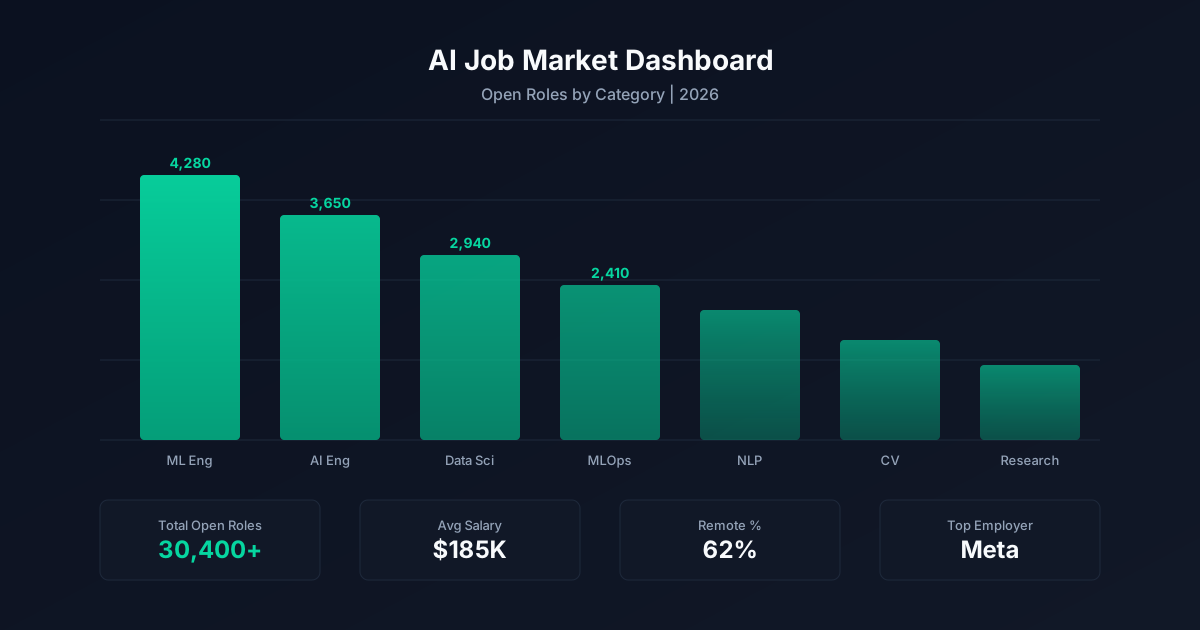
The AI job market has 3,708 open positions tracked in our dataset. By seniority: 102 entry-level, 1,705 mid-level, 1,469 senior, and 432 leadership roles (Director, VP, C-Level). Remote roles make up 14% of the market (508 positions). The remaining 3,180 roles require on-site or hybrid attendance.
The market median for AI roles is $217,500. Top-quartile compensation starts at $272,100. The 90th percentile reaches $325,000. Highest-paying categories: AI Safety ($300,000 median, 21 roles); Research Engineer ($280,000 median, 147 roles); AI Architect ($254,798 median, 67 roles).
AI Product Manager roles are growing as companies realize that shipping AI features requires different product thinking than traditional software. The best candidates combine product management experience with enough technical depth to have productive conversations with ML engineers about model capabilities and limitations.
The AI Job Market Today
The AI job market spans 3,708 open positions across 16 role categories. The largest categories by volume: AI/ML Engineer (2,605), Data Scientist (310), AI Software Engineer (259). These three account for the majority of open positions, though smaller categories often have higher per-role compensation because of specialized skill requirements.
The seniority mix tells a story about where AI teams are in their maturity. Entry-level roles (102) are outnumbered by mid-level (1,705) and senior (1,469) positions, reflecting that most companies are past the 'build a team from scratch' phase and need experienced engineers who can ship production systems. Leadership roles (Director, VP, C-Level) total 432 positions, representing the bottleneck between technical execution and organizational strategy.
Remote work availability sits at 14% of all AI roles (508 positions), with 3,180 requiring on-site or hybrid attendance. The remote share has stabilized after the post-pandemic correction. Senior and specialized roles (Research Scientist, ML Architect) are more likely to be remote-eligible than entry-level positions, partly because experienced hires have more negotiating power and partly because these roles require less hands-on mentorship.
AI compensation is structured in clear tiers. The market median sits at $217,500. Top-quartile roles start at $272,100, and the 90th percentile reaches $325,000. These figures include base salary with disclosed compensation. Total compensation (including equity, bonuses, and sign-on) runs 20-40% higher at companies that offer those components.
Category matters for compensation. AI Safety roles lead at $300,000 median, while Prompt Engineer roles sit at $140,000. The spread between highest and lowest-paying categories reflects the premium on specialized technical skills versus broader analytical roles.
The most in-demand skills across all AI postings: Python (1,890 postings), Aws (1,103 postings), Azure (877 postings), Rag (855 postings), Gcp (631 postings), Prompt Engineering (560 postings), Pytorch (545 postings), Claude (498 postings). Python dominates, appearing in the vast majority of role descriptions regardless of category. Cloud platform experience (AWS, GCP, Azure) is the second most common requirement. The newer entrants to the top skills list (RAG, vector databases, LLM APIs) reflect the shift from traditional ML toward generative AI applications.
Frequently Asked Questions
Get Weekly AI Career Intelligence
Salary data, skills demand, and market signals from 16,000+ AI job postings. Every Monday.