
Interested in this AI/ML Engineer role at HQO?
Apply Now →Skills & Technologies
About This Role
About HqO
HqO is connecting real estate to the people with an asset agnostic, cross\-property suite of powerful applications and services that foster best\-in\-class, dynamic end\-user experiences. HqO’s REX (Real Estate Experience) Platform assesses the health and performance of a person’s experience within a physical space while providing the necessary tools for operators to manage and optimize it, all from one central location.
HqO has been trusted to power 400 million\+ square feet across 700\+ properties in 32 countries, and we’re backed by some of the world’s most prominent VC and real estate companies as we continue to grow rapidly across the world.
We’re driven by our core values of LET’S GO (Learning, Excellence, Truth, Service, Goodness, Ownership) which define our culture and push us to do our best work every day. If you want to join a fast\-growing, highly collaborative, and supportive team that is at the forefront of real estate transformation, we’re the company for you.
Please see the bottom of this application for more details on how to apply!
About the Role
HqO is leading the transformation of the way people experience real estate by converging data, technology, and the customer. Empowering data\-driven strategies and real estate decisions, we're redefining the way people experience space, and in turn, helping to create vibrant, engaging communities.Our REX Platform is used by leading commercial real estate owners and occupiers to activate their spaces, engage tenants, and measure what matters. We are a 100\-person company that moves fast, operates with high ownership, and takes AI seriously and a culture that rewards builders.
We're hiring our first Applied AI Engineer: someone who will embed directly with our Operations and DevOps teams to identify high\-leverage problems, build production\-grade AI agents and automations, and ship tools that make the company measurably more effective.
We care less about where you trained and more about what you've built. We look for slope over intercept. If you have high agency, move with urgency, and get energized by turning ambiguous problems into working systems — read on.
How You'll Make an Impact
Identify and own high\-leverage problems
- Embed with Operations and DevOps to surface workflow inefficiencies and translate them into scoped, buildable solutions
- Own problems end\-to\-end — discovery, design, build, deploy, iterate — not just execution on a handed\-down spec
- Partner directly with team leads and the COO to prioritize work that moves the needle on speed, accuracy, and operational leverage
Build and ship AI\-powered systems
- Design and implement LLM\-powered automations, agent workflows, and internal tools that reduce manual work and unlock team capacity
- Build agentic systems that chain tasks, take actions, and integrate with HqO's internal stack — CRM, ticketing, infrastructure tooling, customer workflows
- Deploy MCP modules and agent\-to\-agent frameworks where they create genuine operational leverage, not just technical novelty
- Use AI\-assisted coding tools (Claude, Cursor, Copilot) to prototype fast, gather feedback early, and iterate toward production\-ready systems
Drive adoption and measure impact
- A shipped tool that nobody uses is not a win. You'll own rollout, drive adoption, and define how success gets measured
- Document what you build so others can maintain and extend it without you in the room
- Surface patterns from deployments that inform HqO's broader AI Operating Model and platform direction
Raise the AI ceiling across the company
- Help teams move from basic AI usage to structured workflows, deeper integrations, and agent orchestration
- Extend HqO's existing foundation of 15\+ deployed agents rather than starting from scratch — understand the stack, improve it, build on top of it
- Act as a visible builder: contribute to a company culture where experimentation is the default and AI fluency is expected
What We're Looking For
We're open to a variety of backgrounds. The signal we care most about is your ability to build and ship real things with AI.
Non\-negotiables
- Demonstrated experience building something real with AI — a side project, automation, internal tool, or workflow that shipped and was used by people other than you
- Comfort using AI\-assisted coding tools (Claude, Cursor, Copilot) as a core part of your development process
- Working knowledge of Python and/or modern scripting and backend tooling
- Familiarity with LLM APIs, agentic patterns, and how to connect systems via APIs and webhooks
- Ability to work on\-site in Boston full\-time
- High agency: you define the problem, scope the solution, and push it forward without waiting to be told what to do next
Strong signals
- Experience building agentic AI workflows — multi\-step reasoning, tool use, orchestration, chaining
- Exposure to RAG systems, embeddings, or vector databases
- Experience integrating APIs or working across SaaS systems (HubSpot, Linear, Slack, Jira, or similar)
- Familiarity with MCP modules or agent\-to\-agent communication frameworks
- Exposure to frontend or full\-stack development — you can build a lightweight UI when the problem calls for it
- Background in SaaS, PropTech, or B2B operations is a plus but not required
- Computer Science degree not required — portfolio of shipped work matters more
Who you are
- You move with urgency. You don't wait for perfect information or a fully scoped brief before starting
- You ship. Not demos. Not prototypes that live forever. Working systems that people rely on
- You think about adoption, not just functionality. A tool that gets used is better than a tool that's technically impressive
- You're honest about tradeoffs. You can articulate why you made a design choice and what you'd do differently next time
- You operate well in ambiguity and at a company where there is no team around you — you are the team
Why This Role Matters
At HqO's scale, one highly capable Applied AI Engineer can materially change how the entire company operates. You won't be one of many — you'll be the person who builds the internal AI layer for a company with real customers, real stakes, and ambitious growth goals.
You'll have direct access to leadership, latitude to define your own roadmap, and a foundation of 15\+ production agents already deployed to build on. The problems are real, the systems are in use, and the impact is visible. This isn't a proof\-of\-concept role.
We're a company in an industry — commercial real estate — being fundamentally transformed by AI. The person in this role will help define how that transformation happens from the inside.
How to Apply
Submit your application with the following:
- A 5\-minute (max) video walkthrough of an AI project you've built — live demo strongly preferred
- A completed README (use the template provided) covering your project, architecture, AI integration, and what you'd do differently
Applications reviewed on a rolling basis. Finalists will be invited to a Builder Day at HqO's Boston office on July 29th. Date subject to change
Applied AI Engineer Application \- Due July 16th
README \& Video Submission Template
Complete all required sections. Optional sections noted. Your video and README will be evaluated using the rubric at the end of this document.
All Application Questions \& Requirements in the Questionnaire Section on the following page
Evaluation Rubric
Projects are scored out of 100 points across four categories.
Category
Points
What Evaluators Look For
Problem Framing \& Real\-World Impact
0–25
Good: Interesting problem with a defined audience. Candidate explains the pain point and why they chose to build it.
Great: Specific, well\-scoped problem tied to a meaningful workflow. Shows product thinking: who is affected, what success looks like, why AI was the right tool, and how to quantify impact.
Technical Execution
0–35
Good: Functional solution with readable code. README covers setup. Shows end\-to\-end build capability.
Great: Clean, well\-structured code with clear architecture decisions. Reproducible. Demonstrates thoughtful design: modularity, error handling, sensible tradeoffs. Setup instructions work out of the box.
AI Fluency: Building with AI \& Using AI
0–25
Good: LLM/AI tools are central to the solution. Candidate describes how coding tools accelerated development with some reflection.
Great: Agentic patterns, RAG, tool use, or non\-trivial orchestration. Candidate articulates how AI coding tools changed their process, where they hit limits, and how they adapted. Shows AI as a force multiplier at both the product and dev levels.
Communication \& Documentation
0–15
Good: Video walkthrough is clear and covers core functionality. README explains solution, architecture, and setup.
Great: Video explains not just "what" but "why." README includes architecture decisions, tradeoffs, and future improvements. Candidate can speak to technical decisions for a non\-technical audience.
Tiebreaker:
Builder Mindset
N/A
Did the candidate go beyond the prompt? Is there evidence of curiosity and iteration, honest reflection on what didn't work, or creative problem framing? Does this person seem like someone who would move with urgency and take initiative from day one without being asked?
Role Details
About This Role
AI/ML Engineers build and deploy machine learning models in production. They work across the full ML lifecycle: data pipelines, model training, evaluation, and serving infrastructure. The role has evolved significantly over the past two years. Where ML Engineers once spent most of their time on model architecture, the job now tilts heavily toward inference optimization, cost management, and integrating LLM capabilities into existing systems. Companies want engineers who can ship production systems, and the experimenter-only role is fading fast.
Day-to-day, you're writing training pipelines, debugging data quality issues, setting up evaluation frameworks, and figuring out why your model performs differently in staging than it did on your dev set. The best ML engineers are obsessive about reproducibility and measurement. They instrument everything. They know that a model is only as good as the data feeding it and the infrastructure serving it.
Across the 3,708 AI roles we're tracking, AI/ML Engineer positions make up 70% of the market. At HQO, this role fits into their broader AI and engineering organization.
Demand for AI/ML Engineers has been strong and consistent. Unlike some AI roles that spike with hype cycles, ML engineering is a foundational need. Every company deploying AI models needs people who can keep them running, and the gap between research prototypes and production systems keeps growing.
What the Work Looks Like
A typical week might include: debugging a data pipeline that's silently dropping 3% of training examples, running A/B tests on a new model version, writing documentation for a feature flag system that lets you roll back model deployments, and reviewing a junior engineer's PR for a new evaluation metric. Meetings tend to be cross-functional since ML touches product, engineering, and data teams.
Demand for AI/ML Engineers has been strong and consistent. Unlike some AI roles that spike with hype cycles, ML engineering is a foundational need. Every company deploying AI models needs people who can keep them running, and the gap between research prototypes and production systems keeps growing.
Skills Required
Python and PyTorch dominate the requirements. Most roles expect experience with cloud platforms (AWS, GCP, or Azure) and familiarity with ML frameworks like TensorFlow or JAX. RAG (Retrieval-Augmented Generation) has become a top-3 skill requirement as companies integrate LLMs into their products. Docker and Kubernetes show up in about a third of postings, reflecting the production focus of the role.
Beyond the core stack, employers increasingly want experience with experiment tracking tools (MLflow, Weights & Biases), feature stores, and vector databases. Fine-tuning experience is valuable but less common than you'd think from reading Twitter. Most production LLM work is RAG and prompt engineering, not fine-tuning. If you have both, you're in a strong position.
Companies that are serious about AI/ML hiring tend to post specific infrastructure details in the job description: the frameworks they use, their model serving stack, their data pipeline tools. Vague postings that just say 'ML experience required' without specifics are often companies that haven't figured out what they need yet.
Compensation Benchmarks
AI/ML Engineer roles pay a median of $218,750 based on 3,817 positions with disclosed compensation. Mid-level AI roles across all categories have a median of $200,000.
Across all AI roles, the market median is $217,500. Top-quartile compensation starts at $272,100. The 90th percentile reaches $325,000. For comparison, the highest-paying categories include AI Safety ($300,000) and Research Engineer ($280,000). By seniority level: Entry: $120,000; Mid: $200,000; Senior: $230,000; Director: $272,150; VP: $250,000.
HQO AI Hiring
HQO has 1 open AI role right now. They're hiring across AI/ML Engineer. Based in Boston, MA, US.
Location Context
AI roles in Boston pay a median of $210,000 across 97 tracked positions. That's 3% below the national median.
Career Path
Common paths into AI/ML Engineer roles include Data Scientist, Software Engineer, Research Engineer.
From here, career progression typically leads toward ML Architect, AI Engineering Manager, Principal ML Engineer.
The fastest path into ML engineering is through software engineering with a self-directed ML education. A CS degree helps, but production engineering skills matter more than academic credentials. Build something that works, deploy it, and measure it. That portfolio project is worth more than a Coursera certificate. For career growth, the fork comes around the senior level: go deep on technical complexity (staff/principal track) or move into managing ML teams.
What to Expect in Interviews
Expect system design questions around ML pipelines: how you'd build a training pipeline for a specific use case, handle data drift, or design A/B testing infrastructure for model deployments. Coding rounds typically involve Python, with emphasis on data manipulation (pandas, numpy) and algorithm implementation. Take-home assignments often ask you to build an end-to-end ML pipeline from raw data to deployed model.
When evaluating opportunities: Companies that are serious about AI/ML hiring tend to post specific infrastructure details in the job description: the frameworks they use, their model serving stack, their data pipeline tools. Vague postings that just say 'ML experience required' without specifics are often companies that haven't figured out what they need yet.
AI Hiring Overview
The AI job market has 3,708 open positions tracked in our dataset. By seniority: 102 entry-level, 1,705 mid-level, 1,469 senior, and 432 leadership roles (Director, VP, C-Level). Remote roles make up 14% of the market (508 positions). The remaining 3,180 roles require on-site or hybrid attendance.
The market median for AI roles is $217,500. Top-quartile compensation starts at $272,100. The 90th percentile reaches $325,000. Highest-paying categories: AI Safety ($300,000 median, 21 roles); Research Engineer ($280,000 median, 147 roles); AI Architect ($254,798 median, 67 roles).
Demand for AI/ML Engineers has been strong and consistent. Unlike some AI roles that spike with hype cycles, ML engineering is a foundational need. Every company deploying AI models needs people who can keep them running, and the gap between research prototypes and production systems keeps growing.
The AI Job Market Today
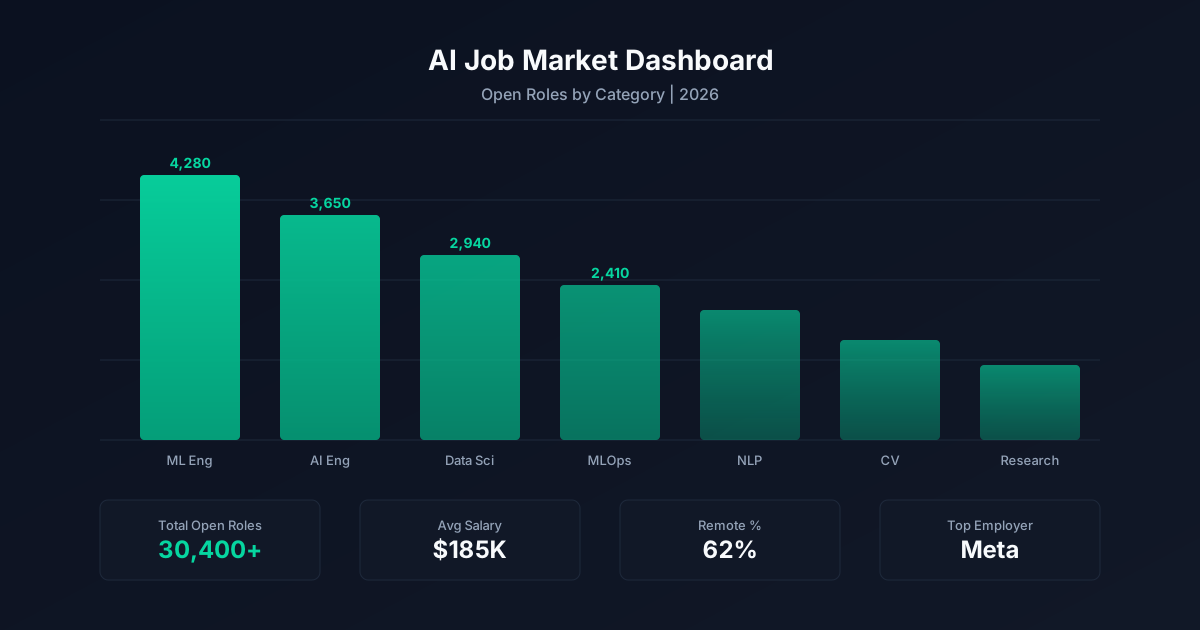
The AI job market spans 3,708 open positions across 16 role categories. The largest categories by volume: AI/ML Engineer (2,605), Data Scientist (310), AI Software Engineer (259). These three account for the majority of open positions, though smaller categories often have higher per-role compensation because of specialized skill requirements.
The seniority mix tells a story about where AI teams are in their maturity. Entry-level roles (102) are outnumbered by mid-level (1,705) and senior (1,469) positions, reflecting that most companies are past the 'build a team from scratch' phase and need experienced engineers who can ship production systems. Leadership roles (Director, VP, C-Level) total 432 positions, representing the bottleneck between technical execution and organizational strategy.
Remote work availability sits at 14% of all AI roles (508 positions), with 3,180 requiring on-site or hybrid attendance. The remote share has stabilized after the post-pandemic correction. Senior and specialized roles (Research Scientist, ML Architect) are more likely to be remote-eligible than entry-level positions, partly because experienced hires have more negotiating power and partly because these roles require less hands-on mentorship.
AI compensation is structured in clear tiers. The market median sits at $217,500. Top-quartile roles start at $272,100, and the 90th percentile reaches $325,000. These figures include base salary with disclosed compensation. Total compensation (including equity, bonuses, and sign-on) runs 20-40% higher at companies that offer those components.
Category matters for compensation. AI Safety roles lead at $300,000 median, while Prompt Engineer roles sit at $140,000. The spread between highest and lowest-paying categories reflects the premium on specialized technical skills versus broader analytical roles.
The most in-demand skills across all AI postings: Python (1,890 postings), Aws (1,103 postings), Azure (877 postings), Rag (855 postings), Gcp (631 postings), Prompt Engineering (560 postings), Pytorch (545 postings), Claude (498 postings). Python dominates, appearing in the vast majority of role descriptions regardless of category. Cloud platform experience (AWS, GCP, Azure) is the second most common requirement. The newer entrants to the top skills list (RAG, vector databases, LLM APIs) reflect the shift from traditional ML toward generative AI applications.
Frequently Asked Questions
Get Weekly AI Career Intelligence
Salary data, skills demand, and market signals from 16,000+ AI job postings. Every Monday.