
Research MLOps Engineer salaries
See compensation benchmarks based on real job postings.
About This Role
MLOps Engineers build the infrastructure that keeps ML models running in production. They own CI/CD pipelines for model deployment, monitoring for data drift and model degradation, and the tooling that lets data scientists ship faster. If ML Engineers build the models, MLOps Engineers build the roads those models travel on.
The job is fundamentally about reliability and velocity. Data scientists want to iterate fast. Product teams want stable predictions. Your job is to make both happen simultaneously. That means building deployment pipelines that catch regressions before they hit production, monitoring systems that alert on data drift before it degrades model performance, and self-service tooling that lets data scientists deploy without filing a ticket.
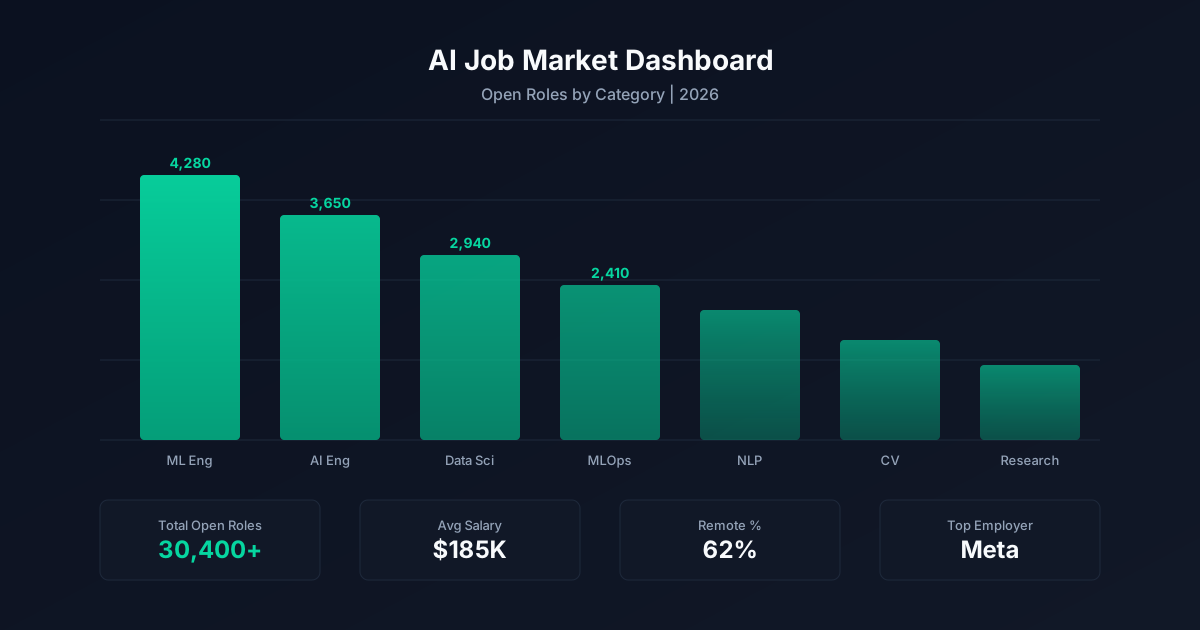
Across the 3,708 AI roles we're tracking, MLOps Engineer positions make up 1% of the market.
MLOps demand tracks closely with production ML adoption. As more companies move models from notebooks to production, the need for MLOps grows. The role is well-established at large tech companies and growing fast at mid-stage startups that are hitting the 'our models work in notebooks but break in production' phase.
Compensation Benchmarks
MLOps Engineer roles pay a median of $220,000 based on 47 positions with disclosed compensation. Senior-level AI roles across all categories have a median of $230,000.
Across all AI roles, the market median is $217,500. Top-quartile compensation starts at $272,100. The 90th percentile reaches $325,000. For comparison, the highest-paying categories include AI Safety ($300,000) and Research Engineer ($280,000). By seniority level: Entry: $120,000; Mid: $200,000; Senior: $230,000; Director: $272,150; VP: $250,000.
AI Hiring Overview
The AI job market has 3,708 open positions tracked in our dataset. By seniority: 102 entry-level, 1,705 mid-level, 1,469 senior, and 432 leadership roles (Director, VP, C-Level). Remote roles make up 14% of the market (508 positions). The remaining 3,180 roles require on-site or hybrid attendance.
The market median for AI roles is $217,500. Top-quartile compensation starts at $272,100. The 90th percentile reaches $325,000. Highest-paying categories: AI Safety ($300,000 median, 21 roles); Research Engineer ($280,000 median, 147 roles); AI Architect ($254,798 median, 67 roles).
MLOps demand tracks closely with production ML adoption. As more companies move models from notebooks to production, the need for MLOps grows. The role is well-established at large tech companies and growing fast at mid-stage startups that are hitting the 'our models work in notebooks but break in production' phase.
Career Path
Common paths into MLOps Engineer roles include DevOps Engineer, Platform Engineer, Data Engineer.
From here, career progression typically leads toward ML Platform Lead, Infrastructure Architect, Engineering Manager.
DevOps engineers with ML curiosity have the shortest path. You already understand deployment, monitoring, and infrastructure. Add ML-specific knowledge (model serving, data pipelines, experiment tracking) and you're competitive. The career ceiling is high: ML Platform Lead roles at top companies pay well because the infrastructure complexity is enormous.
Skills in Demand for This Role
Kubernetes, Docker, and cloud infrastructure are baseline. Most roles want experience with ML-specific tooling: MLflow, Kubeflow, Weights & Biases, or similar. Strong DevOps fundamentals matter more than ML theory. You need to understand model serving (TorchServe, Triton, vLLM), monitoring (Prometheus, Grafana), and infrastructure-as-code (Terraform, Pulumi).
GPU infrastructure knowledge is increasingly valuable as LLM inference becomes a major cost center. Understanding GPU scheduling, multi-node training setups, and inference optimization (quantization, batching, caching) puts you in the top tier. Experience with model registries and feature stores rounds out the profile.
Good MLOps postings specify their ML stack, infrastructure scale, and the problems they're solving (deployment velocity, cost optimization, monitoring gaps). Red flag: companies that want MLOps but don't have any models in production yet. You'll end up doing general DevOps instead.
The AI Job Market Today
The AI job market spans 3,708 open positions across 16 role categories. The largest categories by volume: AI/ML Engineer (2,605), Data Scientist (310), AI Software Engineer (259). These three account for the majority of open positions, though smaller categories often have higher per-role compensation because of specialized skill requirements.
The seniority mix tells a story about where AI teams are in their maturity. Entry-level roles (102) are outnumbered by mid-level (1,705) and senior (1,469) positions, reflecting that most companies are past the 'build a team from scratch' phase and need experienced engineers who can ship production systems. Leadership roles (Director, VP, C-Level) total 432 positions, representing the bottleneck between technical execution and organizational strategy.
Remote work availability sits at 14% of all AI roles (508 positions), with 3,180 requiring on-site or hybrid attendance. The remote share has stabilized after the post-pandemic correction. Senior and specialized roles (Research Scientist, ML Architect) are more likely to be remote-eligible than entry-level positions, partly because experienced hires have more negotiating power and partly because these roles require less hands-on mentorship.
AI compensation is structured in clear tiers. The market median sits at $217,500. Top-quartile roles start at $272,100, and the 90th percentile reaches $325,000. These figures include base salary with disclosed compensation. Total compensation (including equity, bonuses, and sign-on) runs 20-40% higher at companies that offer those components.
Category matters for compensation. AI Safety roles lead at $300,000 median, while Prompt Engineer roles sit at $140,000. The spread between highest and lowest-paying categories reflects the premium on specialized technical skills versus broader analytical roles.
The most in-demand skills across all AI postings: Python (1,890 postings), Aws (1,103 postings), Azure (877 postings), Rag (855 postings), Gcp (631 postings), Prompt Engineering (560 postings), Pytorch (545 postings), Claude (498 postings). Python dominates, appearing in the vast majority of role descriptions regardless of category. Cloud platform experience (AWS, GCP, Azure) is the second most common requirement. The newer entrants to the top skills list (RAG, vector databases, LLM APIs) reflect the shift from traditional ML toward generative AI applications.
Frequently Asked Questions
Get Weekly AI Career Intelligence
Salary data, skills demand, and market signals from 16,000+ AI job postings. Every Monday.