
Interested in this AI Architect role at UT Southwestern Medical Center?
Apply Now →Skills & Technologies
About This Role
WHY UT SOUTHWESTERN?
With over 75 years of excellence in Dallas\-Fort Worth, Texas, UT Southwestern is committed to excellence, innovation, teamwork, and compassion. As a world\-renowned medical and research center, we strive to provide the best possible care, resources, and benefits for our valued employees. Ranked as the number 1 hospital in Dallas\-Fort Worth according to U.S. News \& World Report , we invest in you with opportunities for career growth and development to align with your future goals. Our highly competitive benefits package offers healthcare, PTO and paid holidays, on\-site childcare, wage, merit increases and so much more. We invite you to be a part of the UT Southwestern team where you'll discover a culture of teamwork, professionalism, and a rewarding career!
JOB SUMMARY
The Director of AI Architecture provides guidance on enterprise adoption and development of new AI solutions. Understands the role of IT as a stakeholder and enabler within the governance and oversight processes and committees across the institution. Advises leadership on new and emerging AI technologies that support the mission of UT Southwestern Medical Center.
EXPERIENCE AND EDUCATION
Required
Education
Bachelor's Degree in Data Science, AI, Computer Science, or a related field
Experience
10\+ years of experience in data, AI, and ML, with a proven track record of delivering enterprise\-level AI solutions
Experience with AI techniques such as natural\-language processing, computer vision, deep learning tools (such as PyTorch or TensorFlow), and libraries (such as GitHub or HuggingFace)
Advanced understanding of Generative AI architectures
Experience with Retrieval Augmented Generation (RAG) systems
Experience with SQL and NoSQL databases and their integration with AI models and RAG systems
Familiarity with Azure cloud services and other cloud\-based AI deployment platforms
Experience with data science and ML operations, including data pipelines, model training, and CI/CD processes
Experience with enterprise architecture frameworks for capturing, maintaining, and aligning AI solution architectures with broader enterprise architecture standards and business objectives
Preferred
Experience
Experience in healthcare, research, or academic institutions
JOB DUTIES
Must understand existing enterprise technologies and their standard applications, as well as the application of new technologies, when needed. Build an AI portfolio of capabilities, products and services.
Provide guidance on enterprise adoption of new AI solutions. Balance strategic, essential, and innovative proposals based on feasibility, resource availability, cost, funding, priority, and other factors.
Support the delivery of AI solution architecture for a given initiative complying with enterprise reference architecture.
Lead multi\-disciplinary groups to define desired outcomes, and communicate effectively to appropriate design teams who conduct deeper assessments using business, technical, data, and application domain expertise.
Translate business and technical requirements into an architectural blueprint to achieve business objectives, and document all AI solution architecture design and analysis work
Support the development and delivery of a data strategy for AI solution training, testing and deployment
Create architectural designs to guide and contextualize AI solution development across products, services, projects and systems, including applications, technologies, processes and information
Lead evaluation, design and analysis for the implementation of AI solutions architecture across a group of specific business applications or technologies, based on enterprise business strategies, business capabilities, value streams, business requirements and enterprise standards.
Develop data management strategies for AI model development, training and deployment
Understand the role of information technology as a stakeholder and enabler within the governance and oversight processes and committees across the institution.
Participate in and demonstrate acumen for advisory, compliance and audit activities, including responsible AI best practices, bias detection, and adherence to regulatory or legislative requirements.
Demonstrate proficiency in aggregation of use case, workload, performance, capacity, throughput, preciseness, availability, orchestration components, and other discreet considerations sufficient to reflect an informed view ready for design or implementation.
Embrace a structure of demo, development, test, staging and production AI environments. Define expectations for vendors, programmers, users, and support personnel who interact in multiple personas and roles.
Advise leadership and other stakeholders on configurations (implicit or explicit), guardrails, fitness, and limitations of AI technologies in a conversational manner tailored to healthcare, research, and academic aims.
Work with cross\-functional business and IT teams to ensure proper performance of developed or acquired assets.
Foster a culture of collaboration, innovation, automation, and continuous improvement across IT and the business.
Research and share emerging technologies, leading practices, and industry trends.
Collaborate with business to identify appropriate solutions aligned with appropriate standards, use cases, and leading practices.
Perform other duties as assigned.
BENEFITS
UT Southwestern is proud to offer a competitive and comprehensive benefits package to eligible employees. Our benefits are designed to support your overall wellbeing, and include:
PPO medical plan, available day one at no cost for full\-time employee\-only coverage
100% coverage for preventive healthcare\-no copay
Paid Time Off, available day one
Retirement Programs through the Teacher Retirement System of Texas (TRS)
Paid Parental Leave Benefit
Wellness programs
Tuition Reimbursement
Public Service Loan Forgiveness (PSLF) Qualified Employer
Learn more about these and other UTSW employee benefits!
SECURITY AND EEO STATEMENT
Security
This position is security\-sensitive and subject to Texas Education Code 51\.215, which authorizes UT Southwestern to obtain criminal history record information.
EEO
UT Southwestern Medical Center is committed to an educational and working environment that provides equal opportunity to all members of the University community. As an equal opportunity employer, UT Southwestern prohibits unlawful discrimination, including discrimination on the basis of race, color, religion, national origin, sex, sexual orientation, gender identity, gender expression, age, disability, genetic information, citizenship status, or veteran status.
Role Details
About This Role
This role sits at the intersection of AI and engineering, building systems that bring machine learning capabilities into production environments. The scope varies by company, but the common thread is applying AI technology to solve real business problems at scale. Most AI roles today require a combination of software engineering fundamentals and domain-specific ML knowledge, with the exact mix depending on the team's maturity and the product they're building.
The AI job market is evolving fast. New role categories emerge as companies figure out what they need to ship AI-powered products. What matters most is the ability to learn quickly, build working systems, and iterate based on real-world performance data. The specific title matters less than the skills you bring and the problems you can solve. Companies are past the experimentation phase and want engineers who can deliver production-quality systems that work reliably at scale.
Across the 3,708 AI roles we're tracking, AI Architect positions make up 1% of the market. At UT Southwestern Medical Center, this role fits into their broader AI and engineering organization.
AI hiring keeps growing across industries. Companies in tech, finance, healthcare, and retail are all building AI teams. The strongest demand is for people who can bridge the gap between AI research and production engineering. The shift toward generative AI has created new role types (LLM Engineer, Prompt Engineer, AI Agent Developer) that didn't exist three years ago, while traditional roles (Data Scientist, ML Engineer) have evolved to incorporate LLM capabilities.
What the Work Looks Like
Day-to-day work involves a mix of building, debugging, and collaborating. You'll write code, review pull requests, participate in design discussions, and work with cross-functional teams (product, design, data) to define what AI features should do and how they should behave. Expect to spend time on both technical implementation and communication. Most AI teams operate in two-week sprint cycles, with regular demos and retrospectives. The ratio of heads-down coding to meetings and reviews varies by seniority, with senior roles spending more time on architecture decisions and mentorship.
AI hiring keeps growing across industries. Companies in tech, finance, healthcare, and retail are all building AI teams. The strongest demand is for people who can bridge the gap between AI research and production engineering. The shift toward generative AI has created new role types (LLM Engineer, Prompt Engineer, AI Agent Developer) that didn't exist three years ago, while traditional roles (Data Scientist, ML Engineer) have evolved to incorporate LLM capabilities.
Skills Required
Python and cloud platform experience are common requirements. Specific skill needs vary by company and focus area, but familiarity with ML frameworks, data pipelines, and API design covers the basics for most roles. RAG (Retrieval-Augmented Generation), vector databases, and LLM API integration are increasingly standard requirements across role types.
Beyond the core stack, communication skills matter more than many technical candidates realize. The ability to explain AI capabilities and limitations to non-technical stakeholders is a differentiator at every level. Technical writing, documentation, and clear thinking about tradeoffs are underrated skills in AI roles. Experience with evaluation methodology (how to measure whether an AI system is working well) is becoming a core requirement, especially for roles that involve LLM integration.
Look for job postings that specify the problems you'll work on, the tech stack, and the team structure. Vague postings that list every AI buzzword are often a sign the company hasn't figured out what they need. Strong postings describe the product context, the team you'd join, and the specific challenges you'd tackle.
Compensation Benchmarks
AI Architect roles pay a median of $254,798 based on 67 positions with disclosed compensation. Director-level AI roles across all categories have a median of $272,150.
Across all AI roles, the market median is $217,500. Top-quartile compensation starts at $272,100. The 90th percentile reaches $325,000. For comparison, the highest-paying categories include AI Safety ($300,000) and Research Engineer ($280,000). By seniority level: Entry: $120,000; Mid: $200,000; Senior: $230,000; Director: $272,150; VP: $250,000.
UT Southwestern Medical Center AI Hiring
UT Southwestern Medical Center has 1 open AI role right now. They're hiring across AI Architect. Based in Dallas, TX, US.
Location Context
Across all AI roles, 14% (508 positions) offer remote work, while 3,180 require on-site attendance. Top AI hiring metros: New York (1,045 roles, $220,000 median); San Francisco (810 roles, $277,088 median); Los Angeles (397 roles, $215,000 median).
Career Path
Common paths into AI Architect roles include Software Engineer, Data Scientist, Data Analyst.
From here, career progression typically leads toward Senior Engineer, AI Architect, Engineering Manager, Principal Engineer.
Focus on building things that work. A deployed project that solves a real problem is worth more than any certification. Contribute to open-source, build portfolio projects, and invest in fundamentals (software engineering, statistics, systems design) rather than chasing the latest framework. The AI field moves fast, but the engineers who succeed long-term are the ones with strong fundamentals who can adapt to new tools and paradigms as they emerge.
What to Expect in Interviews
AI interviews typically combine coding challenges (Python-focused), system design questions tailored to the role, and discussions about your experience with relevant tools and frameworks. Strong candidates demonstrate both technical depth and the ability to make pragmatic engineering tradeoffs. Prepare portfolio projects that demonstrate end-to-end capability rather than isolated skills.
When evaluating opportunities: Look for job postings that specify the problems you'll work on, the tech stack, and the team structure. Vague postings that list every AI buzzword are often a sign the company hasn't figured out what they need. Strong postings describe the product context, the team you'd join, and the specific challenges you'd tackle.
AI Hiring Overview
The AI job market has 3,708 open positions tracked in our dataset. By seniority: 102 entry-level, 1,705 mid-level, 1,469 senior, and 432 leadership roles (Director, VP, C-Level). Remote roles make up 14% of the market (508 positions). The remaining 3,180 roles require on-site or hybrid attendance.
The market median for AI roles is $217,500. Top-quartile compensation starts at $272,100. The 90th percentile reaches $325,000. Highest-paying categories: AI Safety ($300,000 median, 21 roles); Research Engineer ($280,000 median, 147 roles); AI Architect ($254,798 median, 67 roles).
AI hiring keeps growing across industries. Companies in tech, finance, healthcare, and retail are all building AI teams. The strongest demand is for people who can bridge the gap between AI research and production engineering. The shift toward generative AI has created new role types (LLM Engineer, Prompt Engineer, AI Agent Developer) that didn't exist three years ago, while traditional roles (Data Scientist, ML Engineer) have evolved to incorporate LLM capabilities.
The AI Job Market Today
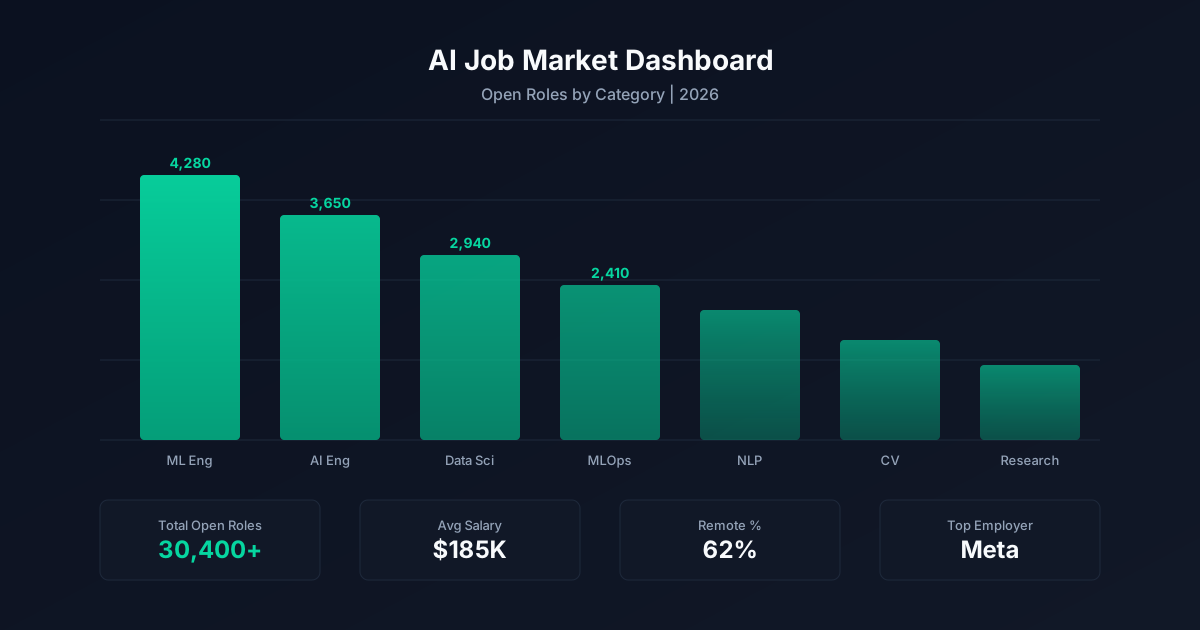
The AI job market spans 3,708 open positions across 16 role categories. The largest categories by volume: AI/ML Engineer (2,605), Data Scientist (310), AI Software Engineer (259). These three account for the majority of open positions, though smaller categories often have higher per-role compensation because of specialized skill requirements.
The seniority mix tells a story about where AI teams are in their maturity. Entry-level roles (102) are outnumbered by mid-level (1,705) and senior (1,469) positions, reflecting that most companies are past the 'build a team from scratch' phase and need experienced engineers who can ship production systems. Leadership roles (Director, VP, C-Level) total 432 positions, representing the bottleneck between technical execution and organizational strategy.
Remote work availability sits at 14% of all AI roles (508 positions), with 3,180 requiring on-site or hybrid attendance. The remote share has stabilized after the post-pandemic correction. Senior and specialized roles (Research Scientist, ML Architect) are more likely to be remote-eligible than entry-level positions, partly because experienced hires have more negotiating power and partly because these roles require less hands-on mentorship.
AI compensation is structured in clear tiers. The market median sits at $217,500. Top-quartile roles start at $272,100, and the 90th percentile reaches $325,000. These figures include base salary with disclosed compensation. Total compensation (including equity, bonuses, and sign-on) runs 20-40% higher at companies that offer those components.
Category matters for compensation. AI Safety roles lead at $300,000 median, while Prompt Engineer roles sit at $140,000. The spread between highest and lowest-paying categories reflects the premium on specialized technical skills versus broader analytical roles.
The most in-demand skills across all AI postings: Python (1,890 postings), Aws (1,103 postings), Azure (877 postings), Rag (855 postings), Gcp (631 postings), Prompt Engineering (560 postings), Pytorch (545 postings), Claude (498 postings). Python dominates, appearing in the vast majority of role descriptions regardless of category. Cloud platform experience (AWS, GCP, Azure) is the second most common requirement. The newer entrants to the top skills list (RAG, vector databases, LLM APIs) reflect the shift from traditional ML toward generative AI applications.
Frequently Asked Questions
Get Weekly AI Career Intelligence
Salary data, skills demand, and market signals from 16,000+ AI job postings. Every Monday.