
Interested in this AI/ML Engineer role at Xperi?
Apply Now →Skills & Technologies
About This Role
Xperi invents, develops and delivers technologies that create extraordinary experiences at home and on the go for millions of people around the world. Powering billions of consumer electronics, connected cars and digital content titles, we make entertainment more immersive, driving more intelligent and every interaction seamlessly personalized through our renowned consumer brands: DTS®, HD Radio™ and TiVo®.
Xperi (NYSE: XPER) is a publicly traded technology company headquartered in San Jose, CA with over 1,500 employees across North America, Europe and Asia. Come join a thriving team where you can play an integral role in shaping the future of entertainment technology.
Role Summary
Xperi is expanding its AI Strategy \& Operations team to accelerate measurable business value from AI. This role sits within a small, high\-impact team operating with a startup mindset, where team members are expected to work collaboratively across a wide range of initiatives and contribute wherever needed.
The Senior Manager, AI Process Transformation will initially operate as an individual contributor, responsible for leading AI\-enabled process transformation from discovery through implementation. This includes identifying inefficient workflows, redesigning them using AI and automation, and delivering measurable improvements in cost, speed, quality, and scalability.
This role is execution\-focused, with success defined by implemented solutions and measurable business impact.
Core Responsibilities
Own end\-to\-end transformation of business processes, including discovery, mapping, redesign, AI enablement, implementation support, and measurable ROI delivery.
Example areas include (but are not limited to) finance, accounting, FP\&A, sales operations, and legal workflows, particularly those that are data\-intensive, spreadsheet\-driven, or reliant on manual processes.
Process Discovery \& Diagnosis
Map current\-state workflows including inputs, decisions, handoffs, systems, and manual interventions.
Identify inefficiencies, bottlenecks, data fragmentation, and quality gaps that limit performance or scalability.
Prioritize opportunities based on business impact, feasibility, and ability to scale across teams.
AI\-Enabled Process Redesign
Define future\-state workflows embedding AI capabilities such as copilots, agents, automation, analytics, and improved data access.
Determine where AI should augment human work, automate tasks, or introduce new decision\-support capabilities.
Design practical, implementable workflows that fit within Xperi’s tools, systems, and operating model.
ROI \& KPI Ownership
Define baseline performance and design appropriate KPIs for each initiative based on the specific process being improved.
Develop business cases that quantify expected impact, and implement measurement frameworks to track outcomes after deployment.
KPIs should be tailored to each workflow, but may include metrics such as cycle time reduction, labor savings, error reduction, throughput improvement, or financial impact.
Ensure that each initiative has a clear measurement plan and that results are validated and sustained post\-implementation.
Implementation Partnership
Work closely with program managers, engineers, IT, and business stakeholders to move initiatives from concept to implementation.
Own process design, business requirements, and outcomes, while collaborating with technical teams responsible for building and deploying solutions.
Ensure implementations align with intended workflow improvements and deliver expected business results.
Technical \& Business Alignment
Act as a business operator with strong technical fluency.
Understand AI concepts such as LLMs, agents, APIs, MCPs, and connectors, and be able to engage effectively with engineering teams.
Bring a business analyst mindset to understanding tools and workflows, without being responsible for solution architecture or implementation.
Change Management \& Influence
Drive adoption and sustained use of redesigned workflows through stakeholder engagement, communication, training, and practical enablement resources.
Operate as a self\-starter who can make progress across teams through credibility, strong problem\-solving, and influence, rather than relying on formal authority.
Required Qualifications
- 8\+ years of experience in process transformation, business operations, consulting, business analysis, or related roles
- Demonstrated experience leading process improvement initiatives from discovery through implementation
- Strong ability to document current\-state workflows and design future\-state processes
- Proven ability to deliver measurable operational or financial improvements
- Strong analytical and quantitative skills, particularly in data\-heavy environments
- Experience working in cross\-functional teams involving business, engineering, and IT stakeholders
- Working familiarity with AI tools, automation, analytics, and enterprise systems
- Ability to communicate complex concepts clearly to both technical and non\-technical audiences
- Ability to drive progress and outcomes across teams without direct authority
Preferred Qualifications
- Experience in finance, accounting, FP\&A, sales operations, legal, or other data\-intensive business functions
- Experience applying AI, automation, or analytics to improve workflows
- Familiarity with enterprise systems such as Salesforce, NetSuite, Jira, Confluence, Microsoft 365, or similar platforms
- Background in Lean, Six Sigma, business process reengineering, or operational excellence methodologies
- Experience working with spreadsheet\-heavy or manual operational workflows
- Exposure to data platforms, integrations, or workflow automation tools
- Familiarity with responsible AI, data privacy, or compliance considerations
- Advanced degree (MBA, MS, or similar) is a plus
Life @ Xperi:
At Xperi, we value People, Customers, Performance and Innovation. We are dedicated to creating a workplace where all employees have a voice and sense of belonging, feel safe and valued, and are acknowledged for how their unique differences contribute to organizational culture and business outcomes.
Our employees and their families are important to us, and our comprehensive pay, stock and benefits programs reflect that. Xperi supports personal well\-being, builds financial security and enables employees to share in our collective success.
Rewards include:* Competitive compensation (salary, equity and bonuses) and comprehensive benefits designed to foster work\-life balance, care for your health, protect your finances and help you save and invest for the future.
- Generous paid time away from work, including flexible time off, holidays and sick time, health and wellness initiatives, and a charitable match program to help you give back to your community.
- Great perks, which vary by location and can be site\-specific: employee discounts, transportation reimbursements, and fitness facilities.
- A flexible, hybrid work environment combining the best of in\-office collaboration and community\-building along with the benefits of working from home.
The estimated base salary range for this full\-time position is $132,112 \- $175,049 plus bonus and benefits, and can vary if outside of this location. Our salary ranges are determined by role, level, and location. Within the range, individual pay is determined by work location and additional factors, including job\-related skills, competencies, experience, market demands, internal parity, and relevant education or training. Your recruiter can share more about the specific salary range and perks and benefits for your location during the hiring process.
Salary Context
This $132K-$175K range is below the median for AI/ML Engineer roles in our dataset (median: $180K across 1841 roles with salary data).
View full AI/ML Engineer salary data →Role Details
About This Role
AI/ML Engineers build and deploy machine learning models in production. They work across the full ML lifecycle: data pipelines, model training, evaluation, and serving infrastructure. The role has evolved significantly over the past two years. Where ML Engineers once spent most of their time on model architecture, the job now tilts heavily toward inference optimization, cost management, and integrating LLM capabilities into existing systems. Companies want engineers who can ship production systems, and the experimenter-only role is fading fast.
Day-to-day, you're writing training pipelines, debugging data quality issues, setting up evaluation frameworks, and figuring out why your model performs differently in staging than it did on your dev set. The best ML engineers are obsessive about reproducibility and measurement. They instrument everything. They know that a model is only as good as the data feeding it and the infrastructure serving it.
Across the 3,708 AI roles we're tracking, AI/ML Engineer positions make up 70% of the market. At Xperi, this role fits into their broader AI and engineering organization.
Demand for AI/ML Engineers has been strong and consistent. Unlike some AI roles that spike with hype cycles, ML engineering is a foundational need. Every company deploying AI models needs people who can keep them running, and the gap between research prototypes and production systems keeps growing.
What the Work Looks Like
A typical week might include: debugging a data pipeline that's silently dropping 3% of training examples, running A/B tests on a new model version, writing documentation for a feature flag system that lets you roll back model deployments, and reviewing a junior engineer's PR for a new evaluation metric. Meetings tend to be cross-functional since ML touches product, engineering, and data teams.
Demand for AI/ML Engineers has been strong and consistent. Unlike some AI roles that spike with hype cycles, ML engineering is a foundational need. Every company deploying AI models needs people who can keep them running, and the gap between research prototypes and production systems keeps growing.
Skills Required
Python and PyTorch dominate the requirements. Most roles expect experience with cloud platforms (AWS, GCP, or Azure) and familiarity with ML frameworks like TensorFlow or JAX. RAG (Retrieval-Augmented Generation) has become a top-3 skill requirement as companies integrate LLMs into their products. Docker and Kubernetes show up in about a third of postings, reflecting the production focus of the role.
Beyond the core stack, employers increasingly want experience with experiment tracking tools (MLflow, Weights & Biases), feature stores, and vector databases. Fine-tuning experience is valuable but less common than you'd think from reading Twitter. Most production LLM work is RAG and prompt engineering, not fine-tuning. If you have both, you're in a strong position.
Companies that are serious about AI/ML hiring tend to post specific infrastructure details in the job description: the frameworks they use, their model serving stack, their data pipeline tools. Vague postings that just say 'ML experience required' without specifics are often companies that haven't figured out what they need yet.
Compensation Benchmarks
AI/ML Engineer roles pay a median of $218,750 based on 3,817 positions with disclosed compensation. Senior-level AI roles across all categories have a median of $230,000. This role's midpoint ($153K) sits 30% below the category median. Disclosed range: $132K to $175K.
Across all AI roles, the market median is $217,500. Top-quartile compensation starts at $272,100. The 90th percentile reaches $325,000. For comparison, the highest-paying categories include AI Safety ($300,000) and Research Engineer ($280,000). By seniority level: Entry: $120,000; Mid: $200,000; Senior: $230,000; Director: $272,150; VP: $250,000.
Xperi AI Hiring
Xperi has 1 open AI role right now. They're hiring across AI/ML Engineer. Based in Calabasas, CA, US. Compensation range: $175K - $175K.
Location Context
Across all AI roles, 14% (508 positions) offer remote work, while 3,180 require on-site attendance. Top AI hiring metros: New York (1,045 roles, $220,000 median); San Francisco (810 roles, $277,088 median); Los Angeles (397 roles, $215,000 median).
Career Path
Common paths into AI/ML Engineer roles include Data Scientist, Software Engineer, Research Engineer.
From here, career progression typically leads toward ML Architect, AI Engineering Manager, Principal ML Engineer.
The fastest path into ML engineering is through software engineering with a self-directed ML education. A CS degree helps, but production engineering skills matter more than academic credentials. Build something that works, deploy it, and measure it. That portfolio project is worth more than a Coursera certificate. For career growth, the fork comes around the senior level: go deep on technical complexity (staff/principal track) or move into managing ML teams.
What to Expect in Interviews
Expect system design questions around ML pipelines: how you'd build a training pipeline for a specific use case, handle data drift, or design A/B testing infrastructure for model deployments. Coding rounds typically involve Python, with emphasis on data manipulation (pandas, numpy) and algorithm implementation. Take-home assignments often ask you to build an end-to-end ML pipeline from raw data to deployed model.
When evaluating opportunities: Companies that are serious about AI/ML hiring tend to post specific infrastructure details in the job description: the frameworks they use, their model serving stack, their data pipeline tools. Vague postings that just say 'ML experience required' without specifics are often companies that haven't figured out what they need yet.
AI Hiring Overview
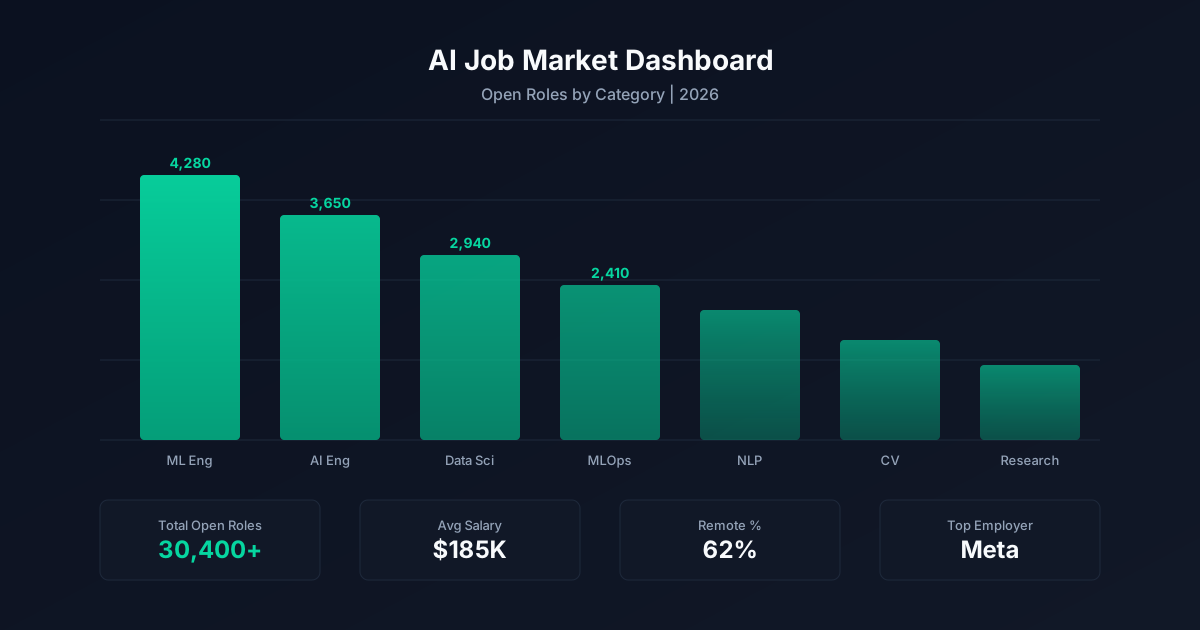
The AI job market has 3,708 open positions tracked in our dataset. By seniority: 102 entry-level, 1,705 mid-level, 1,469 senior, and 432 leadership roles (Director, VP, C-Level). Remote roles make up 14% of the market (508 positions). The remaining 3,180 roles require on-site or hybrid attendance.
The market median for AI roles is $217,500. Top-quartile compensation starts at $272,100. The 90th percentile reaches $325,000. Highest-paying categories: AI Safety ($300,000 median, 21 roles); Research Engineer ($280,000 median, 147 roles); AI Architect ($254,798 median, 67 roles).
Demand for AI/ML Engineers has been strong and consistent. Unlike some AI roles that spike with hype cycles, ML engineering is a foundational need. Every company deploying AI models needs people who can keep them running, and the gap between research prototypes and production systems keeps growing.
The AI Job Market Today
The AI job market spans 3,708 open positions across 16 role categories. The largest categories by volume: AI/ML Engineer (2,605), Data Scientist (310), AI Software Engineer (259). These three account for the majority of open positions, though smaller categories often have higher per-role compensation because of specialized skill requirements.
The seniority mix tells a story about where AI teams are in their maturity. Entry-level roles (102) are outnumbered by mid-level (1,705) and senior (1,469) positions, reflecting that most companies are past the 'build a team from scratch' phase and need experienced engineers who can ship production systems. Leadership roles (Director, VP, C-Level) total 432 positions, representing the bottleneck between technical execution and organizational strategy.
Remote work availability sits at 14% of all AI roles (508 positions), with 3,180 requiring on-site or hybrid attendance. The remote share has stabilized after the post-pandemic correction. Senior and specialized roles (Research Scientist, ML Architect) are more likely to be remote-eligible than entry-level positions, partly because experienced hires have more negotiating power and partly because these roles require less hands-on mentorship.
AI compensation is structured in clear tiers. The market median sits at $217,500. Top-quartile roles start at $272,100, and the 90th percentile reaches $325,000. These figures include base salary with disclosed compensation. Total compensation (including equity, bonuses, and sign-on) runs 20-40% higher at companies that offer those components.
Category matters for compensation. AI Safety roles lead at $300,000 median, while Prompt Engineer roles sit at $140,000. The spread between highest and lowest-paying categories reflects the premium on specialized technical skills versus broader analytical roles.
The most in-demand skills across all AI postings: Python (1,890 postings), Aws (1,103 postings), Azure (877 postings), Rag (855 postings), Gcp (631 postings), Prompt Engineering (560 postings), Pytorch (545 postings), Claude (498 postings). Python dominates, appearing in the vast majority of role descriptions regardless of category. Cloud platform experience (AWS, GCP, Azure) is the second most common requirement. The newer entrants to the top skills list (RAG, vector databases, LLM APIs) reflect the shift from traditional ML toward generative AI applications.
Frequently Asked Questions
Get Weekly AI Career Intelligence
Salary data, skills demand, and market signals from 16,000+ AI job postings. Every Monday.